wayground logo

Free Printable Worksheets

NEW

Font size

S
M
L
XL
Worksheets

Natural Selection & Adaptations

Total questions: 20

Worksheet time: 20mins

Name
Class
Date
1.
The differences among a species, like different bird beaks, are called
a)
genes.
b)
variations.
c)
traits.
d)
theories.
2.
This scientist developed the theory of evolution as he studied the finches.
a)
Charles Darwin
b)
Isaac Newton
c)
Albert Einstein
d)
Marie Curie
3.
What is the advantage of having different shaped beaks?
a)
To look different from other species.
b)
To be able to eat the food readily available in the environment.
c)
To protect itself against predators.
d)
To protect itself against prey.
4.
Why are advantageous traits more likely to be passed onto offspring?
a)
Because they are more likely to survive and reproduce.
b)
Because they come from dominant alleles.
c)
Because they come from recessive alleles.
d)
Because the trait is an acquired phenotype.
5.
An example of a behavioral adaptation is
a)
The long neck of a giraffe
b)
Penguins huddling together for warmth
c)
A camel's hump used to store water
d)
A polar bear's white fur used for camouflage
6.
An owl is mostly nocturnal meaning it hunts and is active at night.
a)
Behavioral Adaptation
b)
Structural Adaptation
c)

Functional Adaptation

7.
Parrots have special feet, with two toes on the front and back to help them cling to branches.
a)
Behavioral Adaptation
b)
Structural Adaptation
c)

Functional Adaptation

8.
When an animal looks like another animal it is called ______________.
a)
camouflage
b)
mimicry
c)
warning coloration
d)
protective resemblance
9.

Changes in genetic material are called _____________

a)

Mutations

b)

RNA

c)

Genes

10.

Fill in the blank: A ______________ adaptation is the way an animal looks in order to help them survive.

a)

simple

b)

behavioral

c)

physical

d)

extreme

11.

A characteristic that is passed from parent to offspring

a)

Favorable trait

b)

Inherited trait

c)

Breeding

d)

Genotype

12.

According to theory, the individuals that tend to survive are those that have...

a)

variations best suited to the environment.

b)

the ability to change their bodies to fit the environment

c)

the best luck.

d)

the biggest body

13.

Adaptations can be:

a)

camouflage

b)

ability to survive cold weather

c)

hunting skills

d)

all of the above

14.

What is most likely to happen to moth populations in the picture shown?

a)

Light moths--hunted easily, dark moths--population increase

b)

Dark moths--hunted easily, dark moths--population increase

c)

Light moths--hunted easily, light moths--population increase

d)

Lights moths will change their color to match dark moths.
15.
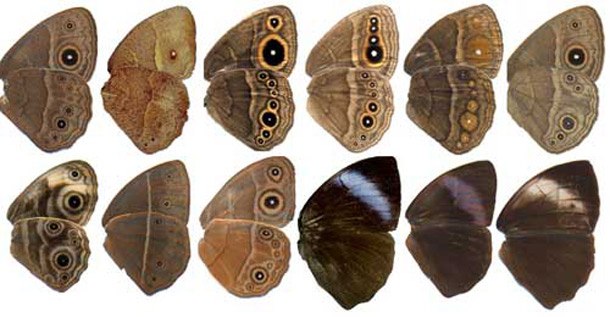
These moths are all the same species. The differences between their wings is an example of ________________
a)
Natural Selection
b)
Variation
c)
Homeostasis
d)
Extinction
16.
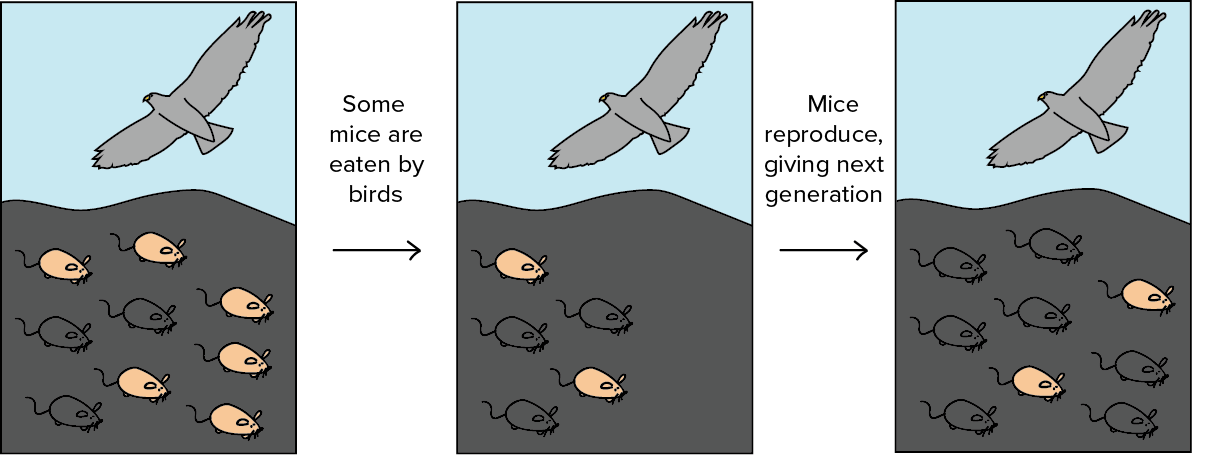
Why is the mouse population changing over time?
a)
The light mice can reproduce more successfully than the dark mice
b)
The hawks eat more dark mice than light mice because the dark mice taste better
c)
The hawks eat more light mice than dark mice because they can see the light mice more easily
d)
The hawks eat more dark mice than light mice because they can see the dark mice more easily
17.
The ears of this fox are an example of...
a)
A behavioral adaptation
b)
Poor breeding
c)
A physical adaptation
d)
Plastic surgery gone horribly wrong
18.
The gradual change in species over time is...
a)
Evolution
b)
Nucleotide 
c)
Adaptation
d)
Natural Selection
19.
When an organism of a species has an adaptation, it will compete for resources better, survive longer and pass that adaptation on to it's offspring. This process is called
a)
evolution by natural selection
b)
artificial selection
c)
inbreeding
d)
outbreeding
20.

Allows an organism to perform special functions within the body like the blow fish

a)

Learned Behaviors

b)

Physiological Adaptations

c)

Instinctive Behaviors