
 Worksheets
G9 Review EASE 1
Total questions: 140
Worksheet time: 3hrs 55mins
When a light ray enters a more dense medium it will...
speed up
slow down
not change speed

A light ray enters a glass block as shown in the diagram. The light ray will...
speed up
slow down
not change speed
bend towards the normal
bend away from the normal

Angle 1 is called the angle of (a) .
Angle 2 is called the angle of (a) .
How do mirrors fundamentally work?
Reflecting light
Refracting light
Focusing light
Producing light
What is a plane mirror?
A curved mirror
A flat mirror
A round mirror
A square mirror
What is the law of reflection?
Angle of incidence = angle of refraction
Angel of incidence = angel of reflection
Angle of reflection > angle of refraction
Angle of incidence = angle of refraction
What is refraction?
Light rays changing direction due to changing speed
Light rays changing direction due to magnetic forces
Light rays reflecting off multiple surfaces
Light rays spinning
How will a light ray bend when it goes from a more dense to a less dense medium?
Towards the normal
90 degrees
45 degrees
Away from the normal
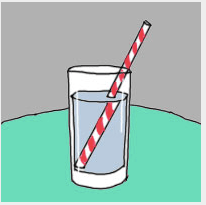
Why does the straw appear to be bent?
light is reflected
light is absorbed
light is turned
light is refracted
When light passes from air to water, what happens to the speed of the light?
speeds up
slows down
stays the same

If the wavelength of an electromagnetic wave is longer, what is true about the energy?
Energy is higher.
Energy is lower.
Energy is not dependent on wavelength.

Radiation from which region of the electromagnetic spectrum can be used to treat cancer?
X-ray
Radio
Infrared
Gamma
Infrared radiation have a shorter wavelength than which waves
Ultraviolet
X-rays
radio
gamma rays

Infra red radiation is used by
MRI scanners
Microwave ovens
Remote Controls
Tanning beds
Select the correct order of waves on the Electromagnetic Spectrum from the longest wavelength to the shortest wavelength
Radio, Microwaves, Infrared, Visible Light, Ultraviolet, X-ray, Gamma
Gamma, X-ray, Ultraviolet, Visible Light, Infrared, Microwaves, Radio
Visible Light, Microwaves, Infrared, Ultraviolet, X-ray, Gamma, Radio
Microwaves, Gamma, Radio, Visible Light, Infrared, Ultraviolet, X-ray

The picture below shows a scan of a nebula. There are two images. One image was created using visible light and the other using infrared light. Notice the two arrows point to two celestial objects in the infrared image. These two celestial objects are believed to be newly developed stars.
Which of the following reason are the two celestial objects visible only in the infrared image?
The infrared image detects brighter objects.
The visible light image detects brighter objects.
The two celestial objects give off more infrared light than visible light.
The two celestial objects give off more visible light than infrared light.

Radiation from which region of the electromagnetic spectrum is used for mobile phone signals?
Microwaves
Gamma
XRays
Radio
Sunblock can be applied to your skin to prevent damage from which electromagnetic waves?
Infrared
Microwaves
Ultraviolet
X Rays

To produce this image we need to use:
X-Rays
Gamma rays
Infrared rays
Ultraviolet
TWO uses of Microwaves are:
to heat food
in communication satellites
to transmit a radio signal
in fibre optics
To communicate radio or tv waves over large distances we use:
X-Rays
Gamma Rays
Radio Waves
Infrared Rays
Which of the following are uses for gamma radiation?
- Food preservation
- Sterilise surgical equipment
- Kill cancer cells
1 and 2 only
2 and 3 only
1 and 3 only
1, 2 and 3
Sunglasses can be used to prevent eye damage from which region of the EM spectrum?
Ultraviolet
Visible
X-ray
Infra red
Which is. a hazard of overexposure to certain frequencies of microwave radiation
Heating of cells
Skin Cancer
Snow blindness

Two balloons are hanging from a stick.
Both balloons have a positive charge.
How would you expect the balloons to move?
there would be no movement
towards each other
away from each other

Two balloons are hanging from a stick.
One balloon has a positive charge and the other has a negative charge.
How would you expect the balloons to move?
there would be no movement
towards each other
away from each other

The ball on the string is being repelled (pushed away) by the metal bar.
What must be the charge on the ball?
postivie
neutral
negative
Electrons have a _________________ charge.
neutral
positive
negative
Protons have a ________________ charge.
neutral
positive
negative
The build up of electric charges on the surface of objects is known as
electricity
static electricity
a circult
electric force
An area over which an electric charge is exerted is called an
conductor
insulator
circuit
electric filed

The comb has been rubbed with a piece of wool fabric and placed next to some scraps of paper.
Some paper moves toward the comb. The movement of the paper is caused by
static electricity
mechanical energy
chemical energy
magnetic attraction
Which of the following is caused by static electricity?
A stove getting hot when it is turned on.
A magnet being attracted to a refrigerator.
A light bulb coming on when a switch is turned on.
A lightning strike during a storm.
Electricity flows well through conductors. A good example of a conductor is ____
Rubber
Wool
Metal
Glass
In a neutral atom, the number of electrons is equal to the number of _______.
Neutrons
Protons
Orbits
Subatomic Particles
If two charges repel each other, the two charges must be?
(choose 2 correct answers)
Positive & Positive
Positive & Neutral
Negative & Negative
Positive and Negative
An object becomes charged when the atoms in the object gain or lose?
Electrons
Protons
Neutrons
All of the above
What charge does a proton have?
Negative (-)
Neutral or no charge (0)
Positive (+)
What charge does an electron have?
Negative (-)
Neutral or no charge (0)
Positive (+)
If a substance has a higher number of electrons than protons on its surface, what type of charge does it have?
A positive charge.
A negative charge.
A neutral charge.
No charge at all.
Which of the following is caused by static electricity?
A stove getting hot when it is turned on.
A magnet being attracted to a refrigerator.
A light bulb coming on when a switch is turned on.
A lightning strike during a storm.
An object becomes negatively charged by
losing protons
gaining electrons
losing electrons
gaining protons
An object becomes positively charged by
losing protons
gaining electrons
losing electrons
gaining protons
Materials that allow electrical charges to flow easily through them are called __________.
Currents
Insulators
Conductors
Semiconductors
Select the materials that are electrical insulators.
(choose 2 correct answers)
Oil
Carbon
Copper
Glass
A positively-charged and a negatively-charged object will...
Attract
Repel
Do nothing
Select the materials that are electrical insulators.
(choose 3 correct answers)


The accumulation of excess electric charge on an object is called
Static Electricity
Electric Discharge
Resistance
Current Electricity
The study of electric charges is called
Thermodynamics
Electrostatics
Electromagnetism
Electronics
If an object has the same number of positive and negative charges, its electrical charge is...
Positive
Negative
Neutral or no charge
Opposite
Static charges build up when
Protons move within an object
The nucleus moves within an object
Neutrons move within an object
Electrons move within an object
What types of charges attract?
Positive and Negative
True
False
If a substance has a higher number of electrons than protons on its surface, what type of charge does it have?
A negative charge.
True
False
The difference between attraction and repulsion is that to attract is to pull something closer and repel is to push something away.
True
False
True or false: Static means unmoving or unchanging
True
False
These allow electrons to pass through them easily
Conductors
Insulators
Atoms
Nucleus
These do NOT allow electrons to pass through them easily
Conductors
Insulators
Atoms
Nucleus
Which of the following is an example of a CONDUCTOR
A metal tube
A cotton shirt
A rubber tire
A wooden bucket
Which of the following is NOT an example of an INSULATOR
A metal tube
A cotton shirt
A rubber tire
A wooden bucket
This is when electrons are rubbed off one object and rubbed onto another
Friction
Conduction
Induction
An early scientific instrument that is still used to detect the presence, magnitude and type of electric charge on a body is called ....
radioactive
speedometer
electroscope
multimeter

A student placed a pencil in a cup of water. The pencil appears broken because light
always travels in a straight line.
bends when it passes through water.
makes the water in the glass evaporate.
reflects the pencil on the water's surface.
When light passes at an angle to the normal from one medium into another in which its speed is higher
it is bent toward the normal.
it always lies along the normal.
it is unaffected.
it is bent away from the normal.
When light passes at an angle to the normal from one medium into another in which its speed is lower
it is bent towards the normal.
it always lies along the normal.
it is unaffected.
it is bent away from the normal.
If all other variables are held constant, what happens to the angle of refraction if the angle of incidence increases?
the angle of refraction stays the same
the angle of refraction decreases
the angle of refraction increases
cannot be determined from the information provided

Based on the image, as light passes from medium 1 to medium 2
light speeds up and bends towards the normal
light speeds up and bends away from the normal
light slows down and bends towards the normal
light slows down and bends away from the normal


What is a permanent magnet?
Always have a magnetic field around them
Always does not have a magnetic field around them
Become magnetic only when in a magnetic field
What is an induced magnet?
Always have a magnetic field around them
Become magnetic only when in a magnetic field
North and South poles
Definition of “field” – “the region in which a (a) will act”
Why is the equator hot and the poles cold?
Poles are colder than the equatorial region because Sunrays do fall straight on poles
Poles are hotter than the equatorial region because Sunrays don't fall straight on poles
Poles are colder than the equatorial region because Sunrays don't fall straight on poles
How does a compass work?
A wooden piece is what makes a compass point north -- the small magnetic pin in a compass is suspended so that it can spin freely inside its casing and respond to our planet's magnetism.
A magnet is what makes a compass point north -- the small magnetic pin in a compass is suspended so that it can spin freely inside its casing and respond to our planet's magnetism.
A magnet works due to the electromagent placed within the device.
The strength of an electromagnet can be increased by doing:
(choose 2 answers)
Increasing the number of coils
Inserting an iron core
Inserting a plastic core
Placing it closer to the equator
Magnetic field around a bar magnet is strongest at the (a)
Same poles (a) . Different poles attract.
Direction of magnetism from each pole goes from (a) to South
The main magnetic metals are (a) , steel, nickel and cobalt
Which of these is not a magnetic material?
aluminium
steel
nickel
iron

Which of the above diagrams shows the magnetic field lines around the north pole of a magnet?
A
B
C
D

When magnets and metal bars are close together they experience forces.
Which row gives the correct description of the effect between these materials?
A
B
C
D
A magnetic compass points North. This shows that...
the Earth is tilted on its axis
the Earth is spinning
the Earth has a magnetic field
the Earth has gravity
A magnetic field line shows the direction of force acting on
a magnetic north pole
a magnetic south pole
a bar magnet
a current carrying wire

A uniform magnetic field can be produced between 2 permanent magnets. Which of the following arrangements of magnets will produce the field shown?
A
B
C
D
Some magnets are easily magnetised when placed in a magnetic field, and then quickly lose their magnetism once the field is removed. These materials are used in electromagnets, and are called...
soft magnetic materials
hard magnetic materials
temporary magnets
partial magnets
Which of these appliances does not use the effect of force on a current in a magnetic field?
loudspeaker
motor
lightbulb
electric fan
The force on a wire can be made stronger in several ways. Which one of these will not work?
Increase the current
Use stronger magnets
Use a coil with many turns
Make the wire thicker
If you push a metal bar quickly between 2 magnets it produces a voltage in the bar. What is this effect called?
Induction
Reduction
Generation
Production
The national grid uses step-up transformers to produce very high voltages in long cables that link towns and cities. Why is this?
People are less likely to steal the electrical energy because it is dangerously high voltage.
The transformers step up the power delivered by the same ratio as the step up in voltage.
Houses and offices need this very high voltage to operate
Less current is needed, and therefore there is less power loss in the cables.

-
A
B
C
D

-
A
B
C
D

-
A
B
C
D

-
A
B
C
D

-
A
B
C
D

-
A
B
C
D

-
A
B
C
D

A
B
C
D
An electromagnet is used to separate magnetic metals from non-magnetic metals.
Why is steel not suitable as the core of the electromagnet?
It forms a permanent magnet.
It has a high density.
It has a high thermal capacity.
It is a good conductor of electricity.
An old and expensive steel watch becomes magnetised. The owner wants to use the watch again. He must demagnetise the watch. What is the best method to do this?
Heat it until it glows red hot.
Pass direct current though it.
Place it in a plastic bag and put the bag in hot water for several hours.
Place it in a solenoid that carries alternating current and then slowly remove it.
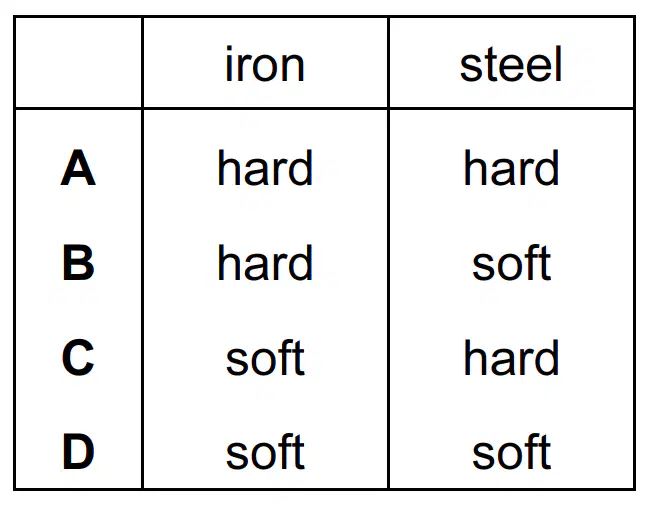
A hard magnetic material can be used to make a permanent magnet.
A soft magnetic material can be used to make a temporary magnet.
Which row shows whether iron and steel are hard or soft magnetic materials?
A
B
C
D
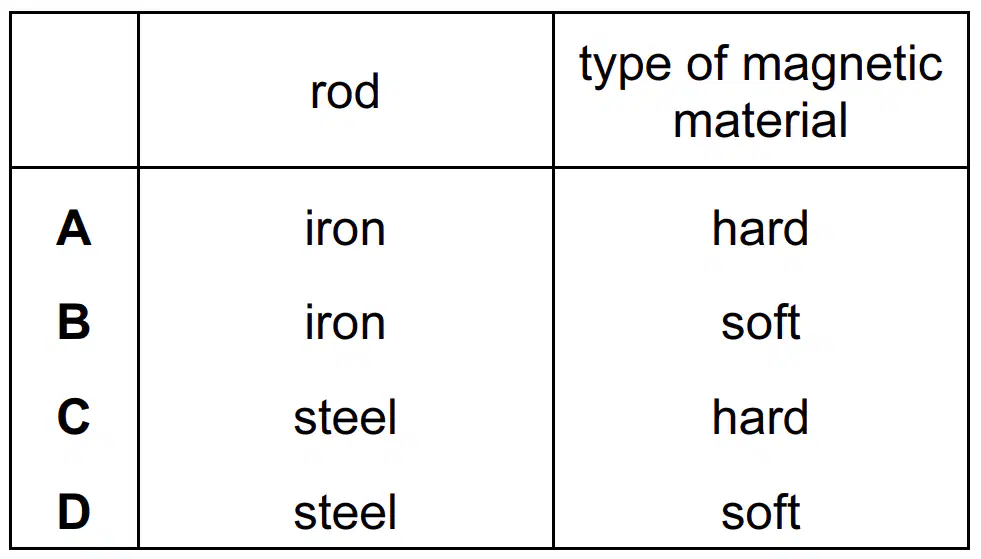
A student wishes to make a permanent magnet. She has an iron rod and a steel rod.
Which rod should she use to make the permanent magnet, and is this rod a hard magnetic
material or a soft magnetic material?
A
B
C
D
In which pair are both materials magnetic?
aluminum and copper
copper and iron
iron and steel
steel and aluminum
Which statement about a magnet is correct?
A magnet attracts a gold rod.
A magnet does not attract a plastic rod.
A magnet never repels another magnet.
A magnet sometimes repels an unmagnetised nickel rod.

A
B
C
D

A
B
C
D

Choose correct answer
A
B
C
D
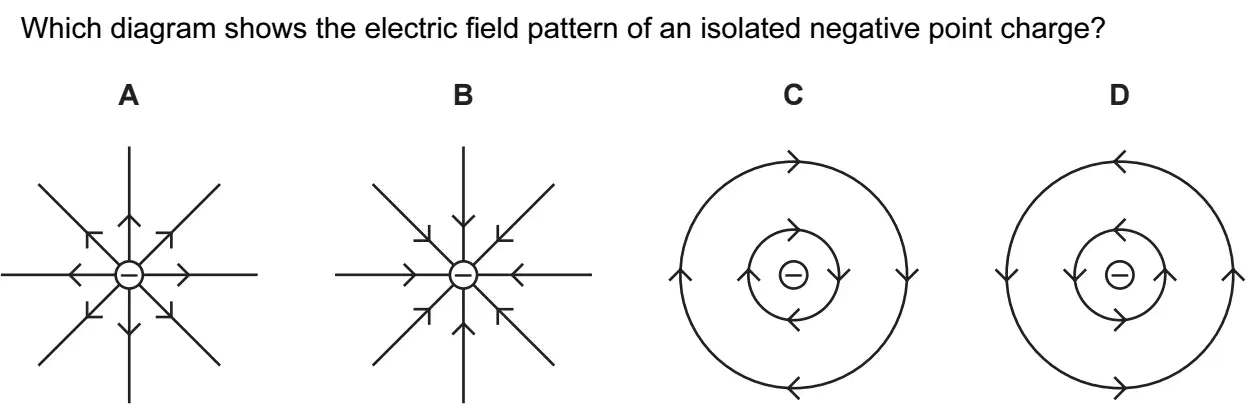
A
B
C
D

A
B
C
D

