
 Worksheets
Quiz: Properties and Changes
Total questions: 15
Worksheet time: 8mins
Name
Class
Date
1.
Min is conducting an experiment where he compares the properties of water and lemonade. The first stage of the experiment is focusing only on the physical properties of the water and lemonade. Which of the following is NOT A PHYSICAL property?
Min está realizando un experimento en el que compara las propiedades del agua y la limonada. La primera etapa del experimento se centra únicamente en las propiedades físicas del agua y la limonada. ¿Cuál de las siguientes NO es una propiedad FÍSICA?
a)
Color (What color is it?) | Color (¿De qué color es?)
b)
Conductivity (Can it conduct electricity?) | Conductividad (¿Puede conducir electricidad?)
c)
Flammability (Will it catch on fire and burn quickly?) | Inflamabilidad (¿Se incendiará y arderá rápidamente?)
d)
Boling point (At what temperature does it boil?) | Punto de ebullición (¿A qué temperatura hierve?)
2.
Which is the LEAST likely indicator that a chemical change has taken place in a substance?
¿Cuál es el indicador MENOS probable de que se ha producido un cambio químico en una sustancia?
a)
change in color | cambio de color
b)
change in state of matter | cambio de estado de la materia
c)
formation of gas bubbles | formación de burbujas de gas
3.
Ann dissolves 4 tablespoons of salt in a bowl of water. She notices that the water has become salty. Ann then keeps the bowl out of the sun for a long time. The water of the bowl evaporates, leaving little crystals of salt behind in the bowl. What kind of change(s) have happened?
Ann disuelve 4 cucharadas de sal en un recipiente con agua. Ella nota que el agua se ha vuelto salada. Luego, Ann mantiene el cuenco alejado del sol durante mucho tiempo. El agua del bol se evapora, dejando pequeños cristales de sal en el bol. ¿Qué tipo de cambios han ocurrido?
a)
Both the salt dissolving and the evaporation of water leaving salt are physical changes. | Tanto la disolución de la sal como la evaporación del agua que deja la sal son cambios físicos.
b)
Both the salt dissolving and the evaporation of water leaving salt are chemical changes. | Tanto la disolución de la sal como la evaporación del agua que deja la sal son cambios químicos.
c)
The salt dissolving is a physical change and the evaporation of water leaving salt is a chemical change. | La disolución de la sal es un cambio físico y la evaporación del agua que deja la sal es un cambio químico.
d)
The salt dissolving is a chemical change and the evaporation of water leaving salt is a physical change. La disolución de la sal es un cambio químico y la evaporación del agua que deja la sal es un cambio físico.
4.
Matter can be classified as having chemical and physical properties. Which step describes part of an experimental procedure that measure a CHEMICAL property of a substance?
La materia se puede clasificar según sus propiedades químicas y físicas. ¿Qué paso describe parte de un procedimiento experimental que mide una propiedad QUÍMICA de una sustancia?
a)
adding varying amounts of salt to one liter of water and heating it to measure the change in boiling point agregar cantidades variables de sal a un litro de agua y calentarlo para medir el cambio en el punto de ebullición
b)
exposing a piece of iron to varying levels of humidity in the air to measure the rate at which the iron rusts | exponer un trozo de hierro a diferentes niveles de humedad en el aire para medir la velocidad a la que se oxida el hierro
c)
measuring the mass of a steel cube and finding the volume by water displacement to measure density | medir la masa de un cubo de acero y encontrar el volumen por desplazamiento de agua para medir la densidad
d)
placing a small sugar cube on a hot plate and warming it slowly to measure the melting point | colocar un pequeño terrón de azúcar en un plato caliente y calentarlo lentamente para medir el punto de fusión
5.
A student pours a colorless liquid into a beaker containing sodium carbonate solution and observes that as the liquid is poured small white particles start to settle at the bottom of the beaker. The solution becomes cloudy but no temperature change is recorded. The student claims that a chemical change occurs when the two liquids are mixed. Which observation supports the students claim?
Un estudiante vierte un líquido incoloro en un vaso que contiene una solución de carbonato de sodio y observa que a medida que se vierte el líquido, pequeñas partículas blancas comienzan a depositarse en el fondo del vaso. La solución se vuelve turbia pero no se registra ningún cambio de temperatura. El estudiante afirma que ocurre un cambio químico cuando se mezclan los dos líquidos. ¿Qué observación respalda la afirmación de los estudiantes?
a)
change in color | cambio de color
b)
formation of a solid | formación de un sólido
c)
no change in temperature | sin cambios de temperatura
d)
freezing of a solid into a liquid | congelación de un sólido a un líquido
6.
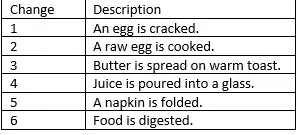
Jake made a chart that showed what changes occurred while he prepared his breakfast.
Which change from Jake's list below represents a CHEMICAL change and why?
Jake hizo un gráfico que mostraba los cambios que ocurrieron mientras preparaba su desayuno.
¿Qué cambio de la lista de Jake a continuación representa un cambio QUÍMICO y por qué?
a)
1 because the egg and eggshell changed shape. | 1 porque el huevo y la cáscara cambiaron de forma.
b)
2 because the cooked egg had new properties. | 2 porque el huevo cocido tenía nuevas propiedades.
c)
3 because the butter melted on the warm toast. | 3 porque la mantequilla se derritió sobre la tostada tibia.
d)
4 because the juice changed shape. | 4 porque el jugo cambió de forma.
7.
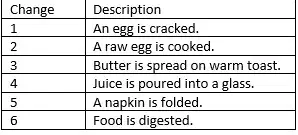
Jake made a chart showing changes that occurred while he prepared his breakfast.
Which numbers would best represent CHEMICAL changes?
Jake hizo un gráfico que muestra los cambios que ocurrieron mientras preparaba su desayuno.
¿Qué números representarían mejor los cambios QUÍMICOS?
a)
2, 3, and 6
b)
2 and 6
c)
1, 2, and 3
d)
2 and 3
8.
When cooking dinner, Kelly places a pot full of water on the stove to heat up. Kelly notices that small bubbles start to appear at the bottom of the pot after 3 minutes.
What type of property of water is Kelly observing?
Mientras prepara la cena, Kelly coloca una olla llena de agua en la estufa para calentarla. Kelly nota que empiezan a aparecer pequeñas burbujas en el fondo de la olla después de 3 minutos.
¿Qué tipo de propiedad del agua observa Kelly?
a)
Kelly is observing a chemical property because the water is changing to steam. | Kelly está observando una propiedad química porque el agua se está transformando en vapor.
b)
Kelly is observing a chemical property because the water is reacting with the pot. | Kelly está observando una propiedad química porque el agua reacciona con la olla.
c)
Kelly is observing a physical property because the water is changing to steam. | Kelly está observando una propiedad física porque el agua se está transformando en vapor.
d)
Kelly is observing a physical property because the water is reacting with the pot. | Kelly está observando una propiedad física porque el agua reacciona con la olla.
9.
What is the density of an object whose mass is 180 grams and whose volume is 45 cm3? (Remember the formula for density looks like a broken heart.)
¿Cuál es la densidad de un objeto cuya masa es de 180 gramos y cuyo volumen es de 45 cm3? (Recuerde que la fórmula de la densidad parece un corazón roto).
a)
4cm3/g
b)
4 g/cm3
c)
0.25 g/cm3
d)
0.25 cm3/g
10.
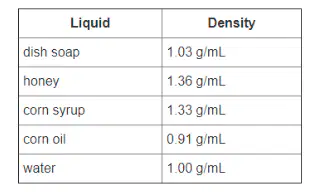
Lauren makes an art piece using the densities of various liquids to create layers of colors. She first determines the density of each liquid. Then she pours them into a glass container and watches them separate into layers.
What information did she need to find the density of each liquid?
Lauren crea una obra de arte utilizando las densidades de varios líquidos para crear capas de colores. Primero determina la densidad de cada líquido. Luego los vierte en un recipiente de vidrio y observa cómo se separan en capas.
¿Qué información necesitaba para encontrar la densidad de cada líquido?
a)
Weight and Volume | Peso y volumen
b)
Weight and Mass | Peso y masa
c)
Mass and Volume | Masa y volumen
d)
Just volume | solo volumen
11.
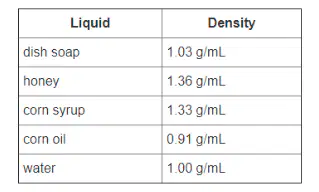
Lauren makes an art piece using the densities of various liquids to create layers of colors. She first determines the density of each liquid. Then she pours them into a glass container and watches them separate into layers.
Which liquid sinks to the very bottom, and which floats at the very top?
Lauren crea una obra de arte utilizando las densidades de varios líquidos para crear capas de colores. Primero determina la densidad de cada líquido. Luego los vierte en un recipiente de vidrio y observa cómo se separan en capas.
¿Qué líquido se hunde hasta el fondo y cuál flota hasta la parte superior?
a)
Corn syrup is at the top and water is at the bottom. | El jarabe de maíz está arriba y el agua abajo.
b)
Corn oil is at the bottom and honey is at the top | El jarabe de maíz está arriba y el agua abajo.
c)
Honey is at bottom and corn oil is at the top. | La miel está abajo y el aceite de maíz arriba. La miel está abajo y el aceite de maíz arriba.
d)
Water is the at the bottom and corn oil is at the top. | El agua está en la parte inferior y el aceite de maíz en la parte superior.
12.
Which is the correct equation for calculating density?
¿Cuál es la ecuación correcta para calcular la densidad?
a)
Density= Mass/Volume | Densidad= Masa/Volumen
b)
Density= Mass/Weight | Densidad= Masa/Peso
c)
Density= Volume/Mass | Densidad= Volumen/Masa
d)
Density= Volume/Weight | Densidad= Volumen/Peso
13.
Which of the following describes just a physical change?
¿Cuál de las siguientes opciones describe simplemente un cambio físico?
a)
A marshmallow burn over an open flame | Un malvavisco se quema sobre una llama abierta.
b)
Icicles melting from a rooftop | Carámbanos derritiéndose desde un tejado
c)
A cat eats a piece of fish | Un gato se come un trozo de pescado.
d)
Milk turns sour. | La leche se vuelve agria.
14.
How can you determine the volume of an irregular solids?
¿Cómo se puede determinar el volumen de un sólido irregular?
a)
Use a scale | usa una escala
b)
By water displacement | Por desplazamiento de agua
c)
length × width × height | largo × ancho × alto
d)
Holding the irregular solid in your hand | Sosteniendo el sólido irregular en tu mano
15.
Jonah and Rachel volunteer at the recycling center sorting and organizing recyclable objects. Jonah is sorting aluminum cans and crushing the cans to fit more in the bag. Rachel is sorting metal and steel objects into appropriate bins.
Rachel notices that many objects have rusted. Rusting is a chemical change that some metal and steel objects undergo when they are exposed to oxygen. Which option best describes a chemical change?
Jonah y Rachel son voluntarios en el centro de reciclaje clasificando y organizando objetos reciclables. Jonah está clasificando latas de aluminio y aplastándolas para que quepan más en la bolsa. Rachel está clasificando objetos de metal y acero en contenedores adecuados.
Rachel nota que muchos objetos se han oxidado. La oxidación es un cambio químico que sufren algunos objetos de metal y acero cuando se exponen al oxígeno. ¿Qué opción describe mejor un cambio químico?
a)
a change from solar energy to chemical energy | un cambio de energía solar a energía química
b)
a change in matter that produces one or more new substances | un cambio en la materia que produce una o más sustancias nuevas
c)
a change from a liquid state to a gas state | un cambio de un estado líquido a un estado gaseoso
d)
a change in the form or appearance of matter | un cambio en la forma o apariencia de la materia
100 %

