
 Worksheets
States of Matter Retest Exam
Total questions: 17
Worksheet time: 9mins
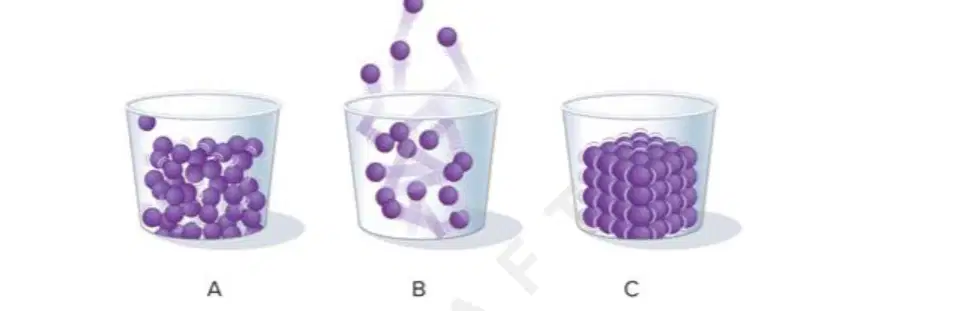
The model in the image below shows three substances. Which statement below identifies the states of matter correctly.
Substance A is a liquid, Substance B is a gas, Substance C is a solid.
Substance A is a solid, Substance B is a gas, Substance C is a liquid.
Substance A is a gas, Substance B is a liquid, Substance C is a solid.
Substance A is a liquid, Substance B is a solid, Substance C is a gas.
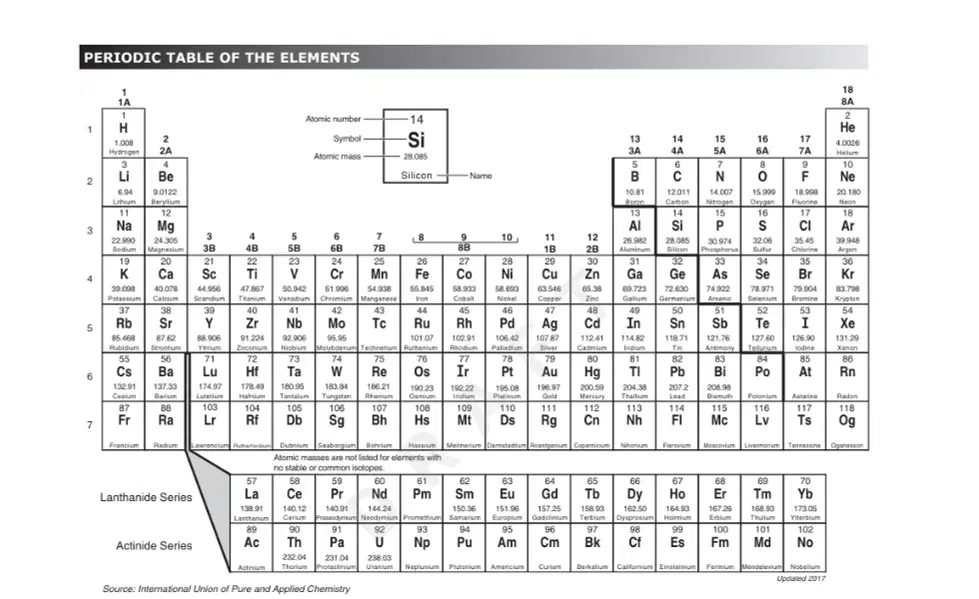
Lithium is a common element used in batteries, such as laptops, cell phones, and electric vehicles, based on its physical properties. It is a soft, silver-white material that is very good at conducting electricity. Because it is the third element in the periodic table seen below, it has a low density. How would you classify Lithium?
Lithium is a metal.
Lithium is a nonmetal.
Lithium is a metalloid.
Lithium is a rare earth element.
Boron has similar properties to metals. For example, it is a solid at room temperature, and it has a metallic luster. Which of the following questions would help determine if it is a metal or a metalloid?
How well does Boron conduct electricity?
Is boron magnetic?
What is the density of Boron?
What color is Boron when it is heated?
Natural gas is a common energy resource that is difficult to safely transport, unless it is stored as a liquid. Which solution below proposes how to turn natural gas into a liquid?
Design a process that slows down the molecules of gas and separates them farther apart.
Design a process that slows down the molecules of gas and brings them closer together.
Design a process that speeds up the molecules of gas and separates them farther apart.
Design a process that speeds up the molecules of gas and brings them closer together.
Compare the kinetic energies of the states of matter in order from greatest to least amount of energy.
Solid, Liquid, Gas
Gas, Liquid, Solid
Gas, Solid, Liquid
Solid, Gas, Liquid
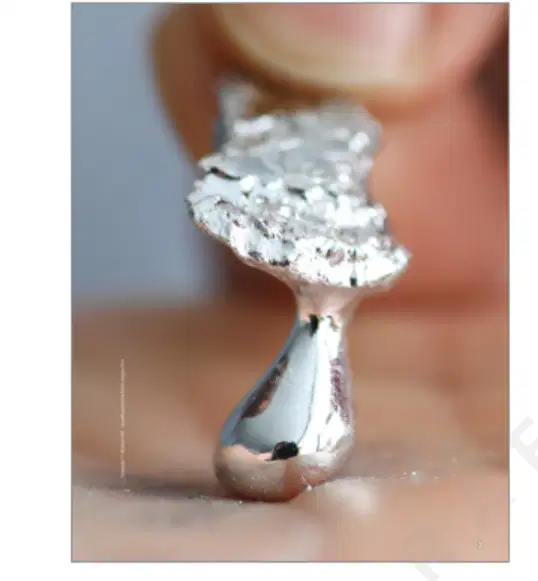
How can knowing the properties of matter help scientists classify the element in the image as a metal, metalloid, or nonmetal?
By noticing that the item has properties of both a solid and a liquid, it can be determined that this is a metalloid.
By noticing that it is shiny, it can be determined that it is a metal.
By noticing that is flowing, it can be determined that it is a liquid only, therefore it is a non-metal.
There is not enough evidence to determine that state of matter.

You are on a hike through the woods with a group of friends and find a ring that you think may be solid gold. What physical property could you use to determine if it is gold?
Its color is golden, therefore it is precious gold.
Its density, as you can compare the ring against a known sample of gold to determine if it is real.
Its conductivity, because gold conducts electricity.
Its mass, because that tells you the type of element it is.
Dry ice is frozen carbon dioxide and is sometimes used to keep food cold longer than regular ice. How is dry ice different from liquid or gaseous carbon dioxide?
There is no difference, They are all carbon dioxide.
Dry ice has a definite shape and volume, while gaseous carbon dioxide takes the shape of its container.
Dry ice is cold, and therefore is a liquid.
Gaseous carbon dioxide is heavier than dry ice, therefore it is less dense.
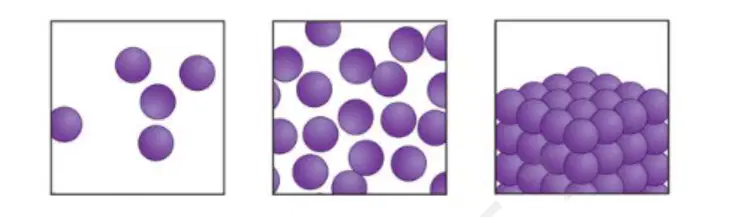
Examine the models below that represent atoms in three states of matter. Which statement best describes the models?
The model on the right has the greatest amount of kinetic energy.
The model in the middle shows the atoms with more kinetic energy than the model on the right.
The model in the middle has more kinetic energy than the model on the left.
The model on the left has the least amount of kinetic energy.
If two objects have the same mass, but one has more volume than the other, do they have the same density?
Yes they do.
No they do not.
You need to show numbers to calculate which answer is true.
Determine if the following object will either sink or float in the following scenario. An object with a mass of 7.5 grams and a volume of 10 ml was placed in a container with vegetable oil, which has a density of 0.92 g/ml. The object should ______ in the liquid because it is ______ dense than the oil.
float, less
sink, more
float, more
sink, less
Samarium is an element on the periodic table that is silvery and can be used to make strong permanent magnets. What would Samarium be classified as?
metal
metalloid
nonmetal
rare earth element
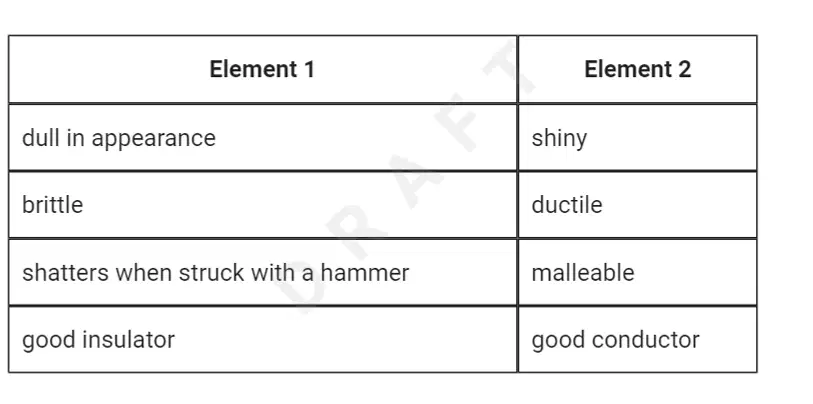
Table 1 shows a comparison between two elements from the periodic table.
Element 1 is oxygen and Element 2 is iron.
Element 1 is hydrogen and Element 2 is copper.
Element 1 is nitrogen and Element 2 is gold.
Element 1 is helium and Element 2 is silver.
Which is NOT a property of metal?
brittleness
malleability
ductility
luster
Which two properties make certain metals a good choice for electrical wires?
conductivity and malleability
ductility and conductivity
luster and malleability
high ductility and luster

Shown below is a periodic table with four elements numbered. Which element is a non-metal?
1
2
3
4
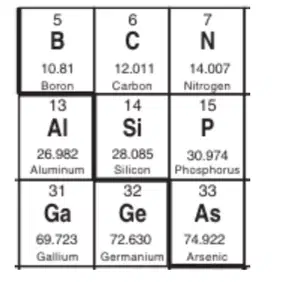
The image below is a portion of the periodic table. Which pair of elements are the most likely to have similar properties?
C and Ge
N and Si
As and Si
As and B

