wayground logo

Free Printable Worksheets

Font size

S
M
L
XL
Worksheets

chapter 17

Total questions: 22

Worksheet time: 40mins

Name
Class
Date
1.
What types of charges attract?
a)
Positive and Positive
b)
Positive and Neutral
c)
Negative and Neutral
d)
Positive and Negative
2.
What charge does a proton have?
a)
negative (-)
b)
positive (+)
c)
neutral or no charge (0)
3.
What charge does an electron have?
a)
negative (-)
b)
positive (+)
c)
neutral or no charge (0)
4.
If a substance has a higher number of electrons than protons on its surface, what type of charge does it have?
a)
A positive charge.
b)
A negative charge.
c)
A neutral charge
d)
No charge at all
5.
Which of the following is caused by static electricity?
a)
a stove getting hot when it is turned on
b)
a magnet being attracted to a refrigerator
c)
a lightning strike during a storm
d)
a light bulb coming on when a switch is turned on
6.
An object becomes postiively charged when which of the following occurs?
a)
loses electrons
b)
gains electrons
c)
loses protons
d)
gains neutrons
7.

The difference between attraction and repulsion is that to attract is to pull something closer and repel is to push something away.

a)

True

b)

False

8.

the positively charged particle in an atom, never leaves the nucleus, determines the element

a)

proton

b)

neutron

c)

electron

9.
What types of charges attract?
a)
Positive and Positive
b)
Positive and Neutral
c)
Negative and Neutral
d)
Positive and Negative
10.
In a neutral atom, the number of electrons is equal to the number of _______.
a)
Neutrons
b)
Orbits
c)
Protons
d)
subatomic particles
11.
An object becomes charged when the atoms in the object gain or lose
a)
electrons
b)
protons
c)
neutrons
d)
all of the above
12.
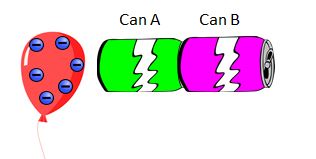
The negatively charged balloon is brought near the two cans. What happens?
a)
The negative charges in Can B move towards the balloon
b)
The negative charges in Can A move away from the balloon
c)
The positive charges in Can B move towards the balloon
d)
The positive charges in Can A move away from the balloon
13.
If the two charges represented in the figure were brought near each other, they would
a)
attract each other.
b)
repel each other.
c)
cause static discharge.
d)
have no affect on each other
14.

Will the balloons ATTRACT or REPEL each other?

a)
b)
15.

Will the balloons ATTRACT or REPEL each other?

a)
b)
16.

Static electricity can "jump" from the charged object to another object, causing . . .

a)

static cling (objects sticking together)

b)

electric discharge (and a shock!)

17.

When negative charges on a cloud cause positive charges to build up on the ground, what may happen?

a)
b)
18.

Why is the balloon attracted to the cat?

a)

The balloon and the cat's hair have opposite electric charges

b)

The cat sat in glue

c)

The balloon is in love with the cat

d)

The balloon and the cat's hair have the same electric charges

19.

When the same charges are near each other,

they repel (move away from) each other.

a)
b)
20.

A force that pushes objects away from each other

a)

electrical charge

b)

attraction

c)

force

d)

repulsion

21.

What type of charge does this balloon have?

a)

Positive

b)

Negative

c)

Neutral

22.
What will you likely see during an electrical discharge?
a)
A rainbow
b)
A spark
c)
Red
d)
Moisture