
 Worksheets
AP 1.2 Mass Spectroscopy of Elements
Total questions: 15
Worksheet time: 8mins
Name
Class
Date
1.
Four isotopes of lead include lead-204, lead-206, lead-207, and lead-208. The average atomic mass of lead is 207.2. Which isotope of lead is likely to be the most abundant.
a)
206
b)
208
c)
207
d)
204
2.
Calculate the average atomic mass of silver.
Silver-107 106.90509amu 51.86%
Silver-109 108.90470amu remaining%
a)
111.91896amu
b)
107.8677amu
c)
106.38649amu
d)
121
3.
An element has two naturally occurring isotopes. One is 10.013 amu and is 19.9% abundant. The other is 11.01 amu and is 80.1% abundant. What is the average atomic mass? What element is it?
a)
6.941, Lithium
b)
10.812, Boron
c)
9.012, Beryllium
d)
12.011, Carbon
4.
Which of following is not true of the carbon-14 atom?
a)
It has six electrons
b)
It has six protons
c)
It is the less common than carbon-12
d)
It has eight neutrons
e)
It has an average mass of 12.011 amu.
5.
The element hafnium (Hf) has five stable isotopes. The correct number of nuclear particles in an atom of hafnium-178 is:
a)
106 protons, 72 neutrons
b)
72 protons, 72 electrons
c)
72 protons, 178 neutrons
d)
72 protons, 106 neutrons
e)
72 protons, 106 neutrons, 72 electrons
6.
The average mass of a magnesium atom is 24.31. If you were able to select and measure a single atom of magnesium, the chance that you would select an atom of mass 24.31 is about:
a)
greater than 50%
b)
0.31%
c)
24.31%
d)
100%
e)
0%
7.
The element rhenium (Re) exists as two stable isotopes and 18 unstable isotopes. Rhenium-185 has in its nucleus
a)
75 protons, 75 neutrons.
b)
75 protons, 130 neutrons.
c)
130 protons, 75 neutrons.
d)
75 protons, 110 neutrons.
e)
not enough information is given.
8.
Uranium occurs naturally as a mixture of uranium-235 and uranium-238. An atom of uranium-235 contains:
a)
92 protons, 92 neutrons, 92 electrons
b)
92 protons, 143 neutrons, 92 electrons
c)
143 protons, 92 neutrons, 143 electrons
d)
143 protons, 92 electrons, 92 neutrons
e)
none of these combinations
9.
Which of the following statements are true of uranium-238?
1-Its chemical properties will be exactly like those of uranium-235
2-Its mass will be slightly different from that of an atom of uranium-235.
3-It will contain a different number of protons than an atom of uranium-235.
4-It is more plentiful in nature than uranium-235.
a)
3, 4
b)
1, 2, 3
c)
1, 2, 4
d)
2, 3, 4
e)
all of them
10.
An isotope, X, of a particular element has an atomic number of 7 and a mass number of 15. Therefore,
a)
X is an isotope of nitrogen.
b)
X has 8 neutrons per atom.
c)
X has an atomic weight of 14.0067.
d)
a and b.
e)
a, b, and c.
11.

Which of the following elements has the mass spectrum represented below?
a)
Nb
b)
Mo
c)
U
d)
Cf
12.
The mass spectrum of the element Sb is most likely represented by which of the following?
a)
122
b)
121&123
c)
120,123,124
d)
120,121,124
13.
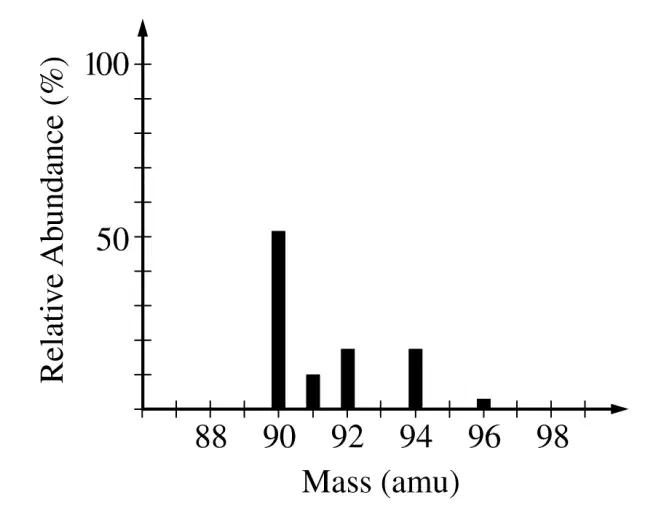
The mass spectrum of element X is presented in the diagram above. Based on the mass spectrum, which of the following can be concluded about element X?
a)
X is a transition metal, and each peak represents an oxidation state of the metal.
b)
X contains five electron sublevels.
c)
The atomic mass of X is 90.
d)
The atomic mass of X is between 90 and 92.
14.
There are two primary isotopes found in any sample of copper: copper-63 and copper-65. The isotope 65Cu composes 69.2% of the sample and 63Cu comprises the other 30.8%. Based on this data, what is the atomic mass of copper?
a)
29 amu
b)
63.546 amu
c)
64.4 amu
d)
63.6 amu
15.
Why the "Atomic Mass: in the periodic Table is different than the "Mass Number" of an Atom ?
a)
It is the average mass of all the isotopes
b)
Because the mass field property of isotopes disperse through the sample
c)
quantum mechanics make mass uncertain
d)
All answers are correct
100 %

