
 Worksheets
Chemistry in Living Systems Review
Total questions: 20
Worksheet time: 13mins
How many bonds can carbon form with other atoms?
1
2
3
4
One link in a chain would be considered a _____ while the entire chain would be considered a _____.
Monomer; polymer
Polymer; monomer
Monomer; monomer
Polymer; polymer
Why is the 3D shape of a protein so important?
It determines the protein's color.
It determines the protein's function.
It determines the protein's size.
It determines the protein's weight.
What is the job of the cell membrane?
To provide energy
To control what enters and leaves the cell
To produce proteins
To store genetic information
During passive transport, molecules move from ____ concentration using ____.
Low to high; energy
High to low; no energy
Low to high; no energy
High to low; energy
What happens to the atoms and bonds in the reactant as the reaction takes place?
They remain unchanged
They are rearranged
They disappear
They multiply
What are two factors that can denature a protein?
Temperature and pH
Light and sound
Pressure and volume
Color and texture
If an enzyme is denatured, what will likely happen to its reaction?
It will speed up
It will slow down or stop
It will remain unchanged
It will explode
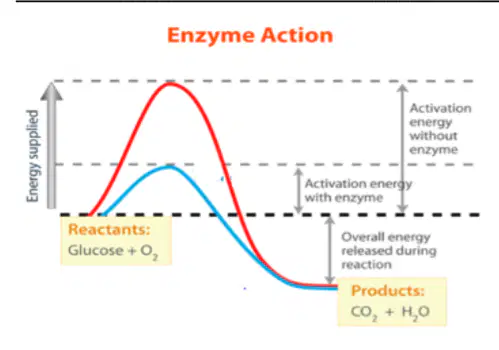
Which type of reaction is shown here, and do reactants or products contain more energy?
exothermic; reactants have more energy
exothermic; products have more energy
endothermic; reactants have more energy
endothermic; products have more energy

What is the overall energy change in a reaction when an enzyme is present?
There's an increase in the energy required
There's a decrease in the energy required
There's no change in the energy required
The energy required is doubled
What is the function of carbohydrates?
Provides quick energy
Provides stored energy
Speeds up chemical reactions
Stores genetic information
What is one function of lipids?
Provides quick energy
Provides stored energy
Speeds up chemical reactions
Stores genetic information
What are the functions of proteins? Choose ALL that apply.
Build muscles and tissues
Provide stored energy
Speed up chemical reactions
Fight infections
What is one function of nucleic acids?
Provide quick energy
Provide stored energy
Speed up chemical reactions
Store genetic information
Which of the following carbohydrates is made of the most monomers?
A monosaccharide
A disaccharide
A polysaccharide
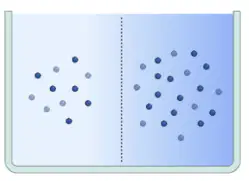
The image to the left represents a beaker filled with water and a dissolved particle like salt. The dotted line in the center represents a semi-permeable membrane. If the salt is small enough to pass through, which direction will it move and why?
To the left; particles move from low to high concentration
To the right; particles move from low to high concentration
To the left; particles move from high to low concentration
To the right; particles move from high to low concentration
Which of the following enzyme-reactant pairs is incorrect?
Proteases break down proteins
Nucleases break down nucleic acids
Lipases break down lipids
Lactase breaks down the sugar sucrose
An enzyme is a _____ that speeds up a chemical reaction by _____ the activation energy required.
protein; raising
protein; lowering
nucleic acid; raising
nucleic acid; lowering
Once a person dies, their body slowly cools off. Why doesn't the body maintain its heat after death?
The body can only break down carbohydrates after death which don't produce much heat.
The body loses its insulation that is keeping the heat trapped.
The body's exothermic reactions are no longer occurring.
The body's exothermic reactions switch to become endothermic reactions.
How can biochemistry be used to solve crimes after they’ve taken place?

