
 Worksheets
+1 Organic Chemistry BB 1mark Quiz
Total questions: 43
Worksheet time: 22mins
Select the molecule which has only one pibond.
CH3 - CH = CH - CH3
CH3 - CH = CH - CHO
CH3 - CH = CH - COOH
All of these
In the hydrocarbon CH3 - CH2 - CH = CH- CH2 - C≡CH the state of hybridisation of carbon 1,2,3,4 and 7 are in the following sequence.
sp, sp, sp3 , sp2 , sp3
sp2 , sp, sp3 , sp2 , sp3
sp, sp, sp2 , sp, sp3
none of these
The general formula for alkadiene is
Cn H2n
Cn H2n-1
Cn H2n-2
Cn Hn-2

The IUPAC name of the Compound is
2,3 - Diemethylheptane
3- Methyl -4- ethyloctane
5-ethyl -6-methyloctane
4-Ethyl -3 - methyloctane.
Which one of the following names does not fit a real name?
3 - Methyl -3-hexanone
4-Methyl -3- hexanone
3- Methyl -3- hexanol
2- Methyl cyclo hexanone.

The IUPAC name of the compound is
Pent - 4 - yn-2-ene
Pent -3-en-l-yne
pent - 2- en - 4 - yne
Pent - 1 - yn -3 -ene

IUPAC name of is
3,4,4 - Trimethylheptane
2 - Ethyl -3, 3- dimethyl heptane
3, 4,4 - Trimethyloctane
2 - Butyl -2 -methyl - 3 - ethyl-butane.

The IUPAC name of is
2,4,4 - Trimethylpent -2-ene
2,4,4 - Trimethylpent -3-ene
2,2,4 - Trimethylpent -3-ene
2,2,4 - Trimethylpent -2-ene

The IUPAC name of the compound is
3 - Ethyl -2- hexene
3 - Propyl -3- hexene
4 - Ethyl - 4 - hexene
3 - Propyl -2-hexene
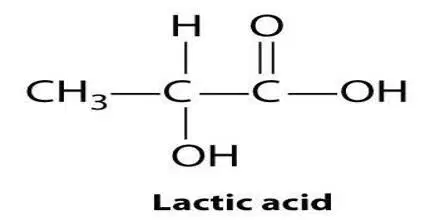
The IUPAC name of the compound is
2 - Hydroxypropionic acid
2 - Hydroxy Propanoic acid
Propan - 2- ol -1 - oic acid
1 - Carboxyethanol.
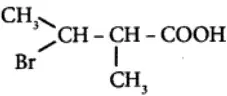
The IUPAC name of is
2 - Bromo -3 - methyl butanoic acid
2 - methyl - 3- bromobutanoic acid
3 - Bromo - 2 - methylbutanoic acid
3 - Bromo - 2, 3 - dimethyl propanoic acid.
The structure of isobutyl group in an organic compound is
CH3 - CH2 - CH2 - CH2
CH3 - C CH3 CH3
CH3 - CH - CH2 - CH3
CH3 - CH - CH2 - CH3
The number of stereoisomers of 1,2-dihydroxycyclopentane
1
2
3
4
Which of the following is optically active?
3 - Chloropentane
2 Chloro propane
Meso - tartaric acid
Glucose
The isomer of ethanol is
acetaldehyde
dimethylether
acetone
methyl carbinol
How many cyclic and acyclic isomers are possible for the molecular formula C3 H6 O?
4
5
9
10
Which one of the following shows functional isomerism?
ethylene
Propane
ethanol
CH2 Cl2
CH2 -C-CH3 and CH2 = C - CH3 O O are
resonating structure
tautomers
Optical isomers
Conformers.
Nitrogen detection in an organic compound is carried out by Lassaigne's test. The blue colour formed is due to the formation of.
Fe3 [Fe(CN)6 ]2
Fe4 [Fe(CN)6 ]3
Fe4 [Fe(CN)6 ]2
Fe3 [Fe(CN)6 ]
Lassaigne's test for the detection of nitrogen fails in
H2 N - CO- NH.NH2 .HCl
NH2 - NH2 . HCl
C6 H5 - NH - NH2 . HCl
C6 H5 CONH2
Connect pair of compounds which give blue colouration / precipitate and white precipitate respectively, when their Lassaigne's test is separately done.
NH2 NH2 HCl and ClCH2 -CHO
NH2 CS NH2 and CH3 - CH2 Cl
NH2 CH2 COOH and NH2 CONH2
C6 H5 NH2 and ClCH2 - CHO.
Sodium nitropruside reacts with sulphide ion to give a purple colour due to the formation of
[Fe(CN)5 NO]3-
[Fe(NO)5 CN]+
[Fe(CN)5 NOS]4-
[Fe (CN)5 NOS]3-
An organic Compound weighing 0.15g gave on carius estimation, 0.12g of silver bromide. The percentage of bromine in the Compound will be close to
46%
34%
3.4%
4.6%
A sample of 0.5g of an organic compound was treated according to Kjeldahl's method. The ammonia evolved was absorbed in 50mL of 0.5M H2 SO4 . The remaining acid after neutralisation by ammonia consumed 80mL of 0.5 MNaOH, The percentage of nitrogen in the organic compound is.
14%
28%
42%
56%
In an organic compound, phosphorus is estimated as
Mg2 P2 O7
Mg3 (PO4 )2
H3 PO4
P2 O5
Ortho and para-nitro phenol can be separated by
azeotropic distillation
destructive distillation
steam distillation
cannot be separated
The purity of an organic compound is determined by
Chromatography
Crystallisation
melting or boiling point
both (a) and (c)
A liquid which decomposes at its boiling point can be purified by
distillation at atmospheric pressure
distillation under reduced pressure
fractional distillation
steam distillation.
Assertion: CH3 - C = CH - COOH is COOC2 H5 3- carbethoxy -2- butenoicacid. Reason: The principal functional group gets lowest number followed by double bond (or) triple bond.
both the assertion and reason are true and the reason is the correct explanation of assertion.
both assertion and reason are true and the reason is not the correct explanation of assertion.
assertion is true but reason is false
both the assertion and reason are false.
What is the hybridisation state of benzyl carbonium ion?
sp2
spd2
sp3
sp2 d
Decreasing order of nucleophilicity is
OH- > NH2 - >- OCH3 > RNH2
NH2 - > OH- >- OCH3 > RNH2
NH2 - > CH3 O- > OH- > RNH2
CH3 O- > NH2 - > OH- > RNH2
Which of the following species is not electrophilic in nature?
Cl+
BH3
H3 O+
+NO2
Homolytic fission of covalent bond leads to the formation of
electrophile
nucleophile
Carbo cation
free radical
Hyper Conjugation is also known as
no bond resonance
Baker - nathan effect
both (a)and (b)
none of these
Which of the group has highest +I effect?
CH3 -
CH3 -CH2 -
(CH3 )2 -CH-
(CH3 )3 -C-
Which of the following species does not exert a resonance effect?
C6 H5 OH
C6 H5 Cl
C6 H5 NH2
C6 H5 NH3 +
-I effect is shown by
-Cl
-Br
both (a) and (b)
-CH3
Which of the following carbocation will be most stable?
Ph3 C-+
CH3 -CH2 +-
(CH3 )2 -CH +
CH2 =CH-CH2+
Assertion: Tertiary Carbocations are generally formed more easily than primary Carbocations ions. Reason: Hyper conjugation as well as inductive effect due to additional alkyl group stabilize tertiary carbonium ions.
both assertion and reason are true and reason is the correct explanation of assertion.
both assertion and reason are true but reason is not the correct explanation of assertion.
Assertion is true but reason is false
Both assertion and reason are false
Heterolytic fission of C-C bond results in the formation of
free radical
Carbanion
Carbocation
Carbanion and Carbocation
Which of the following represent a set of nuclephiles?
BF3 , H2 O, NH2-
AlCl3 , BF3 , NH3
CN- , RCH2 - , ROH
H+, RNH3 +, :CCl2
Which of the following species does not acts as a nucleophile?
ROH
ROR
PCl3
BF3
This type of exam helpful for you?
Then enter your name & your school name.
Thank you🙏.
(a)

