
NEW
Font size
 Worksheets
Unit 2- Matter & Measurement 8th Grade Review -2024
Total questions: 30
Worksheet time: 54mins
Jason wanted to explain the difference between mass and weight to his classmates. Which is a correct statement that Jason could include in his explanation?
Weight is a measure of the amount of matter in an object.
Mass is the measure of the gravitational force on an object.
Mass varies depending on the location of the object.
Weight varies depending on where the object is in the Solar System.
Suppose you have two pieces of modeling clay. One piece contains more clay than the other. How do the two pieces of clay differ?
The larger piece of clay has a greater mass and a greater weight.
The larger piece of clay has a greater mass but the same weight.
The larger piece of clay has a smaller mass but the same weight.
The larger piece of clay has a smaller mass and a greater density.
Which of the following actions described below will change an object's weight, but not its mass?
Breaking the object
Compressing the object
Putting the object in a box
Placing the object on a different planet
Which of these statements is true about the weight of objects?
Objects on the same planet all have the same weight.
Weight depends on mass and where the object is.
Only objects on the surface of a planet have weight.
All objects have weight, regardless of where they are in the universe.
Physical properties can be used to compare and classify substances. Which statement is correct about a physical property?
A physical property is based on a substance’s ability to change into a new substance.
A physical property is difficult to observe and even more difficult to measure.
A physical property describes a substance’s ability to be involved in a chemical reaction.
A physical property can be observed or measured without changing the identity of the substance.
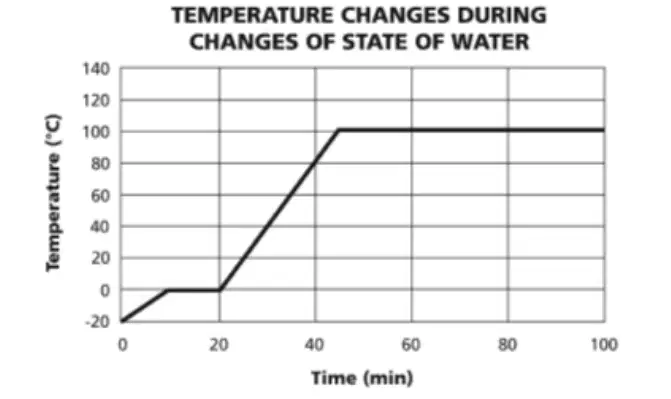
Thomas performed an experiment to measure the temperature of water as he heated it on a hotplate. At the end of his experiment, he plotted the results as shown in the graph . Which of the following physical properties of water did Thomas measure?
volume and thermal conductivity
solubility and electrical conductivity
melting point and boiling point
densities and physical states of matter
This physical property is one that remains the same regardless of the amount of matter that is present. Which of the following physical properties of matter is described above?
mass
density
volume
weight
Mario performed an experiment to investigate how certain substances dissolve in water. He poured the substances in separate beakers of water and stirred each one using a glass rod. He then observed the results. What physical property of the substances did Mario investigate?
density
melting point
solubility
thermal conductivity

Physical properties can be used to classify and compare substances. The illustration below shows a physical property that is being investigated using different materials. What physical property is most likely being investigated in this illustration?
thermal conductivity
melting point
magnetism
electrical conductivity
For a laboratory exercise in class, a student is given a mixture of small pieces of iron, sand, water, and salt. What physical property could be used to best separate the iron from the other ingredients?
magnetism
solubility
melting point
electrical conductivity
Two cubes are placed into a bucket of water. One cube is made of solid foam and it floats. The other cube is made of solid metal and it sinks. Why does this happen when both are placed into water?
The foam cube absorbs more water than the metal cube.
The foam cube is less dense than the metal cube.
The foam cube is more dense than the metal cube.
The foam cube absorbs less water than the metal cube.
The ability to conduct an electric current, dissolve in water and melt are considered which of the following?
Chemical Changes
Chemical Properties
Physical Properties
Physical Changes
You are given two objects that are made from the same material. They are also the same size and color. One is hollow and one is solid. Determine the physical property that could be used to identify which object is solid and which object is hollow.
boiling point
density
electrical conductivity
thermal conductivity
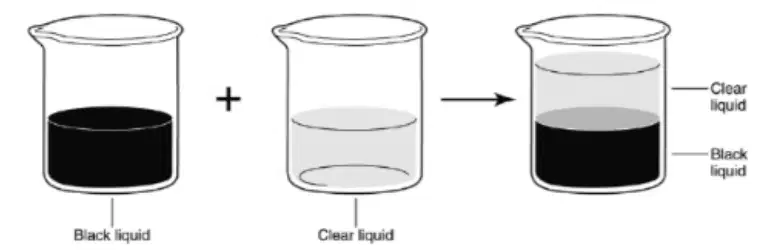
Derek mixed two liquids. One liquid was black, and the other liquid was clear. The illustration shows what happened after Derek mixed the two liquids and allowed them to stand for 10 minutes. Which of the following statements could explain why the two liquids formed distinct layers
The liquids have different densities.
The liquids have different colors.
The liquids have different volumes.
The liquids have different states of matter.
Lucy wanted to determine the density of a colorful stone that she had picked up on the beach. Which two properties must Lucy measure in order to calculate the density of the stone?
size & shape
mass & volume
mass & temperature
composition & texture
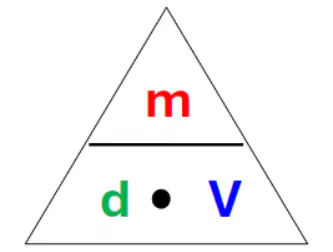
Copper has a density of 9g/cm3. Suppose you had a piece of copper that had a mass of 27g. The formula for density is d = m/v, where m is mass and v is volume. What is the volume of this piece of copper metal?
19.3 cm3
10 cm3
3 cm3
81 cm3
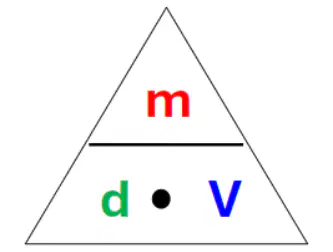
Sam finds a gold-colored rock on a hike. He takes it home and uses his digital balance to find its mass of 25g. Sam uses a graduated cylinder and water displacement to find the volume of the rock to be 5cm3. The formula for density is d = m/v, where m is mass and v is volume. What is the rock’s density?
20 g/cm3
5 g/cm3
30 g/cm3
125 g/cm3
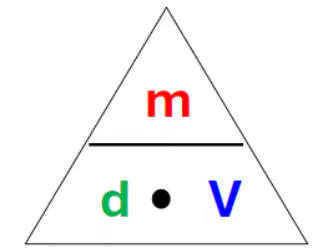
Chocolate cake has an average density of 4.2g/cm3. The volume of a single slice is 113.1cm3. The formula for density is d = m/v, where m is mass and v is volume. What is the mass of this slice of chocolate cake?
26.93 g
475.02 g
0.04 g
117.3 g
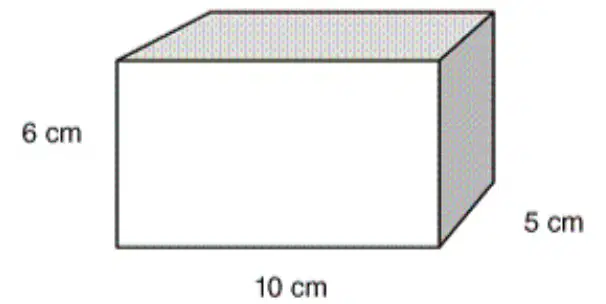
Owen wanted to determine the density of a wooden block. He made the measurements shown. Owen knew he could use these measurements to calculate the amount of space occupied by the block. What else must Owen determine in order to calculate the density of this block?
Its mass
Its volume
Its surface area
Its number of sides
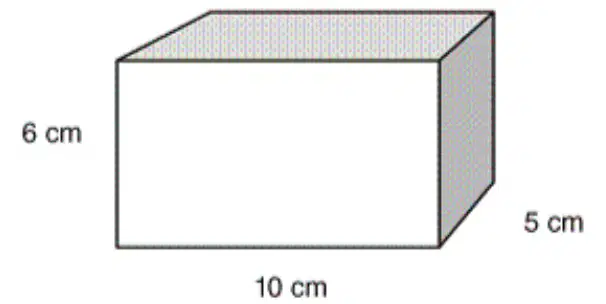
Owen wanted to determine the density of a wooden block. He made the measurements shown below. How much space is occupied by the block?
30 cm3
60 cm3
21 cm3
300 cm3

Ron carried out the following procedure to obtain a measurement needed to calculate the density of a solid object. What else must Ron measure in order to calculate the density of this object?
Its mass
Its volume
Its melting point
Its surface area

Ron carried out the following procedure to obtain a measurement needed to calculate the density of a solid object. What property is Ron measuring? What is the measurement for this object?
volume = 5 mL
mass = 5 g
density = 5 g/mL
weight = 5 N
A golf ball and a ping-pong ball are about the same size. In other words, they have about the same volume. However, a golf ball has more mass than a ping-pong ball. What can you conclude from this information?
A ping-pong ball contains more matter than a golf ball.
A ping-pong ball has the same properties as a golf ball.
A golf ball has a greater density than a ping-pong ball.
A golf ball contains a smaller amount of mass per volume than a ping-pong ball.
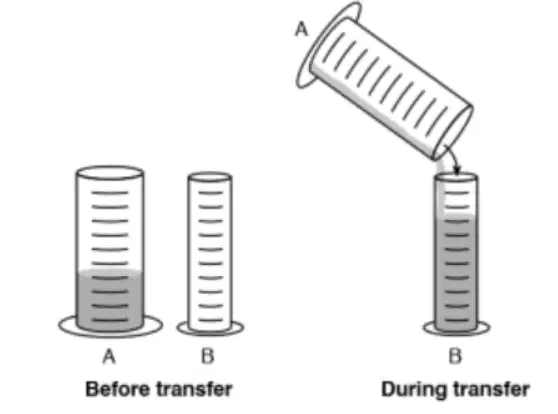
The diagram represents two graduated cylinders. 100mL of a liquid was completely transferred from A to B. Compared to the liquid that was in A, the liquid in B will have ___.
More mass and more volume
More mass and the same volume
The same mass and the same volume
The same mass and more volume
Properties of matter describe features about specific objects or substances. What makes physical properties and chemical properties different from one another?
Physical properties DON'T change the matter, but chemical properties DO change the matter.
Physical properties DO change the matter, but chemical properties DON'T change the matter.
Physical properties ARE measurable, but chemical properties are NOT measurable.
Physical properties are NOT measurable, but chemical properties ARE measurable.
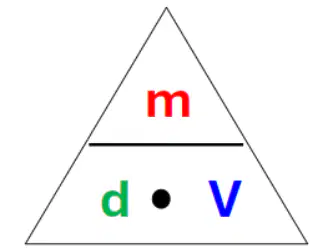
Three liquids--R and S and T--are poured into a graduated cylinder together, however, they separate immediately and form three layers.
Liquid R has a volume of 16mL and a mass of 87g.
Liquid S has a volume of 48mL and a mass of 49g.
Liquid T has a volume of 234mL and a mass of 100g.
Based on this information, describe the order of the liquid layers. The formula for density is d = m/v, where m is mass and v is volume.
Liquid T will be on TOP, liquid R will be in the MIDDLE, liquid S will be on BOTTOM.
Liquid R will be on TOP, liquid S will be in the MIDDLE, liquid T will be on BOTTOM.
Liquid T will be on TOP, liquid S will be in the MIDDLE, liquid R will be on BOTTOM.
Liquid R will be on TOP, liquid T will be in the MIDDLE, liquid S will be on BOTTOM.
Melting point is a property of matter. A large block of ice and a small cube of ice are both allowed to sit in the sunlight and melt. The temperature of each is measured during this process. Which of the following is TRUE?
The large block and the small cube will have the same melting point because they are the same substance.
The large block will have a higher melting point because it is bigger than the small cube.
The small cube will have a higher melting point because it is smaller than the large block.
There is not enough information to know.
Metals have many properties, including the ability to be folded and shaped. What is this property called?
luster
malleability
viscosity
brittleness
When a gas is heated, the molecules move faster causing the volume of the gas to increase while the mass remains the same. How does this affect the density of the gas?
Volume is a physical property and is therefore impossible to change.
Greater volume results in the gas NOT changing density as it heats up.
Greater volume results in the gas becoming MORE dense as it heats up.
Greater volume results in the gas becoming LESS dense as it heats up.

Michelle built a circuit using wires, clips, a battery, and a light bulb. She hooked up various items--like the knife pictured--and recorded which ones caused the light to turn on brightly, dimly, or not at all. What property of matter was Michelle testing?
thermal conductivity
electrical conductivity
malleability
flammability

