
 Worksheets
Topic 4 Test Review
Total questions: 78
Worksheet time: 3hrs 36mins
Write the equation of a line PARALLEL to y = 2x + 3 that passes through the point (3, 1).
y=2x −3
y=2x−5
y=2x + 1
y=−21x+25
Write the equation of a line PARALLEL to that passes through the point (3, 1). y=−25x+10
y=−25x + 6
y =−25x+217
y=52x+6
y=52x+ 8
Write the equation of a line PERPENDICULAR to y = -2x + 1 that passes through the point (2, 3).
y=−21x+21
y=21x+2
y=−2x+7
y=−2x+8
Write the equation of a line PERPENDICULAR to y=31x−9 that passes through the point (-6, 10).
y=31x−9
y=31x+10
y=−3x+6
y=−3x−8
Select the two lines that are parallel.
y=4x−2
y=−41x
y=−4x+1
None are parallel.
Select the two lines that are parallel.
y=5x−3
x + 5y=2
−10y−2x=0
None are parallel
Select the two lines that are perpendicular.
y=4x−2
y=−41x
y=−4x+1
None are perpendicular.
Select the two lines that are perpendicular.
2x+6y=−3
−1.5y+4.5x=6
y=−4x+1
None are perpendicular.
y = -1/3x - 5
y = 1/3x + 2

Two lines that are parallel will have ...
Slope that is opposite reciprocals
No slope
Slope that is the same
none of the above
Two lines that are perpendicular lines have ...
Slope that is opposite reciprocals
No Slope
Slope that is the same
none of the above
m = 4
m = 5/8
What is it's slope?
The following represents slopes of two lines. Which answer choice describes the two lines? m=−31 and m=−31 .
Parallel
Perpendicular
Neither
What is the slope of a line perpendicular to 5?
5
1/5
-1/5
-5
y=−32x+9 y=23x+9
These lines are...
y = x + 9 ?
A(3,-3) & B(1,-1)
A(1,3) & B(-3,5)
Which property says that if m∠1 = m∠3, then m∠1 + m∠2 = m∠3 + m∠2?
Addition Property
Subtraction Property
Multiplication Property
Division Property
Which property justifies that if AB = XY and XY = MN, then AB = MN?
Substitution Property
Reflexive Property
Symmetric Property
Transitive Property
What allows you to say that AM = AM?
Symmetric Property
Reflexive Property
Transitive Property
Identity Property

Which reason justifies the statement below?
AC + CD = AD
Angle Addition Postulate
Addition Property
Segment Addition Postulate
Definition of a Midpoint
Which reason justifies the statement below?
If MN = PQ, then MN ≅ PQ.
Definition of Congruence
Definition of Midpoint
Reflexive Property
Symmeric Property
Which reason justifies the statement below?
If ∠T and ∠U are supplementary, then m∠T + m∠U = 180∘.
Definition of Complementary Angles
Definition of Supplementary Angles
Complements Theorem
Supplements Theorem

Which reason justifies the statement below?
If segment AB ⊥ segment MN, then ∠MNB is a right angle.
Complement Thereom
Definition of Complementary Angles
Definition of Right Anlge
Definition of Perpendicular
Which reason justifies the statement below?
If ∠T and ∠U are complementary, then m∠T + m∠U = 90∘.
Congruent Complements Theorem
Definition of Right Angles
Definition of Complementary Angles
Congruent Complements Theorem

If ∠CAT is a right angle, then m∠CAT = 90°.
Definition of Right Angle
Definition of Perpendicular Lines
Angle Addition Postulate
Segment Addition Postulate
Which property justifies EF = EF?
Substitution Property
Reflexive Property
Symmetric Property
Transitive Property
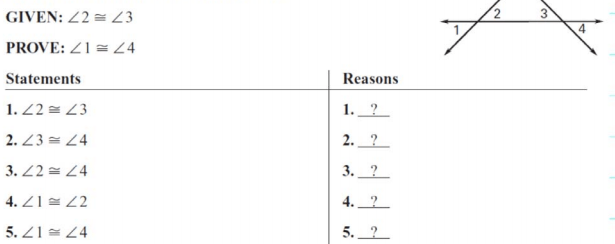
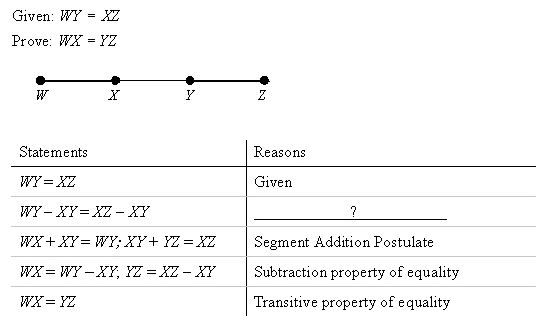

Supply the second reason.
Linear Pair Postulate
Alternate Interior Angles Theorem
Vertical Angles Theorem
Corresponding Angles Postulate

Supply the third reason.
Vertical Angle Theorem
Corresponding Angles Postulate
Alternate Interior Angles Postulate
Same Side Interior Angles Theorem

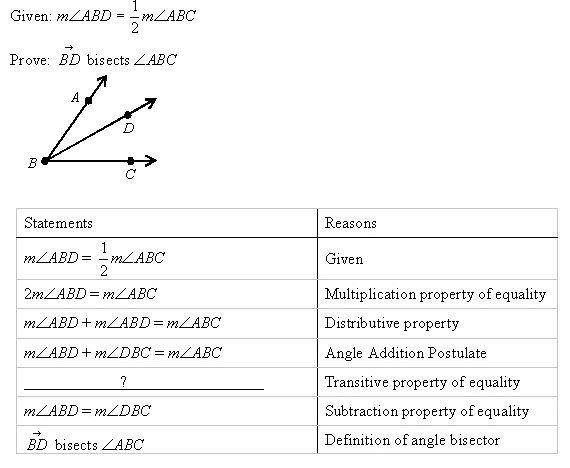
What is the correct reason for line 5 and 6?
5.Transitive Property of equality 6. Substitution
5.Algebra 6.Definition of ≅
5.Substitution 6.Definition of ≅
5.Angle addition postulate 6.Substitution

Which could be used to prove the lines are parallel?
Converse of Alternate Interior Angles Theorem
Converse of Same-Side Interior Angles Theorem
Converse of Corresponding Angles Postulate
Cannot be proved parallel

Which could be used to prove the lines are parallel?
Converse of Vertical Angles
Converse of Alternate Interior Angles Theorem
Converse of Corresponding Angles Postulate
Cannot be proved parallel

No
Yes, Corresponding angles are congruent
Yes, Alternate Interior angles are congruent
Yes, Alternate Exterior angles are congruent

No
Yes, corresponding angles are congruent
Yes, consecutive interior angles are congruent
Yes, Alternate exterior angles are congruent

Converse of Corresponding Angles Postulate
Corresponding Angles Postulate
Converse of Consecutive Interior Angles Theorem
Converse of Alternate Interior Angles Theorem
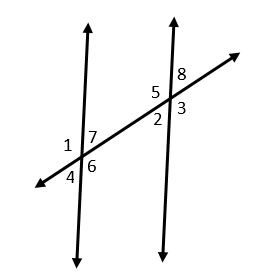
Given the following two parallel lines cut by a transversal.
Which pair of angles represents corresponding angles?
∠1 and ∠6
∠6 and ∠5
∠7 and ∠8
∠4 and ∠8
Given the following two parallel lines cut by a transversal.
Which pair of angles represents alternate interior angles?
∠3 and ∠8
∠7 and ∠2
∠7 and ∠8
∠4 and ∠8

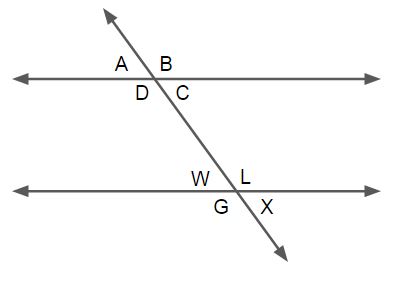

What is the relationship of the angle pair?
vertical
supplementary
complementary
adjacent

What is the relationship of the angle pair?
vertical
supplementary
adjacent
complementary

Identify the angle relationship.
vertical
supplementary
complementary
adjacent

What is the measure of angle b?
39 degrees
51 degrees
129 degrees
83 degrees

Find the value of b.
147 degrees
57 degrees
50 degrees
40 degrees


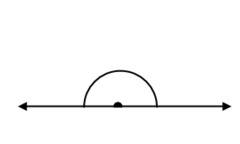
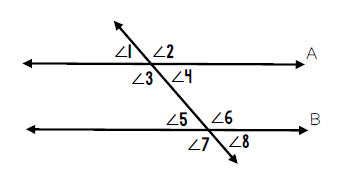
Angle 3 and Angle 6 are examples of which type of angle pair?
Alternate exterior angles
Alternate interior angles
Vertical angles
Corresponding angles

Which choices are two examples of same side interior angles in the diagram:
∠6 and ∠10 and ∠8 and ∠12
∠1 and ∠9 and ∠3 and ∠11

What is the value of x?
30°
35°

∠3 and ∠7 are ___.
Alternate Interior Angles
Alternate Exterior Angles
Same-side Interior Angles
Corresponding Angles
None of these
∠3 and ∠2 are ___.
Alternate Interior Angles
Alternate Exterior Angles
Same-side Interior Angles
Corresponding Angles
None of these
∠7 and ∠5 are ___.
Alternate Interior Angles
Alternate Exterior Angles
Same-side Interior Angles
Corresponding Angles
None of these
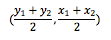
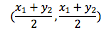
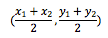
Which of the following is the correct midpoint formula given two endpoints (x1, y1) and (x2, y2)?

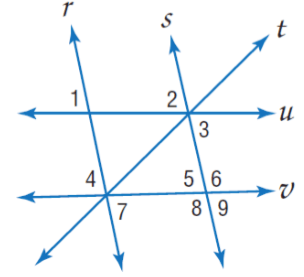
If ∠5 ≌∠7, which of the following can be concluded?
r is parallel to s by converse of Alternate Interior Angles Thm.
u is parallel to v by Converse of Corresponding Angles Thm
s is ⊥ u by Converse of Alternate Interior Angles Thm
v ⊥ r by Converse of Alternate Exterior Angles Thm
Supply the third reason.
Vertical Angle Theorem
Corresponding Angles Postulate
Alternate Interior Angles Postulate
Same Side Interior Angles Theorem

Set up your equation and solve for x.
6x - 5 = 4x + 5; x = 0
6x - 5 + 4x + 5 = 180; x = 18.
6x - 5 = 4x + 5; x = 1
6x - 5 + 4x + 5 = 90; x = 9.

If m∠8 = 9x+15 and m∠6 = 6x +45.
Set up your equation and solve for x.
9x + 15 + 6x +45 = 180; x = 8
9x + 15 = 6x + 45; x =10
9x + 15 + 6x +45 = 90; x = 2
9x + 15 = 6x + 45; x =2

Identify the angle pair.
∠3 and ∠9
Vertical Angles (VA)
Same-Side Interior Angles (SSIA)
Corresponding Angles (CA)
Linear Pair (LP)
Identify the angle pair.
∠13 and ∠14
Alternate-Exterior Angles (AEA)
Same-Side Interior Angles (SSIA)
None
Alternate-Interior Angles (AIA)
Identify the angle pair.
∠13 and ∠16
Vertical Angles (VA)
Same-Side Interior Angles (SSIA)
Corresponding Angles (CA)
Alternate-Interior Angles (AIA)

Identify the angle pair.
∠4 and ∠14
Same-Side Interior (SSIA)
Corresponding (CA)
Alternate Interior (AIA)
Same-Side Exterior (SSIA)

