
 Worksheets
9-26 Parallel Circuit Recap
Total questions: 15
Worksheet time: 2hrs 23mins
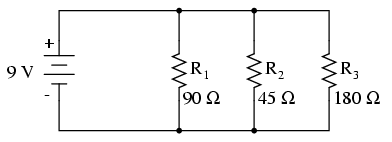

Circuit elements connected in series have the same
voltage drop across them.
current through them.
power dissipation by them.
None of the above.
CIrcuit elements connected in parallel have the same
voltage drop across them.
current through them.
power dissipation by them.
None of the above.
Three 9-ohm resistors connected in parallel have a total resistance of ___.
27 ohms
3 ohms
18 ohms
4.5 ohms
Three 9-ohm resistors connected in series have a total resistance of ___.
27 ohms
9 ohms
3 ohms
18 ohms
4.5 ohms

The equivalent resistance (total resistance) for the circuit shown is ___.
0.333 ohms
3 ohms
31 ohms
10 ohms
6 ohms

If R2>R3>R1. Which resistor will have more voltage across it?
R1
R2
R3
all will have the same voltage
If R2>R3>R1. Which resistor will have more current flowing through it?
R1
R2
R3
all the same current

What is the total resistance in the circuit?
9 Ω
3 Ω
18 Ω
2 Ω
What is the current passing through the 3Ω resistor?
1 A
0.5 A
2 A
9 A
What is the current passing through the 6Ω resistor?
1 A
0.5 A
2 A
9 A
What is the total current of the circuit?
1.5 A
1 A
3 A
2 A

What must ALWAYS be equal for these two resistors?
current
resistance
voltage
amperes
What is one ADVANTAGE to parallel circuits?
If a wire is cut, it's possible for electricity to continue flowing in the other branches
It increases resistance in your circuit
It supplies less voltage to the each part of your circuit
It increases current

