
 Worksheets
Changes in Matter/Law of Conservation
Total questions: 19
Worksheet time: 14mins
What is the difference between a chemical and a physical change?
A chemical change results in the formation of new substances, while a physical change does not.
A physical change results in the formation of new substances, while a chemical change does not.
Both chemical and physical changes result in the formation of new substances.
Neither chemical nor physical changes result in the formation of new substances.
List two examples of physical changes.
Melting of ice and tearing of paper
Burning of wood and rusting of iron
Cooking an egg and baking a cake
Digesting food and rotting fruit
Which of the following are examples of chemical changes?
Melting ice
Melting of ice
Burning of wood
Boiling of water
What happens during a physical change?
New substances formed.
The identity of a substance is changed.
A chemical reaction occurs.
A property of a substance changes, but its identity stays the same.
Which of the following is a chemical change?
water freezing
paper being torn
cake baking
ice melting
Which of the following would cause a chemical change in a piece of wood?
hammering a nail into the wood
burning the wood
painting the wood
sawing the piece of wood in half
Scenario: John is conducting an experiment where he adds a piece of zinc to sulfuric acid. He observes bubbles forming and notices that the beaker feels warm to the touch.
Question: What type of change is John most likely observing, and what evidence supports this conclusion?
Physical change; the formation of bubbles and the warm beaker
Chemical change; the bubbles form and the beaker becoming warm
Physical change; the zinc dissolving and the temperature rising
Chemical change; the zinc dissolving and no temperature change
A physical change is taking place when
a nail rusts.
onions are chopped.
a piece of apple rots.
a piece of paper burns.
Which is a clue that a chemical change has occurred?
A beaker becomes warm when you mix two room-temperature liquids in it.
A liquid forms bubbles when it reaches a high temperature.
Water changes color when food coloring is added.
A car door feels hot when touched in summer.
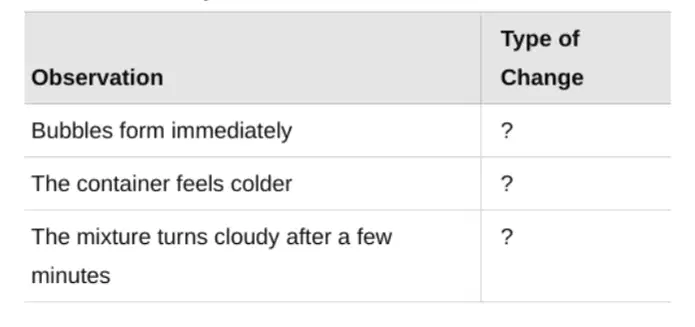
Scenario: A class observes what happens when vinegar is added to baking soda. They record the following data:
Which of the following observations supports the conclusion that a chemical change occurred?
The formation of bubbles and the temperature change both indicate a chemical change.
Only the bubbles indicate a chemical change; the temperature change is a physical change.
The cloudiness indicates a chemical change, while the bubbles and temperature change are physical changes.
None of these observations indicate a chemical change because the color did not change.
The law of conservation of mass states that:
Mass is neither created nor destroyed in a chemical reaction.
Mass can be created and destroyed in a chemical reaction.
Mass is always conserved in physical changes only.
Mass is only conserved in closed systems.
Consider the balanced chemical equation: CH₄(g) + 2O₂(g) → CO₂(g) + 2H₂O(g) Which of the following correctly describes the word description of this equation?
One molecule of methane reacts with two molecules of oxygen to produce one molecule of carbon dioxide and one molecule of water.
One molecule of methane reacts with two molecules of oxygen to produce one molecule of carbon dioxide and two molecules of water.
Two molecules of methane react with one molecule of oxygen to produce two molecules of carbon dioxide and one molecule of water.
Two molecules of methane react with one molecule of oxygen to produce one molecule of carbon dioxide and two molecules of water.

Which of the following correctly describes the word description of this equation?
One molecule of nitrogen reacts with two molecules of hydrogen to produce two molecules of ammonia
Two molecules of nitrogen react with three molecules of hydrogen to produce one molecule of ammonia
One molecule of nitrogen reacts with three molecules of hydrogen to produce two molecules of ammonia
Two molecules of nitrogen react with two molecules of hydrogen to produce three molecules of ammonia
A chemical reaction produces two new substances, and each product has a mass of 25 grams. What was the total mass of the reactants?
25 grams
50 grams
75 grams
100 grams
Which of the following equations proves the Law of Conservation of Mass?
H₂ + 2O → H₂O
2H₂ + 2O → 2H₂O
H₂ + 2O → HO
H + 2O → H₂O

Does the chemical equation 2K + 2Cl₂ → 2KCl represent a balanced reaction?
Yes
No

Consider the chemical reaction below:
Assuming that Magnesium and Oxygen react completely, how many grams of Magnesium Oxide is produced?
3g
12g
15g
27g
Which of these is not evidence that a chemical change may have taken place?
release of heat
formation of precipitate
change in shape
change in color
Which shows an example of physical and then chemical change?
dissolving sugar and grinding pepper
melting butter and mixing flour with salt
roasting meat and freezing leftovers
boiling water and burning gasoline

