
 Worksheets
Solar Collector Orientation Quiz
Total questions: 85
Worksheet time: 48mins
What is the relevance of Building Regulation A?
Fire safety
Electrical safety
Structure
Conservation of fuel and power
Building Regulation G is concerned with which of the following?
Energy efficiency
Hot water safety
Electrical controls
Fire resistance
Which building regulation is concerned with energy efficiency?
L
G
A
P
Which regulation addresses the energy efficiency of the system and the building it is installed in?
A
L
C
P
Where does permitted development apply for a solar thermal system installation?
On a block of flats
In a single-family home
In a commercial building
In a school
What type of system can be installed as a stand-alone in the grounds of a property?
Wind turbine
Solar thermal system
Hydroelectric generator
Geothermal pump
How many stand-alone systems are allowed in the property grounds?
Two
Three
One
Four
What is the maximum area allowed for a stand-alone solar thermal system?
8.0m²
9.0m²
10.0m²
11.0m²
What do the Water Supply (Water Fittings) Regulations 1999 cover?
Electrical installation and maintenance
Potential contamination of potable water
Building construction standards
Fire safety regulations
What is a financial limitation of solar thermal systems?
They have low initial installation costs.
They have no installation costs.
There are high initial installation costs.
They are free to install.
Which regulation addresses sanitation and hot water safety?
G
L
P
A
Which regulation is related to electrical safety?
A
B
L
P
Building Regulation G ensures what within the system?
Electrical safety
Fire resistance
Hot water safety and water efficiency
Soundproofing
Regulation G ensures safety in which area?
Electrical systems
Hot water systems
Structural integrity
Soundproofing
What is the best direction for a solar collector to face in order to achieve maximum efficiency?
North
East
South
West
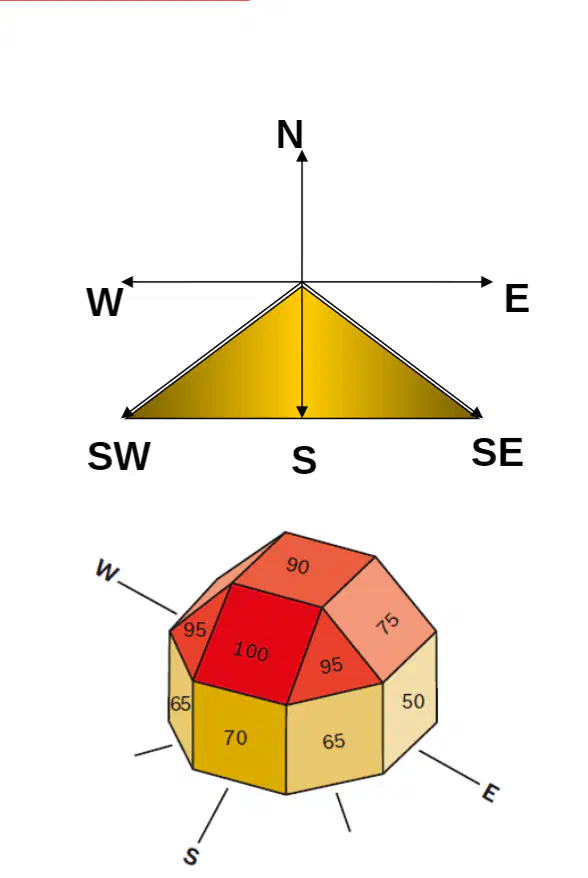
According to the image, what is the efficiency percentage of a solar collector facing due south?
50%
70%
90%
100%
If a solar collector is mounted facing east or west, will it be as efficient as one facing due south?
Yes, it will be equally efficient.
No, it will be less efficient but still suitable.
No, it will not work at all.
Yes, but only during sunrise or sunset.
Why is a compromise angle of 30° commonly used for the tilt angle of solar collector panels?
It allows the panel to be perpendicular to the sun's rays at all times.
It is the angle at which the panel produces the maximum amount of energy.
It is not practical to alter the tilt angle of the collector panel to be perpendicular to the sun's rays throughout the year.
It represents the average latitude of the Earth.
During which season is the sun's elevation higher relative to the horizon?
Spring
Summer
Winter
Autumn
What is the ideal orientation of a solar collector relative to the sun's rays?
Parallel
At a fixed angle of 30°
Perpendicular
At a variable angle depending on the season
When positioning solar collectors, what should you be aware of to prevent shading?
The color of the collectors
Nearby structures, trees, chimneys, and aerials
The brand of the solar panels
The angle of the roof
What is a recommended practice to ensure solar collectors are not shaded during different times of the day?
Installing the collectors at the highest point possible
Visiting the property at different times of the day to note any shadows
Using artificial lighting to compensate for shading
Painting the collectors a reflective color
Before installing a collector panel, what needs to be surveyed?
The electrical systems of the property
The strength and condition of the roof
The plumbing systems within the property
The interior design of the property
Along with the strength and condition of the roof, what additional factor needs to be considered before mounting the collector panel?
The color of the roof
The material of the roof tiles
Additional forces exerted by the wind
The angle of the sun
What determines the area required to mount the collectors for hot water on a roof?
The size of the roof
The number of solar panels available
The demand for hot water based on the number of people living in the property
The color of the roof
According to the rule of thumb, how much collector area is needed per person for hot water demand in a property?
0.5–1m²
1–2m²
2–3m²
3–4m²
What type of properties are not suitable for solar thermal systems?
Properties with gas heaters
Properties using under/over sink water heaters or electric showers
Properties with a large number of occupants
Properties with a dual-coil cylinder
What modification is necessary for a hot water cylinder to be compatible with a solar thermal system?
Why would a property using a combination boiler not be suitable for a solar thermal system?
Because it cannot provide instant hot water
Because it only works with gas heaters
Because it is incompatible with dual-coil cylinders
Because it requires an electric connection
According to Building Regulation A, what additional force must be considered apart from the downward load on a structure?
Wind uplift
Earthquake resistance
Thermal expansion
Snow load
What is the relevance of Building Regulation B concerning fire safety?
Ensures electrical safety
Reduces the fire resistance of the building fabric when holes for pipes are made
Increases the structural integrity of the building
Prevents moisture from entering the building
What does Building Regulation C emphasize for resistance to contaminants and moisture?
Conservation of fuel and power
Sanitation and hot water safety
Reducing the moisture resistance of the building and allowing the ingress of water (rainwater)
Fire safety measures
What aspect of a system is ensured by Building Regulation G?
Electrical safety
Fire safety
Sanitation, hot water safety, and water efficiency
Structural integrity
Building Regulation L is focused on what aspect of a building's performance?
Electrical safety
Fire safety
Conservation of fuel and power
Resistance to contaminants and moisture
What is the main concern of Building Regulation P?
Conservation of fuel and power
Sanitation, hot water safety, and water efficiency
Structure and foundation safety
Electrical safety
Permitted development for a solar thermal system installation applies in which of the following scenarios?
Inside a commercial office building
On a block of flats
Underneath a bridge
On a mobile home
Which of the following is NOT a condition where permitted development for a solar thermal system is applicable?
In the grounds of a property or block of flats
As a stand-alone system in the grounds of a property or block of flats
On a block of flats
When specific criteria are not met in each installation
How far can a building-mounted solar thermal system protrude above a wall or roof line according to the planning permission criteria?
It must not protrude more than 200mm
It must not protrude more than 300mm
It must not protrude more than 400mm
It must not protrude more than 500mm
What is the maximum height allowed for a stand-alone solar thermal system?
3.0m
4.0m
5.0m
6.0m
What is the maximum area permitted for a stand-alone solar thermal system?
8.0m²
9.0m²
10.0m²
11.0m²
How close to the property boundary can a stand-alone solar thermal system be installed?
3.0m
4.0m
5.0m
6.0m
What is the maximum length that no dimension of a stand-alone solar thermal system can exceed?
2.0m
2.5m
3.0m
3.5m
Can a solar thermal system be installed on or in the grounds of a listed building without any special considerations?
Yes, it can be installed without restrictions
No, it cannot be installed on or in the grounds of a listed building
Yes, but only with permission from the local authority
No, unless it is within a conservation area
What is the purpose of The Water Supply (Water Fittings) Regulations 1999?
To regulate the temperature of hot water systems
To cover the potential contamination of wholesome potable water within the property
To establish guidelines for waste water treatment
To set standards for plumbing materials and products
What does BS7671 cover?
Health and safety practices in plumbing
Electrical installation and maintenance within the system of controls and circulators
Water conservation techniques
Gas safety regulations
What is one of the benefits of solar thermal systems?
Increase in CO2 emissions from the property.
Increase in energy costs for the customer.
These systems are high maintenance.
Reduction of CO2 emissions from the property.
How do solar thermal systems affect the energy rating of a property?
They have no effect on the energy rating of the property.
They worsen the energy rating of the property.
They improve the energy rating of the property.
They only change the energy rating during summer months.
What is a maintenance characteristic of solar thermal systems?
They require daily maintenance.
They are low maintenance.
They need to be replaced every year.
They are only maintained by specialized personnel from the manufacturer.
What is a financial benefit of using solar thermal systems for the customer?
Increase in property taxes.
Reduction in energy costs.
Higher insurance premiums.
Additional costs for solar panel disposal.
What is one of the limitations of solar thermal systems regarding compatibility with existing systems?
The system is always compatible with existing systems.
The system may not be compatible with the existing system in the property.
The system improves the efficiency of existing systems.
The system replaces all functions of the existing systems.
How does the demand for hot water in winter affect solar thermal systems?
The system provides excess hot water in winter.
The system's hot water supply is unaffected by seasons.
The system may not meet demand for hot water in winter.
The system only works in winter.
What is a financial consideration when installing solar thermal systems?
There are no installation costs.
There are moderate initial installation costs.
There are high initial installation costs.
The installation costs decrease over time.
What additional requirement may be necessary for a solar thermal system to function effectively?
The system requires no additional heat sources.
The system functions solely on solar power.
The system requires an auxiliary heat source.
The system requires a cooling source.
What is a requirement for the building that a heat pump supplies in terms of insulation?
The building must have minimal insulation.
The building must be well insulated to allow the pump to work effectively.
The building should have no insulation for the heat pump to function.
Insulation is not necessary for heat pumps.
What provision must be made for the installation of a GSHP (Ground Source Heat Pump)?
Provision for additional heating sources.
Provision for solar panel installation.
Provision will have to be made for machinery to access the property to dig the trench.
Provision for water conservation systems.
What does Building Regulation A pertain to in the context of compliance with building regulations for GSHP?
Fire safety
Structure
Electrical safety
Conservation of fuel and power
Building Regulation B is relevant to which aspect of building safety?
Resistance to sound
Fire safety
Sanitation, hot water safety, and water efficiency
Resistance to contaminants and moisture
Which Building Regulation covers the resistance to contaminants and moisture?
C
E
G
L
What is the focus of Building Regulation E?
Electrical safety
Fire safety
Resistance to sound
Conservation of fuel and power
Building Regulation G ensures what within the system?
Electrical safety
Fire safety
Hot water safety and water efficiency
Conservation of fuel and power
What is the relevance of Building Regulation L?
Structure
Fire safety
Electrical safety
Energy efficiency of the system and the building
Which Building Regulation is concerned with the installation and testing of electrical controls and components in the system?
A
C
L
P
Is the installation of a GSHP usually considered to be a permitted development that does not require planning permission?
Yes, it is always considered a permitted development.
No, it always requires planning permission.
Yes, but it is subject to local authority criteria.
No, it is never considered a permitted development.
Before installing a GSHP, what is recommended to check with the local authority?
If there are any discounts available.
If there are any criteria that need to be met.
If the local authority can provide the GSHP.
If the installation requires a special license.
What does the BS671 standard cover?
The installation and maintenance of gas safety controls
The installation and maintenance of the electrical controls and circulators
The regulations for water supply systems
The health and safety guidelines for plumbing
What do F-gas regulations pertain to?
The installation of boilers and heating systems
The maintenance of electrical wiring in domestic heating
Fluorinated gas used in refrigeration pipework that is under strict laws
The safety standards for domestic gas appliances
What is one of the benefits of GSHP (Ground Source Heat Pumps) listed in the learning material?
High maintenance costs
Short life span
High efficiency
Requires fuel storage
According to the learning material, how does a GSHP compare to an ASHP (Air Source Heat Pump)?
Less efficient than an ASHP
Same efficiency as an ASHP
More efficient than an ASHP
GSHP is a type of ASHP
Which of the following is a benefit of GSHPs during the summer period?
Increased energy bills
Offers heating only
Offers cooling
Requires combustion in appliances
What is a benefit of GSHPs related to environmental impact?
Increases CO2 emissions
No reduction in energy bills
Reduction of energy bills and CO2 emissions
Requires frequent fuel deliveries
What is an advantage of GSHPs regarding the maintenance?
Higher maintenance costs
Lower maintenance costs
Requires specialized maintenance daily
Maintenance costs are not mentioned
What is one of the limitations of Ground Source Heat Pumps (GSHP) mentioned in the learning material?
Low installation costs
Small area of land required
Design and installation are complex
Works efficiently with any existing heating system
Compared to Air Source Heat Pumps (ASHP), Ground Source Heat Pumps (GSHP) are:
Less expensive to install
The same price to install
More expensive to install
Not comparable in terms of installation costs
Which of the following is a potential environmental concern associated with Ground Source Heat Pumps (GSHP)?
They are powered by renewable energy sources
They increase air quality
Refrigerants used are harmful to the environment
They reduce greenhouse gas emissions
Why might Ground Source Heat Pumps (GSHP) be unlikely to work efficiently?
When paired with solar panels
With an existing heating system
In new construction buildings
When installed in a small area
Why must the property be well insulated for an ASHP to work effectively?
To reduce the noise from the unit
To allow the unit to work effectively
To prevent water from entering the unit
To enhance the visual appeal of the unit
What is necessary to have around the ASHP unit?
Decorative plants
Good airflow
A water source
Electrical outlets
What is the ideal system to connect an ASHP to?
A solar panel system
A central air conditioning system
An underfloor heating system
A portable heater
Where should there be sufficient space to mount the ASHP unit?
Inside the property
On the roof
Outside or on a wall
In a basement
What does Building Regulation A concern?
Fire safety
Structure
Electrical safety
Conservation of fuel and power
Which Building Regulation is related to the resistance to contaminants and moisture?
B
C
E
G
Building Regulation E is about resistance to what?
Sound
Fire
Contaminants and moisture
Structure
What is the relevance of Building Regulation B?
Which Building Regulation covers the conservation of fuel and power?
A
G
L
P
What is the focus of Building Regulation P?
Resistance to sound
Electrical safety
Fire safety
Structure

