
 Worksheets
Chapter 2 Properties of Matter - Review
Total questions: 35
Worksheet time: 18mins
Which of the following is a mixture?
air
gold
hydrogen
nitrogen
Which of the following describes a substance that cannot be decomposed into simpler substances?
a mixture
an element
composed of multiple types of atoms
both b and c
Which of the following is the chemical symbol for silver?
Ag
Si
Sl
Sg
Why is water considered a compound?
It consists of two or more elements chemically combined.
It can be separated into hydrogen and oxygen through chemical reactions.
It is composed of identical water molecules.
both a and b
Which of the following statements is true about mixtures?
can be separated into components by physical means
always have a uniform composition
are pure substances
both a and c
Which of the following is an example of a colloid?
fog
salt water
pure gold
granite
Before pouring a carton of almond milk, you see a note that says “shake well before use.” The almond milk is most likely a
solution.
pure substance.
colloid.
suspension.
Which of the following has the highest viscosity?
oil
milk
water
syrup
Which of the following materials is ductile and a good conductor of heat?
plastic
glass
a metal
rubber
Which of the following materials is useful for making molds because it has a low melting point?
wood
metal
clay
wax
Which technique is used to separate components of a liquid mixture that cannot be separated by filtration?
evaporation
distillation
decantation
centrifugation
Which of the following is an example of a chemical change? a. melting ice b. dissolving sugar in water c. baking a cake d. cutting paper into pieces
melting ice
dissolving sugar in water
baking a cake
cutting paper into pieces
What characteristic does a highly reactive substance exhibit?
It rapidly forms compounds with other elements.
It remains stable in all conditions.
It has a low melting point.
It is inert and unreactive.
Which of the following processes leads to the formation of a precipitate?
Vinegar is mixed with baking soda.
Milk is added to lemon juice.
Ice melts in the sun.
Water evaporates from a puddle.
Which of the following indicates a chemical reaction has occurred? a. Water freezes into ice. b. A metal rusts over time. c. Sugar dissolves in water. d. Ice melts into water.
Water freezes into ice.
A metal rusts over time.
Sugar dissolves in water.
Ice melts into water.
Complete each statement on the line provided. Pure substances are either ________________ or ________________.
elements or compounds
mixtures or solutions
atoms or molecules
solids or liquids
Complete each statement on the line provided. The symbols for elements have either ________________ or ________________ letters.
uppercase or lowercase
numeric or symbolic
bold or italic
large or small
Complete each statement on the line provided. A compound can be made from two or more elements or other ________________ joined together in a fixed composition.
compounds
molecules
atoms
mixtures
Fill in the blank: Iron tends to rust because it is a ________________ element when exposed to oxygen.
reactive
inert
stable
neutral
What methods can be used to alter the characteristics of a mixture?
By separating the components
By applying heat or cooling
By mixing or agitating
All of the above
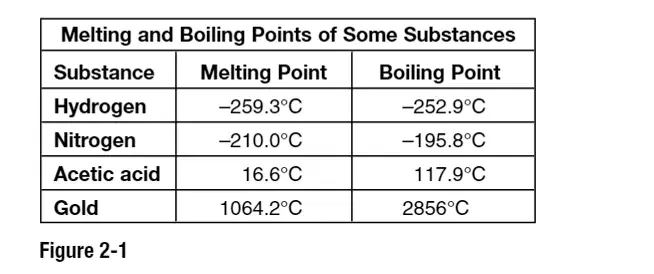
Based on the information in Figure 2-1, which substances would be solids at 10.0°C?
Substance A and B
Substance C and D
Substance E and F
Substance G and H
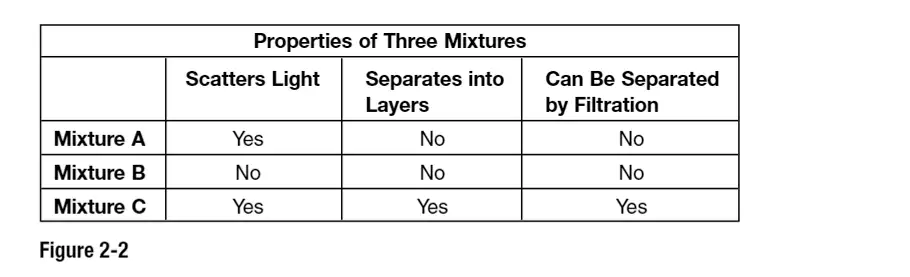
Based on the data in Figure 2-2, Mixture C is a:
Homogeneous mixture
Heterogeneous mixture
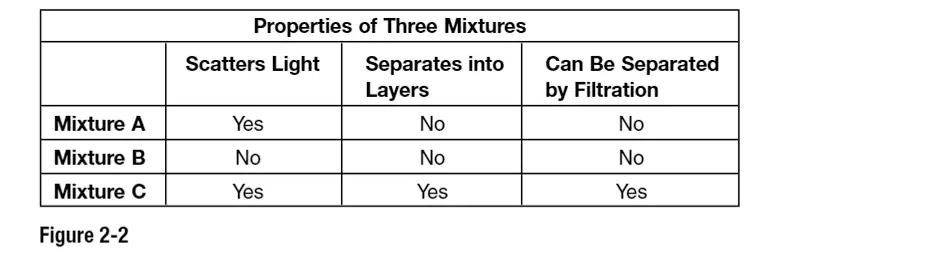
Using the table in Figure 2-2 to answer each question. Which of the mixtures in Figure 2-2 is a solution?
Mixture A
Mixture B
Mixture C
Mixture D
Changes in temperature usually affect the viscosity of a liquid in which way?
Viscosity increases with an increase in temperature
Viscosity decreases with an increase in temperature
Viscosity remains constant with temperature changes
Viscosity fluctuates unpredictably with temperature changes
Which of the following is an example of a physical change that can be reversed and an example of a physical change that cannot be reversed?
Melting ice and cutting paper
Boiling water and burning wood
Freezing water and breaking glass
Dissolving sugar in water and rusting iron
What type of change occurs when a banana turns brown?
Physical change
Chemical change
No change
Nutritional change
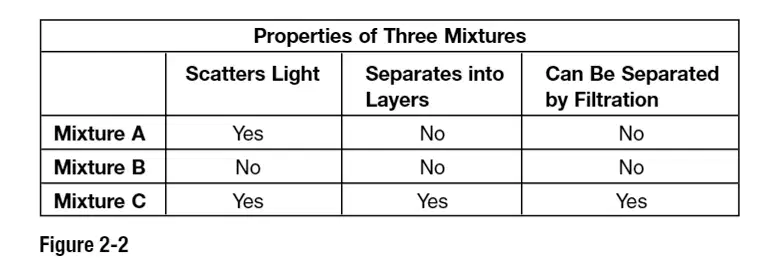
Using the table in Figure 2-2, to answer each question. Write the answers on a separate sheet of paper. Which of the mixtures in Figure 2-2 is a colloid? Explain how you know.
Mixture A
Mixture B
Mixture C
Mixture D
Rank the mixtures in Figure 2-2 in order of the size of their largest particles, starting with the mixture with the smallest particles.
Mixture A, Mixture B, Mixture C
Mixture B, Mixture A, Mixture C
Mixture C, Mixture B, Mixture A
Mixture A, Mixture C, Mixture B
Mixture B in Figure 2-2 cannot be separated by filtration because:
It is a homogeneous mixture.
It contains large particles.
It is a suspension.
It is a colloid.
Compare the properties of water to the properties of the elements it contains.
Water is a liquid at room temperature, while hydrogen and oxygen are gases.
Water is a gas at room temperature, while hydrogen and oxygen are liquids.
Water is a solid at room temperature, while hydrogen and oxygen are gases.
Water is a liquid at room temperature, while hydrogen and oxygen are solids.
What method can be used to determine the authenticity of a gold bar without causing any damage?
Density
Color
Weight
Size
Suppose you want to separate the leaves, acorns, and twigs from a pile of soil. Which process would you use and why?
Filtration, because it separates solid particles from liquids or gases.
Distillation, because it separates substances based on boiling points.
Filtration, because it separates solid particles from other solids.
Distillation, because it separates solid particles from liquids.
Rust forms in steel tanks that hold seawater in ships because of the presence of oxygen and moisture. How can nitrogen be used to reduce rust in these tanks?
By creating a protective layer over the steel
By displacing oxygen and moisture
By reacting with seawater to form a barrier
By increasing the temperature inside the tank
Suppose you heat a liquid and then gas bubbles are produced. With no other evidence, can you tell if a physical change or chemical change is occurring?
Yes, it is definitely a chemical change.
Yes, it is definitely a physical change.
No, it is not possible to determine the type of change.
Yes, it is both a physical and chemical change.
Mixtures are different than pure substances because mixtures-
have lower boiling points
can be separated physically
are less dense than pure substances
contain only one type of atom

