
 Worksheets
Winds and Weather Instruments
Total questions: 25
Worksheet time: 6hrs 15mins
Name
Class
Date
1.
Which instrument measures how much precipitation has fallen?
a)
Rain Gauge
b)
Anemometer
c)
Thermometer
d)
Weather Balloon
2.
Which instrument measures the temperature of the air?
a)
Thermometer
b)
Rain Gauge
c)
Anemometer
d)
Hygrometer
3.
Which instrument measures air pressure
a)
Anemometer
b)
Barometer
c)
Hygrometer
d)
Wind Vane
4.
Which instrument measures wind speed?
a)
Anemometer
b)
Barometer
c)
Hygrometer
d)
Wind Vane
5.
Which instrument shows how much water vapor or moisture is in the air?
a)
Anemometer
b)
Barometer
c)
Hygrometer
d)
Wind Vane
6.
Which instrument shows the direction that wind is coming from?
a)
Doppler Radar
b)
Weather Satelite
c)
Wind Vane
d)
Hygrometer
7.

What instrument is this?
a)
Wind Vane
b)
Weather Satellite
c)
Barometer
d)
Anemometer
8.
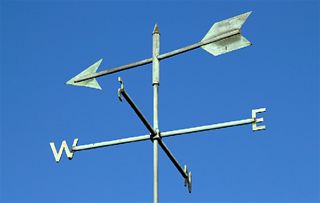
From which direction is the wind blowing in this picture?
a)
north
b)
east
c)
south
d)
west
9.
Which instrument is used to measure air pressure?
a)
thermometer
b)
anemometer
c)
barometer
d)
weather vane
10.
How does wind move?
a)
From areas of low pressure to areas of high pressure.
b)
From areas of high pressure to areas of low pressure.
c)
From areas of high temperature to areas of low tempreture
d)
From areas of low temperature to areas of high temperature
11.
What are the two classifications of wind?
a)
Local Winds and Global Winds
b)
Global and Land Wind
c)
Local and Coriolis Wind
d)
Tradewinds and Sea Winds
12.
When the water is warmer than the land, in the evening, what kind of breeze do you get?
a)
Sea Breeze
b)
Land Breeze
13.
What is the initial source for global winds and convection in the atmosphere?
a)
continental deflection
b)
the rotation of the Earth
c)
Moon's gravity
d)
unequal heating of the Earth by the sun
14.
In which direction do prevailing westerlies flow?
a)
from east to west
b)
from west to east
c)
from north to south
d)
from south to north
15.
Which global winds are found at the poles?
a)
Polar Westerlies
b)
Prevailing Easterlies
c)
Polar Easterlies
d)
Trade Winds
16.
Which term best describes how the earth's land and atmosphere are heated?
a)
Evenly
b)
Unevenly
c)
Circularly
d)
Kinetically
17.
When Earth's rotation causes the wind to curve
a)
cloudy
b)
Coriolis effect
c)
high pressure
d)
low pressure
18.

Why does warm air rise?
a)
Warm air is more dense than cooler air.
b)
Warm air has more pressure than cooler air.
c)
Warm air is less dense than cooler air.
d)
Warm air has a higher dew point than cooler air.
19.
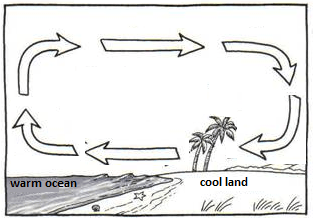
What kind of breeze is this and when would it form?
a)
Land breeze - daytime
b)
Land breeze - nighttime
c)
Sea breeze - daytime
d)
Sea breeze - nighttime
20.
Air always blows from
a)
High pressure to low pressure
b)
Hot air to cold air
c)
low pressure to high pressure
d)
East to west
21.
The Coriolis effect causes ___________.
a)
the Earth to rotate on its axis
b)
earthquakes
c)
global winds to move in a curved path instead of a straight line
d)
the Earth to revolve around the sun
22.
Which global winds are found at the poles?
a)
Polar Westerlies
b)
Prevailing Easterlies
c)
Polar Easterlies
d)
Trade Winds
23.
The tropical winds running that blow from east to west near the Equator are called the
a)
subtropical westerlies
b)
polar westerlies
c)
trade winds
d)
polar winds
24.
Why does a sea breeze at the beach keep you cool and comfortable during the hottest part of the day?
a)
warm air rising over land lets cooler air from the ocean blow in
b)
a storm is approaching
c)
cool air rising over land lets warm air from the ocean blow in
d)
Similarities in temperature between land and water
25.
Water is _______ than land during the day, causing a sea breeze.
a)
more inviting
b)
larger
c)
cooler
d)
warmer
100 %

