
NEW
Font size
 Worksheets
4th Grade Unit 2 Social Studies
Total questions: 20
Worksheet time: 20mins

Based on the map above, the Mississippi River runs along the eastern edge of which region?
the Great Plains
the Appalachians
the Great Lakes
the Colorado Plateau
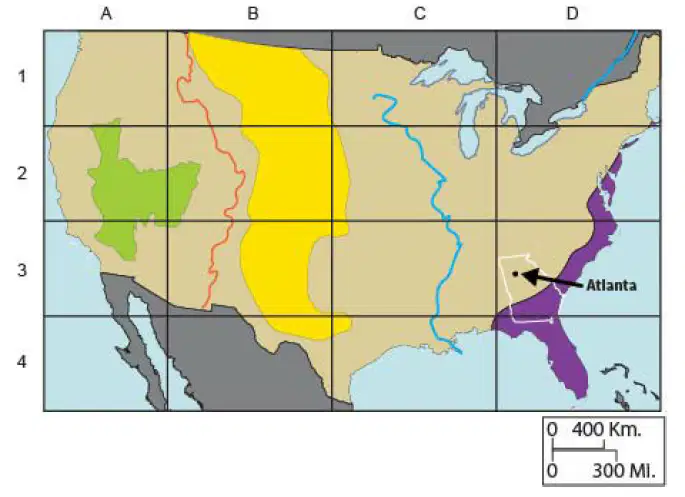
If a person is in Atlanta, Georgia, in which direction would he or she need to travel to visit the Great Plains?
east
north
south
west
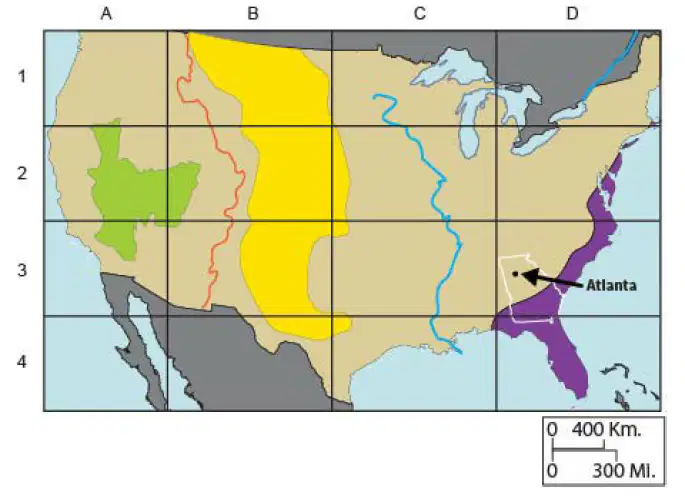
If a person is in Atlanta, Georgia, in which direction would he or she need to travel to visit the Gulf of Mexico?
east
north
south
west
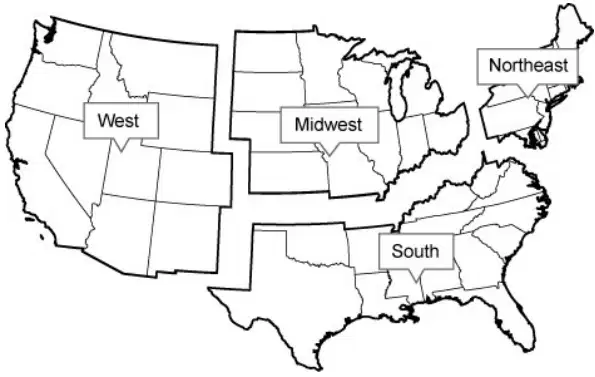
Use the map showing illustrating four regions in the United States to answer any questions that follow. Look at the map. Then answer the question that follows. Through which regions does the Mississippi River flow?
the Midwest and South
the Northeast and Midwest
the West and Midwest
the South and Northeast
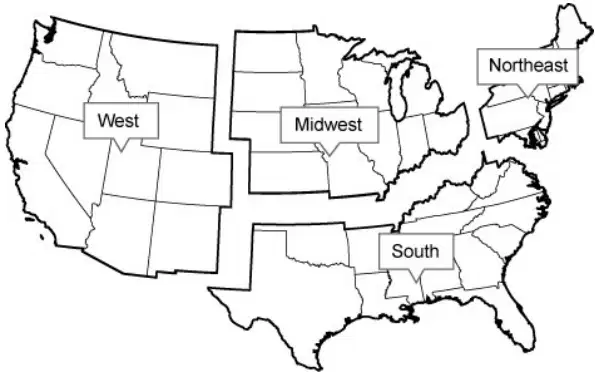
Look at the map. Then answer the question that follows. Which region is bordered by the Gulf of Mexico?
the Midwest
the Northeast
the South
the West
How did colonists protest unfair British rules before the start of the American Revolution?
They attacked Britain's colonies in Canada.
They destroyed British forts and warships.
They refused to buy goods made in Britain.
They sailed to Britain to vote in Parliament.
Which patriotic phrase was inspired by acts of Parliament in the 1750s and 1760s?
"With freedom comes responsibility."
"The time is always right to do what is right."
"A house divided against itself cannot stand."
“No taxation without representation.”
What led to the first meeting of the Sons of Liberty?
the passage and enforcement of the Stamp Act
the signing of the Declaration of Independence
the Battles of Lexington and Concord
the Boston Tea Party protest
Which of the following BEST describes the events that led to the Boston Tea Party?
Colonists were forced to only buy tea from one company and taxed heavily for it.
The British did not allow colonists to sell tea to France or other European powers.
The British refused to sell tea to colonists because of shortages in Great Britain.
Colonists decided to stop selling tea to the British because they were not paid fairly.
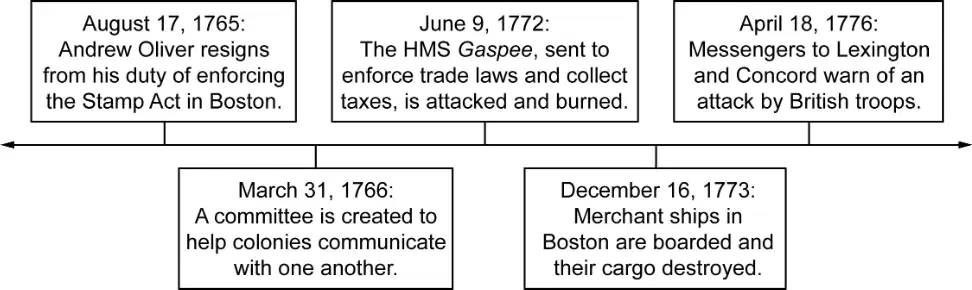
Use the timeline to answer the question. Which person or group was MOST responsible for the events on the timeline?
the Loyalists
Paul Revere
Samuel Adams
the Sons of Liberty
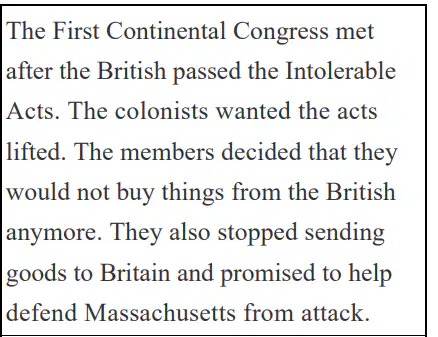
Read the information in the box and answer the question. What was the MOST important decision made by the First Continental Congress?
The decision to help defend Massachusetts, because it drew all of the colonies into the Revolutionary War.
The decision not to buy British goods, because it caused the British to stop buying colonial goods.
The threat to send a militia to Massachusetts, because it led the British to lift the Intolerable Acts.
The threat to stop sending goods to Britain, because it made Britain give the colonies their independence.
In what way did geography play a major role in the outcome of the American Revolution?
The Americans allied with settlers in the Spanish North American colonies, and they helped Americans evade British blockades.
Most major battles were fought at sea, which gave the British an advantage because of their large and powerful navy.
Fearing that the Americans would want to expand, the French allied with the British to protect the French North American colonies.
American commanders were more familiar with the land where battles were fought, which gave them an advantage over the British.
In the Battle of Concord, how did Concord's physical geography affect the strategy of the American revolutionaries?
They used the ravines to move quickly and stay ahead of the British.
They destroyed the bridge and forced the British to spend time and energy crossing the river.
They formed large battle lines in fields and used fences as cover against British fire.
They hid on high ground and surprised the British as they crossed the river.
Which is NOT a way that British soldiers were affected by physical geography at the Battle of Saratoga?
They suffered frequent injuries from the loose rocks on the bluff.
They had to build and guard bridges to move supplies across streams.
The thick mud left by the rain reduced their willingness and ability to fight.
The dense forests and ravines slowed their movement and communication.
How did the British try to use the geography of New York to help them invade Albany before being stopped at the Battle of Saratoga?
They used rivers to quickly move troops and supplies.
They traveled in forests to hide their movements.
They built strong forts on top of mountains and cliffs.
They camped in swamps that the colonists would not cross.
How did the geography surrounding Lexington and Concord affect the British after the battles that took place there?
The British were able to quickly regroup on top of a hill before attacking colonial troops again from above.
The British defeated the colonists by attacking them with cannons mounted on British warships in a nearby harbor.
The British lost a lot of troops because colonists used the forests as cover to attack them as they retreated.
The British outnumbered the colonists because they were joined by troops sailing up the Concord River.
Why were the British unable to send more soldiers to aid General Charles Cornwallis at the Battle of Yorktown?
The Royal Navy was busy defending Great Britain from Spanish attacks.
The city was far from the coast and the Royal Navy could not reach them.
The French Navy defeated the Royal Navy and took control of the York River.
The US Navy sailed along the Atlantic Coast and attacked all Royal Navy ships.
Why did American colonists burn supplies and crops before the Battle of Saratoga?
The smoke helped them hide in order to attack the British.
They were able to retreat while the smoke blinded the British.
It signaled American troops in the area to come to their aid.
It forced the British to rely on long supply lines from Canada.
The St. Lawrence River connects the Great Lakes to which major body of water?
the Mississippi River
the Arctic Ocean
the Atlantic Ocean
the Rio Grande
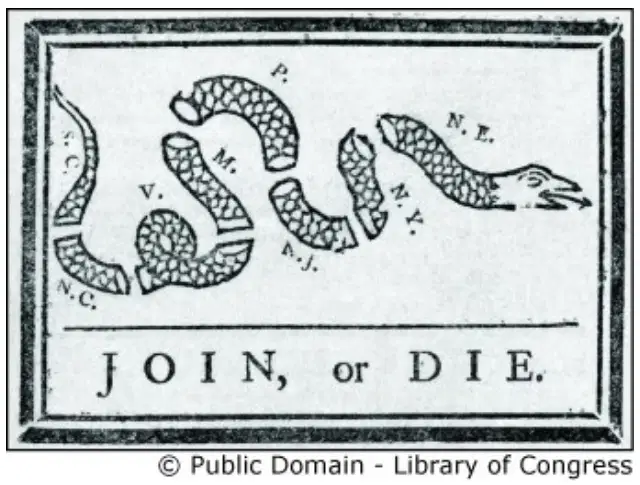
Use the political cartoon made by Benjamin Franklin to answer the question. What message was this political cartoon used to send when it was made popular during the American Revolution?
The colonies needed more soldiers to make their army stronger.
The colonies had to unite together in order to win their independence.
Britain was ready to attack the colonies like a deadly snake.
Britain would be easier to defeat if the colonies fought separately.

