
 Worksheets
Congressional Debate Robert's Rules and Motions
Total questions: 15
Worksheet time: 16mins
Match Like Terms with their Examples:
- "I move to open debate on a bill to support Alaskan drilling"
- The motion used to bring any bill or resolution to the floor for debate.
- The process repeated after legislation is tabled or brought to the previous question.
- The order of legislative debate is determined by the docket unless the rules are suspended
Main Motion
- Example: “I move to previous question.”
- When the motion passes the legislation is then voted on
- requires a verbal second and a 2/3 vote
Previous Question
- Example: “I move to table this piece of legislation”
- It requires a verbal second and a majority vote.
- To take legislation off the table one must move to reconsider the tabled legislation. This should be executed just like a main motion.
- To remove a bill from the table you need a verbal second and a majority vote.
Tabling or Table the Bill
- Examples:-“I move to suspend the rules and consider legislation in the order thischamber sees fit”- “I move to suspend the rules to allow a one minute question and answer period after each non authorship three minute speech.”
- Should not be done lightly
- Common uses are to abandon the docket and bring legislation to the floor early, and to extend question periods.
- Requires a verbal second and a 2\3 majority of the chamber to pas
Suspending the Rules
- Examples:- "I move to amend the resolution by inserting the word 'very' before theword 'good;'" - "I move to insert 'very' before 'good.'"
- The full text of an amendment must be submitted to the P.O. before the motion to amend is made.
- Clearly identify what words should be removed replaced or added.
- Motions to amend require a 1\3 second to open debate on an amendment.
Amendments
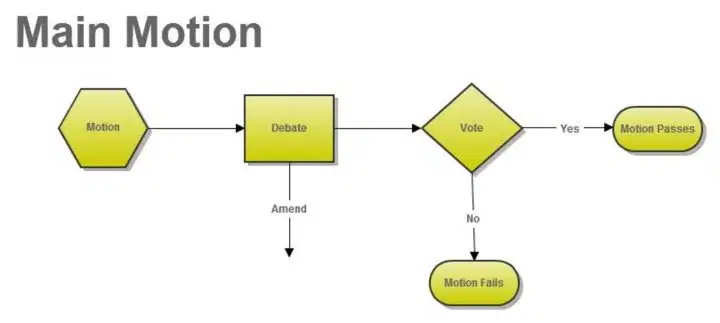
In a Congressional Debate chamber, a "Main Motion..."
Introduces business to the chamber
Means to bring to a vote. It is the vote to close the debate.
allows the chamber to move forward with other business without bringing the legislation to an immediate vote.
changes some standing rule of the congress.
changes some important aspect of the bill/legislation

In Congressional Debate, "I motion/move to Previous Question.."
introduces business to the chamber
means to bring to a vote. It is the vote to close debate.
allows the chamber to move forward with other business without bringing the legislation to an immediate vote.
changes some standing rule of the congress.
changes some important aspect of a bill/legislation/resolution.

In Congressional Debate, "I motion/move to table.." or "Tabling"
introduces business to the chamber
means to bring to a vote. It is the vote to close debate.
allows the chamber to move forward with other business without bringing the legislation to an immediate vote.
changes some standing rule of the congress.
changes some important aspect of a bill/legislation/resolution.

In Congressional Debate, "I motion/move to suspend the rules." or "Suspending the Rules"
introduces business to the chamber
means to bring to a vote. It is the vote to close debate.
allows the chamber to move forward with other business without bringing the legislation to an immediate vote.
changes some standing rule of the congress.
changes some important aspect of a bill/legislation/resolution.
In Congressional Debate, "I motion/move to amend the resolution/bill..." or "Amendments"
introduces business to the chamber
means to bring to a vote. It is the vote to close debate.
allows the chamber to move forward with other business without bringing the legislation to an immediate vote.
changes some standing rule of the congress.
changes some important aspect of a bill/legislation/resolution.
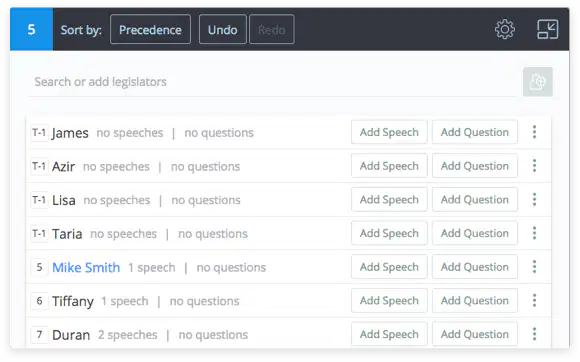
In Student Congress, what term refers to the system used to ensure that speakers who have spoken less or not at all are given priority to speak?
Amendment
Precedence
Docket
Authorship Speech
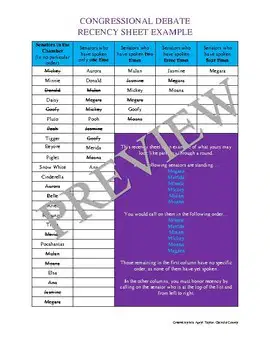
In NSDA Student Congress, what term refers to the system that gives priority to speakers who have spoken least recently during a session?
Adjournment
Resolution
Precedence
Recency
In a Congressional Debate, what is the purpose of a Point of Order?
To introduce new business to the chamber
To correct a procedural error
To bring a motion to a vote
To amend a bill or resolution
In NSDA Student Congress, what is the term for a speech given by the author of a bill or resolution?
Authorship Speech
Amendment Speech
Closing Speech
Rebuttal Speech
When writing an effective speech, it is important to:
Repeat the same point in different ways to fill time
Use a sophisticated vocabulary that the general audience may not understand
Start with a strong opening to grab the audience's attention
Avoid personal anecdotes as they are seen as unprofessional
Which of the following is NOT a recommended practice in public speaking?
Making eye contact with different parts of the audience
Using gestures to emphasize points
Reading directly from notes without looking up
Modulating your voice to maintain interest
How can a speaker effectively conclude their speech?
By introducing a new topic to leave the audience thinking
By summarizing the key points and restating the call to action
By abruptly ending to create a dramatic effect
By apologizing for any mistakes made during the speech
In the context of debate, why is evidence important?
It is only necessary if the audience is not familiar with the topic
It adds length to the speech without adding value
It supports the speaker's arguments and adds credibility
Evidence is less important than the speaker's charisma
Which of the following debate techniques is effective for refuting an opponent's argument?
Ignoring the argument and restating your own points
Attacking the opponent's character instead of their argument
Providing evidence and logical reasoning to counter the argument
Speaking louder than the opponent to drown out their points

