
 Worksheets
Changes of State Quiz
Total questions: 20
Worksheet time: 10mins
What is thermal energy?
The energy stored in a solid
The total kinetic and potential energy of all particles
The energy of motion
The energy that cools substances
What happens to particles during melting?
They lose thermal energy
They gain thermal energy
They stop moving
They become solid
What does a thermometer measure?
Pressure
Mass
Volume
Temperature
What happens to the temperature of a substance when it is heated?
It stays the same
It increases
It decreases
It becomes solid
What is the melting point of silver?
100℃
0℃
1538℃
961.8℃
What happens to particles when a substance cools?
They gain energy
They move faster
They move slower
They stop moving
What is the relationship between temperature and kinetic energy?
Temperature does not affect kinetic energy
Kinetic energy is always constant
Higher temperature means higher kinetic energy
Higher temperature means lower kinetic energy
What happens to water molecules at the melting point?
They change to gas
They freeze
They vibrate faster
They stop moving

What is the process called when ice turns back into liquid water?
Evaporation
Melting
Freezing
Condensation
What is the arrangement of particles in a solid?
Randomly arranged, far apart
Regularly arranged, close together
Randomly arranged, close together
Regularly arranged, far apart
Which of these are properties of solids?
Can flow and take the shape of their container
Fixed shape and cannot flow
Can flow and spread out to completely fill their container
Can be compressed
How would you describe the movement of particles in a solid?
Free to move around each other
Free to move quickly and randomly in all directions
Vibrate about a fixed position
Do not move at all
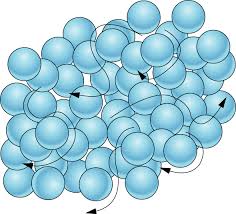
Which state of matter is shown?
Solid
Liquid
Gas
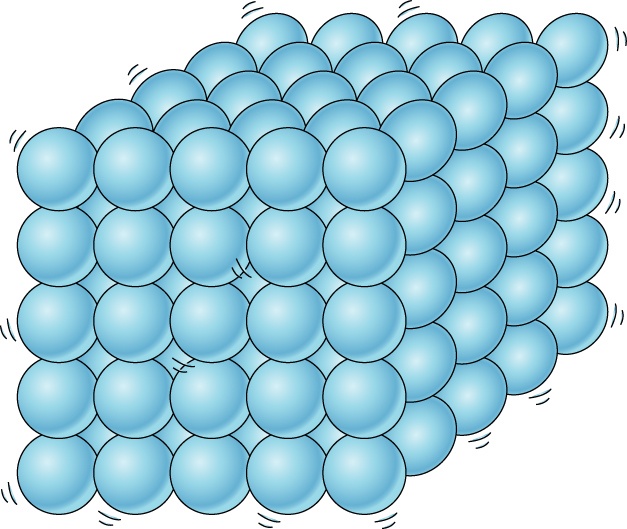
Which state of matter is shown?
Solid
Liquid
Gas
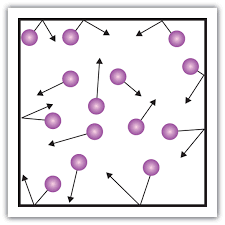
Which state of matter is shown?
Solid
Liquid
Gas
Can melting points be used to identify a substance?
No, because melting points are the same for all substances
Yes, but only in combination with other properties
Yes, melting points can be used to identify a substance
No, melting points are irrelevant to the identification of substances
Solid to liquid
Evaporation
Condensation
Melting
Freezing
What happens to the internal energy when a solid is heated?
It decreases
It fluctuates
It remains the same
It increases
What type of energy do particles have due to their motion?
Kinetic energy
Potential energy
Thermal energy
Chemical energy

