
 Worksheets
Standard 7.01 - 7.39 Review
Total questions: 178
Worksheet time: 3hrs 24mins
Byzantine Empire
Ancient Greek city; renamed Constantinople and would be the capital city of the Byzantine Empire
The Eastern Roman Empire, which survived after fall of Western Roman Empire; capital city was Constantinople
Warlike people who migrated from Asia into territory controlled by Germanic tribes, forcing them to move into areas controlled by Rome
Constantinople
Byzantine emperor; reconquered parts of Western Roman Empire; building projects like Hagia Sophia; established a new legal code
Justinian's wife; encouraged laws to protect women
Capital city of the Byzantine empire; located between the Black Sea and Mediterranean Sea
Christian followers in the Byzantine Empire; split from Roman Catholic Church
Theodora
Byzantine emperor; reconquered parts of Western Roman Empire; building projects like Hagia Sophia; established a new legal code
Justinian's wife; encouraged laws to protect women
Capital city of the Byzantine empire; located between the Black Sea and Mediterranean Sea
Christian followers in the Byzantine Empire; split from Roman Catholic Church
Justinian
Byzantine emperor; reconquered parts of Western Roman Empire; building projects like Hagia Sophia; established a new legal code
Justinian's wife; encouraged laws to protect women
Capital city of the Byzantine empire; located between the Black Sea and Mediterranean Sea
Christian followers in the Byzantine Empire; split from Roman Catholic Church
Code of Justinian
at the end of the Roman Empire, the Romans bought more than they produced, which added another reason for their collapse
Byzantine legal code; foundation for justice systems around the world today
series of trade routes between Asia and Europe and run through Constantinople; allowed for political, cultural, religious and economic interactions
mostly Greek (some Latin)
Silk Road
at the end of the Roman Empire, the Romans bought more than they produced, which added another reason for their collapse
Byzantine legal code; foundation for justice systems around the world today
series of trade routes between Asia and Europe and run through Constantinople; allowed for political, cultural, religious and economic interactions
mostly Greek (some Latin)
Eastern Roman Empire
warlike people who migrated from Asia into territory controlled by Germanic tribes, forcing them to move into areas controlled by Rome
narrow passage of water between the Mediterranean Sea and Black Sea; location of Constantinople
region of the Roman Empire that would develop into the Byzantine Empire
The city of _____________ was the capital of the Eastern Byzantine Empire.
Alexandria
Rome
Istanbul
Constantinople
Which Byzantine emperor rebuilt the Hagia Sophia?
Justinian
Constantine
Zeno
Irene
Emperor Justinian revised the Roman laws which then became known as?
Justinian's Code
Hammurani's Code
The Da Vinci Code
Chaussard's Code
Which statement is true about the city of Constantinople?
It sat at the location of many trade system
It was able to prosper despite having no harbord
It cut all cultural ties with Rome
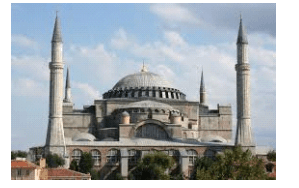
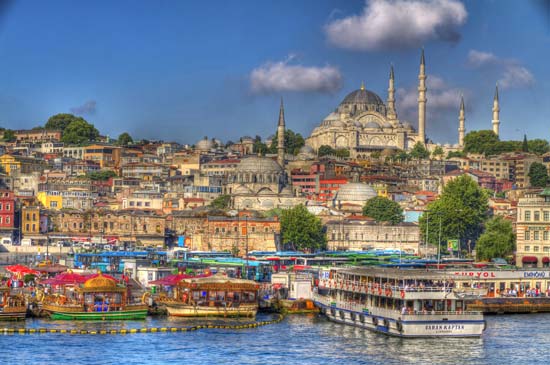
Which group conquered Constantinople?
Persians
Huns
Ottoman Turks
Carthage
Roman Emperor _______________ made Christianity the official religion of the Roman Empire.
Diocletian
Galerius
Constantine
Augustus
Cultural diffusion means?
sharing of secrets
sharing and spreading of culture
practice of one religion such as Christianity
The Christian religion spread within the Byzantine empire because of what two reasons?
It was made the official religion of Rome by Constantine
The Goths forced Christianity on Rome
Christianity had a message of hope
The Turks took over Constantinople
After the Tigris and Euphrates Rivers merge, they empty into the _______.
Persian Gulf
Caspian Sea
Black Sea
Red Sea

Examine the map. Which location identifies the Arabian Peninsula?
A
B
C
D

Examine the map. Which location identifies Mecca?
A
B
C
D

Examine the map. Which of these identifies the Black Sea?
F
C
E
A
Examine the map. Which of these identifies the Persian Gulf?
B
D
G
H
Examine the map. Which of these identifies the Red Sea?
B
D
G
H
What is the lifestyle of nomadic people?
Settling in one location permanently
Living exclusively on boats
Constantly moving from one place to another
Residing near oasis'

a dry, barren area of land, especially one covered with sand, that is characteristically desolate, waterless, and without vegetation.
oasis
desert
coastal plain
mountains
A piece of land that is surrounded by water on three sides
Peninsula
Dune
Shamal
Simoom
The followers of Islam are calld
Christians
Muslims
Hindus
None of the above
Muslims pray _________ times a day.
3
7
1
5
According to the Islamic religion, Muslims believe _________ was the prophet.
Yathrib
Medina
Muhammad
none of the above
The sacred text is called the
Mosque
Quran
Torah
Sheikh
According to the Five Pillars of Islam every Muslim must:
Read the bible
Give charity to help the poor
Believe in many gods
Obey Rabbis
What was the capital of the Ottoman Empire?
Baghdad
Istanbul
Cairo
Ankara
Who captured Constantinople in 1453?
Murad II
Osman I
Mehmed II
Suleyman I
What was Mehmed II's nickname?
The Conqueror
The Magnificent
The Great
The Wise
Hagia Sophia was a Greek Orthodox in Constantinople before the fall to the Ottomans.
True
False
Constantinople was not part of the Byzantine Empire before the fall to the Ottomans.
True
False
The Hagia Sophia turned into a mosque after Constantinople's fall to the Ottomans.
True
False
Constantinople was part of the Ottoman Empire after the fall to the Ottomans.
True
False


What ocean borders Japan?
Atlantic Ocean
Pacific Ocian
Southern Ocean
Arctic Ocean
One of the reasons the Mongols were successful conquerors was
They live in yurts.
Their skill at horse and bow.
Their ability to read and write.
They valued Chinese government.
Made the Great Wall stronger and more elaborate, the way we see it today.
Ming
Yuan
Han
Qing
Who was the Mongol emperor of the Yuan dynasty?
Kublai Khan
Genghis Khan
Ogedei Khan
Mr. Givens

What was the purpose of the Seven Voyages?
To show off the Chinese prestige, power, and riches
To find more trade routes to Europe
To make money for the Chines
To find a lost treasure
What policy does the Chinese emperor adopt after the Seven Voyages?
Expansionism
Expedition
Exploration
Isolationism
Which of Genghis’ grandsons conquered the Song Dynasty in China in 1279?
Khan Noonien Singh
Kublai Khan
Shere Khan
Tolui Khan
What was Genghis Khan's birth name?
Temujin
Jurchen Jin
Yuan Haowen
Marco Polo
Large portable wool-felt tent used by the Mongols
teepee
suni
yurt
domo
How were practitioners of other religions treated in the Mongol empire?
they were killed
they were enslaved
they were tolerated
they were forced to convert
merchant
a person whose job is buying and selling things
a person who directs and monitors the course of a ship or plane
a person who speaks for a country's government to keep ggod relations with other countries
a ruler in ancient China and other countries of Asia
What is the name of the trade routes that Marco Polo and his family traveled in the 15th century?
Shangtu
Beijing
the Silk Road
the summer court

this tea cup is made of ________
ceramics
porcelain
plastic
silk

What country is this?
China
Mongolia
Spain
Italy
Italy is shaped like a (a)
Marco spent the next 17 years working for Kublai Khan and became a highly respected (a) .
What method did West African people use to convey history?
Writing and printing
Oral tradition
Art and music
Symbols and patterns
What role did griots play in West African communities?
Maintaining oral histories
Creating written records
Leading political movements
Teaching foreign languages
What did griots memorize?
Names, dates, places, and events
Artistic patterns and symbols
Music and dance routines
Foreign languages
An area of grassland with scattered trees and bushes
Savanna
Sub-Saharan Africa
Polytheism
Mansa Musa
Seeking guidance from and holding the spirits of deceased ancestors in high esteem
overgraze
Matrilineal
ancestor worship
Animism
The belief that bodies of water, animals, trees, and other natural objects have spirits
Animism
Rain forest
Surplus
Polytheism
an excess supply of something
Polytheism
Surplus
Griots
Sahel
Belief in many Gods
Surplus
Polytheism
Matrilineal
Rain forest
One of Mali's most famous leaders who made Timbuktu into an important city
Jeff Bezos
Mansa Musa
King George III
James Monroe
A West African storyteller
Oral Tradition
Babushka
Greeotz
Griots
What two key products did the kings of Ghana build their power on?
Salt and Gold
Iron and Salt
Gold and Ivory
Gold and Silver
In what way were Camels used in the Kingdom of Ghana?
For Sport
Transportation of Goods
As Entertainment
For Religion
The Northern desert in Africa is the...
Sahara
Kalahari
Senegalese
Nambia
What was the name of the kingdom directly after Ghana?
Mali
Songhai
What type of trade route did the people of the Empire of Ghana have?
Trans-Saharan
Trans-Kalaharian
Trans-Mediterranean
Trans-Eastward
What new religion did the traders bring into the Kingdom of Ghana?
Islam
Buddhism
Hinduism
Christianity
What was the name of the last Kingdom of Western Africa?
Ghana
Mali
Songhai

Name the West African Kingdoms in order.
Mali-Ghana-Songhai
Ghana-Mali-Songhai
Songhai-Mali-Ghana
Mali-Songhai-Ghana
What were the two major resources traded in Ghana?
Leather
Spices
Salt
Gold
Mansa Musa was the first West African ruler to
be very rich and powerful
practice Islam devoutly
wear a crown
trade gold, salt, and slaves
How did West Africans preserve their history before writing was introduced?
Booksellers made marks with sharp sticks on wet clay.
Painters made a long series of paintings like a comic strip.
Griots memorized the stories and passed them down.
Foreign visitors kept the only record of events in the region.
Which answer best describes the trans-Saharan-trade?
a network of trade routes used by traders in the Sahara desert
a market where traders met to trade
a trade route controlled by Muslims in West Africa
a path used by gold miners in Ghana
Islam was first brought to West Africa by
caravan traders.
enslaved prisoners.
religious refugees.
armed nomads.
What is the belief system unique to Japan?
Buddhism
Christianity
Shintoism
Animism
What is the spirit of a god called in Shintoism?
Kami
Ancestor
Shrine
Festival
What is the primary focus of daily ritual practices in Shintoism?
Building discipline
Connecting with nature
Honoring ancestors
Achieving moral purity
What is the primary focus of Shintoism?
Achieving spiritual enlightenment
Gaining material wealth
Honoring ancestors
Connecting with nature
What is the traditional Japanese teaching that everything in nature contains?
Kami
Ancestors
Shrines
Festivals

How were European and Japanese societies similar in the Middle Ages?
They created a system of feudalism in which land was exchanged for service and protection
They created representative democracies in which common citizens elected leaders
They created direct democracies in which citizens had the power to vote on specific laws
They created forms of government in which religion determined the law

Who was the figurehead of power in Japanese society?
Emperor
Shogun
Daimyo
Samurai
Peasants

Who was the military general that ruled in Japan in the Emperor's name?
Emperor
Shogun
Daimyo
Samurai
Peasants

These were powerful lords that lead armies of samurai in Japan.
Emperor
Shogun
Daimyo
Samurai
Peasants

These were trained warriors served their lords in Japan.
Emperors
Shoguns
Daimyo
Samurai
Peasants

These were the poorer farmers and craftsmen in Japan that provided food and service but had little to no power.
Emperors
Shoguns
Daimyo
Samurai
Peasants

In feudal society, a person's social rank was determined primarily by which of the following choices?
Birth
Education and training
Marriage
Individual Abilities

In Europe, the Kings and Nobles were the primary lords and the Knights were their vassals. In Japan, which social groups took these roles?
Shoguns were the primary lords and Daimyo were their vassals
The Emperor was the greatest lord and the Shoguns were his vassals
The Daimyo were powerful lords and the Samurai were their vassals
The Samurai were lords and the peasants were their vassals
Which of the following seas did the Romans have a special connection with?
Ionian sea.
Adriatic sea.
Tyrrhenian sea.
Mediterranean sea.
Boot shaped peninsula south of France and Germany. Also located above the Medierranean Sea
France
Iberian Peninsula
Florida
Italy
Peninsula located in southwest Europe; contains Spain and Portugal
Iberian Peninsula
Italy
European Plain
Scandinavian Peninsula

What body of water is identified by the blue "X"s?
Strait of Gibralter
Bay of Biscay
Black Sea
Baltic Sea

What body of water is identified by the red arrow?
Strait of Gibralter
Bay of Biscay
Black Sea
Baltic Sea

What mountains are represented by the black triangles?
The Alps
The Apennines
The Pyrenees
The Kjolen Mountains

What mountains are represented by the black triangles?
The Alps
The Apennines
The Pyrenees
The Balkan Mountains

What peninsula is outlined in red?
The Scandinavian Peninsula
The Italian Peninsula
The Iberian Peninsula
The Balkan Peninsula

What peninsula is outlined in red?
The Scandinavian Peninsula
The Italian Peninsula
The Iberian Peninsula
The Balkan Peninsula

What sea is identified by the blue "X"s?
Adriatic Sea
Aegean Sea
Mediterranean Sea
North Sea

What geographic feature is represented by the red "X"s?
The North European Plain
The French Riviera
The Ukrainian Steppe
The Rock of Gibralter

People who were given priestly authority by the Church. Also known as "people of the church".
serfs
clergy
emperors

Who was the spiritual and political leader of the Church?
Pope
Nuns
Monks

These people copied and translated religious texts.
knights
monks and nuns
emperors
popes
Pope Gregory ___________________ Emperor Henry, which meant he banned him from heaven. This scared King Henry and his followers.
excommunicated
slapped
communicated
didn't forgive
Who was the leader of the Catholic Church?
A. Archbishop
B. Priest
C. Pope
D. King
King
Priest
Pope

What was the name for the religious trips that that church encouraged people to take?
vacations
journeys
pilgrimages
destinations

Where did the religious men named "monks" live in order to isolate themselves from politics? Where did the monks spend their time copying important religious texts?
in monasteries
in manor houses
in convents
in churches

Where did religious women named "nuns" live in order to isolate themselves from politics?
monasteries
churches
convents
manor houses

The King of the Frankish Empire was named...
Charlemagne
Gregory
Henry
Justinian

While he was king of the Franks, Charlemagne was also crowned the...
King of Germany
King of England
Eastern Roman Emperor
Holy Roman Emperor
In what three ways did Charlemagne bring stability to Europe?
Created feudalism.
Promoted education.
He destroyed major farming systems.
Created a system of checks and inspections.
He began to use democracy, like Ancient Greece.
Before and during Charlemagne's rule, Europe became mostly...
Animism
Muslim
Buddhist
Christian

What is the system of loyalty & land in exchange for protection & service called?
animism
manorialism
feudalism
imperialism
Which social class is the single ruler of a kingdom?
king
noble
knight
peasant
serf

Feudalism is a _____ system.
social
religious
economic
military

A noble's land, containing his property, village, and fields, is called a...
castle
manor
country
city
What is a vassal?
A boat you sail on.
A powerful warrior.
A religious person.
A person who swore loyalty.

Which social class is mostly made of farmers or artisans, who pay taxes and rent to a lord, but are free to move around to new manors?
king
noble
knight
peasant
serf

Which social class is a wealthy landowner?
king
noble
knight
peasant
serf
Manorialism is a ______ system.
social
military
religious
economic

Which social class are warriors who can also own land and have vassals?
king
noble
knight
peasant
serf
The crusaders were from which place?
Europe
The Middle East
The Holy Land
Which Christian leader helped to start the crusades?
Saladin
Pope Urban II

Look at the map below. In what region (continent) of the world did the Black Death BEGIN?
Europe
Middle East
Asia
Africa
Look at the map below. In what region (continent) of the world did the Black Death END?
Europe
Middle East
Asia
Africa
How was the Black Death spread?
Rats and fleas
Dogs and ticks
Cats and Bats
Birds
What class did the Black Death Affect?
Nobility
Peasants / Serfs
Monarchy
All of the above
The Black Death (Plague) ORIGINATED (started) in what country?
China
India
Turkey
Spain
How did the Bubonic Plague contibute to the decline of Feudalism?
Killed off everyone in the Feudal system
Gave more power to the clergy allowing them to gain more land and taxes
Desperate need for workers and now workers could demand more rights
Stopped all legal reforms which gave power back to its original owners
What was the plagues impact on the population?
Doubled the population
Killed 1/3rd of population
Did not do anything to population
Wiped out Central Asia
How did the Black Death get to Europe?
Car and train
Ship and Silk road
Mail and Air
Buggies and Mile runs
The Hundred Years' War was one continuous war that lasted for 100 years.
True
False
How long did The Hundred Years' War last?
100 years
150 years
116 years
99 years
The war was between____________
Christians and Muslims
Spain and Muslims
England and France
Europe and Africa
Both countries wanted control over Northern France and the English Channels?
True
False
__________ changed the fate of the French at the Battle of __________.
Joan of Arc; Orleans
Joan of Arc; Agincourt
King Henry; Orleans
King Henry; Agincourt
Series of campaigns over control of the throne of France, involving English and French royal families and French noble families.
Battle of Agincourt
Battle of Crecy
Hundred Years' War
Battle of Orleans
Which group took control of the Iberian Peninsula and settled it starting in the 700s?
Southern France
Roman Catholics
Muslims
Jews

