
 Worksheets
Civics PMA 1 Review 25-26
Total questions: 75
Worksheet time: 1hrs 7mins
Which statement describes a representative democracy?
A. The government is led by a strong leader that takes over by force.
B. The government provides citizens with the right to vote on all issues.
C. The government provides citizens with property based on family status.
D. The government is led by elected officials that reflect the ideas of citizens.
How does monarchy differ from other forms of government?
A. leaders are elected by the people
B. leaders are born into ruling families
C. leaders are named in the constitution
D. leaders are chosen by the upper class
The scenario below describes the government of an imaginary country.
In country X power is shared between the central government and the governments of all 10 of
the country's states.
Based on the description, country X has which system of government?
A. federal
B. unitary
C. confederal
D. parliamentary
What do a republic and a direct democracy have in common?
A. rule by a single political party
B. a small group of leaders
C. rule by the people
D. a single leader
Where is power concentrated in a unitary system of government?
A. central government
B. state government
C. dictator
D. military
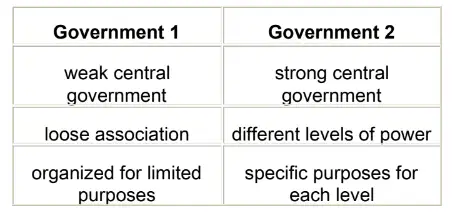
The chart illustrates two systems of government.
Based on the chart, which two systems of government are described?
A. Government 1 - federal Government 2. · confederal
B. Government 1 confederal Government 2 - federal
C. Government 1 - federal Government 2- parliamentary
D. Government 1 — parliamentary Government 2 confederal
The scenario below describes a government decision.
A self-appointed council amends the country’s constitution.
Based on the scenario, which form of government would most likely take this type of action?
A. autocracy
B. monarchy
C. oligarchy
D. republic
Which is an influence both Ancient Greece and Ancient Rome had on the American government?
a polis
civic participation
a written constitution
separation of powers
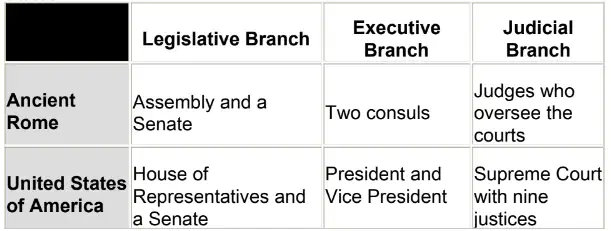
The graphic organizer compares the governments of ancient Rome to the United States.
Based on the chart, which major influence did the Founders gain from the government of Ancient Rome?
rule of law
natural rights
direct democracy
separation of powers
The proverb below comes from the Judeo-Christian tradition.
Do not withhold good from those who deserve it, when it is in your power to act.
Which ethical idea is described in the proverb?
justice
rule of law
sovereignty
republicanism
The quote below is from an American historical document.
No State shall make or enforce any law which shall abridge the privileges or immunities of citizens of the United States; nor shall any State deprive any person of life, liberty, or property, without due process of law.
Based on the quote, which best describes the principle of due process?
no one is above the law
all citizens must be treated the same
the government must follow fair legal procedures
the government can only do what is listed in the constitution
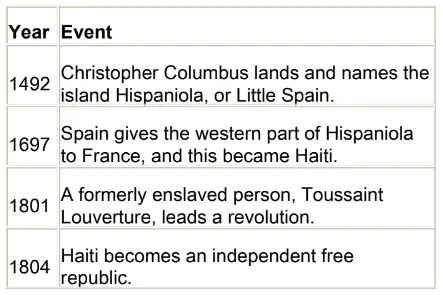
The timeline shows events that took place in the Caribbean country of Haiti.
Based on the timeline, which document could have been used to encourage independence and the establishment of a representative government?
Magna Carta
Common Sense
Mayflower Compact
English Bill of Rights
In which way did the signing of the Magna Carta influence the American political system?
by creating natural rights
by establishing states' rights
by giving the king unlimited power
by limiting the power of the government
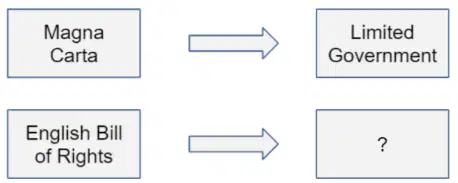
The table shows a relationship between historical documents and their impacts.
Which idea completes the diagram?
Rule of law
Individual rights
Self-government
Declaring independence
The quote below is from the Second Treatise on Government (1690).
The state of nature has a law of nature to govern it, which obliges everyone: and reason, which is that law, teaches all mankind, who will but consult it, that being all equal and independent, no one ought to harm another in his life, health, liberty, or possessions.
Based on the quote, which conclusion can be drawn about how Enlightenment ideas are reflected in the American government?
general protection of natural rights
the people's agreement to governmental authority
the equal application of laws to all American citizens
the separation of government into three distinct branches
What characteristic of the U.S. government was developed from the idea that no single branch of government should hold all authority?
rule of law
natural law
social contract
separation of powers
Which document outlined colonial concerns about British policies?
A. Bill of Rights
B. Mayflower Compact
C. United States Constitution
D. Declaration of Independence
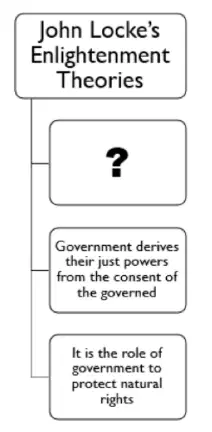
The diagram illustrates concepts from the Declaration of Independence.
Which statement completes the diagram?
A. People establish natural rights.
B. It is the role of a social contract to list natural rights.
C. It is the role of government to determine unalienable rights.
D. People are endowed by their creator with certain unalienable rights.
The passage below is from the Declaration of Independence.
We hold these truths to be self-evident, that all men are created equal, that they are endowed by their Creator with certain unalienable Rights, that among these are Life, Liberty and the pursuit of Happiness.--That to secure these rights,
Governments are instituted among Men, deriving their just powers from the consent of the governed.
According to this passage, what is the main role of government?
A. to promote greater social equality
B. to protect the natural rights of citizens
C. to celebrate the ruler in the eyes of the Creator
D. to help individuals cooperate against the forces of nature
Which describes an impact of natural rights on the United States independence?
A. The colonists lack of religious freedom pushed them to fight for independence.
B. The colonists loss of English citizenship pushed them to fight for independence.
C. The colonists loss of the French and Indian War pushed them to fight for independence.
D. The colonists lack of representation in Parliament pushed them to fight for independence.
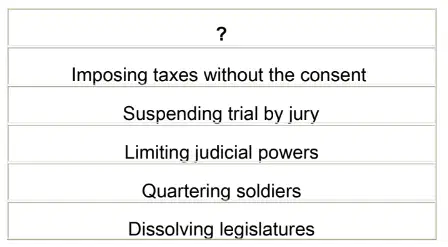
Which of the following best categorizes the chart above?
A. Protected Natural Rights from the Magna Carta
B. Pillars of Rule of Law from the English Bill of Rights
C. Enlightenment Ideas set forth in the U.S. Constitution
D. Colonial Grievances listed in the Declaration of Independence
What was the Anti-Federalists’ greatest concern about ratifying the U.S. Constitution?
The lack of a federal court system
The lack of legislative veto power
The lack of a strong military
The lack of a bill of rights
The statement below appeared in a 1787 essay by James Winthrop.
"It is impossible for one code of laws to suit Georgia and Massachusetts"
What does this statement reflect?
Federalist views
Anti-Federalist views
a cause of Shay's Rebellion
a cause of the Great Compromise
The excerpt below is from Anti-Federalist No. 84 .
The principles, therefore, upon which the social compact is founded, ought to have been clearly and
precisely stated, and the ... full declaration of rights to have been made. But on this subject there is
almost an entire silence.
According to this excerpt, what was a major complaint during the debate over the ratification of the
U.S. Constitution?
the states having too much power
the lack of a strong central government
the lack of a bill of rights
the executive branch being too weak

Which Enlightment thinker came up with the natural rights and social contract?
Voltaire
John Locke
Baron de Montesquieu
Thomas Hobbes

Which enlightenment thinker came up with separation of powers and checks and balances?
John Locke
Voltaire
Baron de Montesquieu
Thomas Hobbes

Our Natural Rights are...
Life, Liberty and Money
Death, Money and Property
Liberty, Property, Death
Life, Liberty and Property

When the people give up some freedoms in exchange for protection by the government is called:
Natural Rights
Checks and Balances
Social Contract
Separation of Powers
Separation of Powers is represented by the three separate branches in the US government
True
False

Which document created a government for the pilgrims because they had no government in America?
Magna Carta
Mayflower Compact
English Bill of Rights
Common Sense

Which document was the first to introduce the idea of limited government?
Magna Carta
Mayflower Compact
English Bill of Rights
Common Sense

Which document convinced many colonist to fight for independence from Britain?
Magna Carta
Mayflower Compact
English Bill of Rights
Common Sense
Which document introduced some of the rights that we have in our own Bill of Rights?
Magna Carta
Mayflower Compact
English Bill of Rights
Common Sense

What was the big idea of the Mayflower compact?
Limited Government
Due Process
Self-Government
Rule of Law

Which enlightenment thinker influenced the Declaration of Independence?
Montesquieu
Thomas Hobbes
John Locke
Thomas Jefferson
What did Common Sense do?
called for an independent Britain
colonists should accept the King
called for an independent America
colonists should reject the crown and become British
What big idea says people create their own government?
Rule of Law
Limited Government
Self Government
Rights

What right did Magna Carta guarantee?
no excessive bail
trial by jury
free elections
right to bear arms

What was the colonial response to the Stamp Act?
boycott
paid the tax
sent the King a member for Parliament
did absolutely nothing

Document written by Thomas Jefferson to tell why the colonies should be free from England.
Magna Carta
English Bill of Rights
Common Sense
Declaration of Independence

What are the unalienable rights people have according to Jefferson?
life, liberty, and property
life, freedom, and property
life, liberty, and the pursuit of happiness
life, freedom, and the pursuit of happiness

What was outcome of the Boston Tea Party?
passage of the Tea Act
passage of the Stamp Act
passage of the Intolerable Acts
passage of the Townshend Revenue Act
Where does a person get natural rights?
from their "Creator"
from their family
from Government
from their friends

What was "no taxation without representation?"
Colonists adhering to Parliament taxes
can't be taxed with a voting member in gov't
Parliament passing taxes in the colonists interests
can't be taxed without a voting member in gov't

What is a social contract?
agreement between the people and God
agreement between the government and government
agreement between the people and government
agreement between the government and God
According to the DOI, if a government violated the social contract, what do the people do?
alter or abolish government
petition the government
take up arms and fight
elect a new monarch
Which example illustrates Montesquieu's idea of the separation of powers?
by choosing public officials in elections
life, liberty, and property are guaranteed
Florida has a governor, legislature, and courts
people have a right to overthrow an unjust gov't
Why did Parliament begin to pass acts in the 1760s and 1770s?
Indian tribes were able to keep their lands
British gov't was unable to pay off its debt
Colonists began to think of independence
The French lost the French and Indian War
Oligarchy
A form of government which consists of rule by an elite group who rule in their own interests. Especially the accumulation of wealth and privilege.
A system of government by one person with absolute power.
Rule by a single leader who has not been elected and may use force to keep control.
Government owns all businesses and farms and provides its people healthcare, education, and welfare. Political and Economic theory derived from the ideas of Karl Marx.
Autocracy
The government is elected by the people. Everyone who is eligible to vote, which is a majority of the population, has a chance to have their say over who runs the country.
A system of government by one person with absolute power.
Government owns all businesses and farms and provides its people healthcare, education, and welfare. Political and Economic theory derived from the ideas of Karl Marx.
This form of government means "rule by the people".
Democracy
Monarchy
Oligarchy
Theocracy
As sole leader of North Korea, Kim Jong Un has total, oppressive control over his people. What type of government is this?
Dictatorship
Communism
Absolute Monarchy
Anarchy
In Congress, elected Senators from each state vote on key issues. Is this an example of direct democracy or representative democracy?
Direct Democracy
Representative Democracy
In this type of democracy, the people vote on every issue.
Representative Democracy
Direct Democracy

What system of government was in place after the United state adopted the U.S. Constitution?
Parliamentary
Unitary
Confederal
Federal
What form of government did ancient Rome have?
Republican form of government
Theocracy
Direct democracy
Monarchy
What is one principle that the Judeo-Christian tradition emphasized?
Justice and the rule of law
Only priests can govern
Governments should control religion
Might makes right
What type of democracy did ancient Greece practice?
Representative democracy
Autocracy
Direct democracy
Oligarchy
What does the rule of law mean?
Laws do not apply to government officials
Everyone is subject to the same laws
Only the king is above the law
Laws are made by the strongest
How is America's democracy similar to ancient Rome?
It is a direct democracy
It is a monarchy
It is an oligarchy
It is a representative democracy
What did legislative bodies in ancient Greece do?
Built monuments
Focused on military conquest
Served as religious leaders
Made decisions on behalf of the people
Which ethical idea from the Judeo-Christian tradition influenced America?
The divine right of kings
Individual worth and personal responsibility
The caste system
Worship of multiple gods
What is a key term to remember from ancient Greece's influence on America?
Civic participation
Feudalism
Divine monarchy
Centralized power
A city-state in ancient Greece.
polis
morals
democracy
civic
Do your best
Do what's right
Treat others the way you want to be treated
These school rules apply to the U.S. government as well and are "ethical ideas of justice." Where did this principle originate?"
Magna Carta
Judeo-Christian Tradition
English Bill of Rights
Ancient Greece
This term means, "every individual is born equal, has equal opportunity to succeed and is entitled to the same set of basic rights."
Religious Liberty
Equality of Mankind
Due Process of Law
Rule of Law
The ability for individuals to worship or not worship freely without government interference
Natural Rights
Religious Freedom
Rule of Law
Due Process

