
NEW
Font size
 Worksheets
EOU 1 REVIEW
Total questions: 20
Worksheet time: 10mins
Two solutions are mixed and react to produce AgCl. The chemical reaction is shown by the balanced equation.
AgNO3 + LiCl → AgCl + LiNO3
What happens to the total mass as the reaction takes place?
The mass first increases and then decreases.
The mass remains constant.
The mass decreases.
The mass increases.
What atoms are involved in this chemical reaction?
CaCO3 → CaO + CO2
calcium, cobalt, and oxygen
calcium, carbon, and oxygen
carbon and oxygen
calcium, carbon, and cobalt
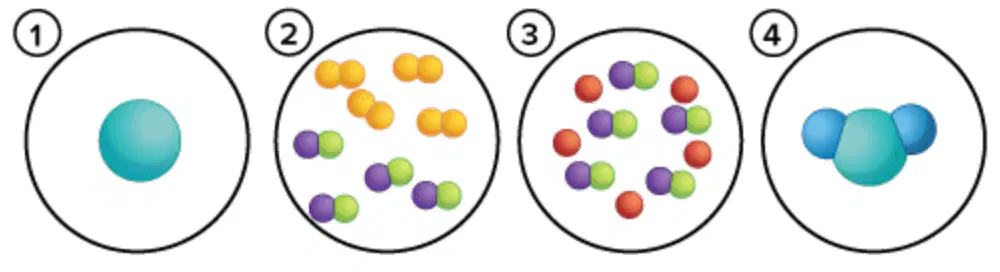
Which labels correctly classify elements, compounds, homogeneous mixtures, and heterogeneous mixtures?
element, heterogenous mixture, homogenous mixture, compound
heterogenous mixture, element, homogenous mixture, compound
element, homogenous mixture, compound, heterogenous mixture
homogenous mixture, compound, heterogenous mixture, element
Capillary action happens because of what property of water?
adhesion
cohesion
property
surface tension
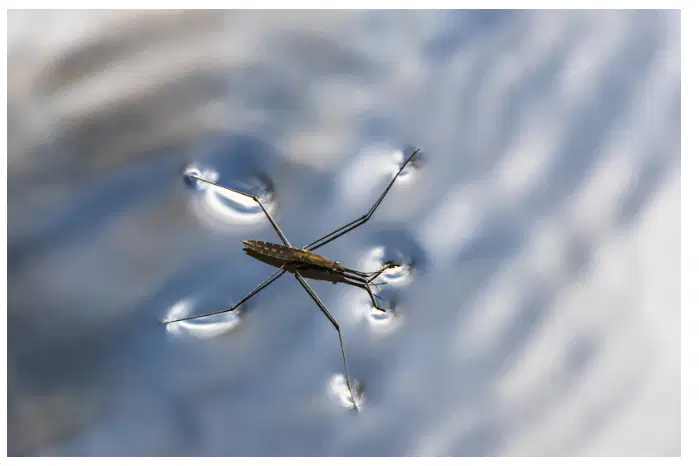
Which process is depicted in the image of an insect on water, such as the insect on water?
capillary action
adhesion
surface tension
cohesion
As the seasons begin to change, a leaf falls from a tree and lands on the surface of a pond. Instead of sinking, the leaf floats. What has happened to stop the leaf from sinking?
The connection between the water molecules and the leaf molecules prevents the leaf from sinking.
The connection between the water molecules on the surface of the water is very strong and prevents the leaf from sinking.
The connection between the air molecules and the leaf molecules is very strong and prevents the leaf from sinking.
The gravitational force on the leaf is very small, so there is not enough weight to allow the leaf to sink into the water.
What color does a base turn litmus paper?
blue
red
yellow
purple
What type of solution is one that has a pH of 9?
acid
base
neutral
acidic and basic
What is formed when an acid and a base are combined?
sugar
baking soda
acidic solution
salt
Using the periodic table, what atoms are present in the following chemical reaction?
CO2 + NaOH → NaHCO3
nitrogen, hydrogen, oxygen, carbon
sodium, oxygen, hydrogen, cobalt
nitrogen, hydrogen, oxygen, cobalt
sodium, oxygen, hydrogen, carbon
Examine the chemical equation for photosynthesis. Which statement correctly describes how mass is conserved during this chemical reaction?
6CO2 + 6H2O → C6H12O6 + 6O2
carbon dioxide + water → sugar + oxygen gas
Atoms disappear, causing the mass of the products to be less than the mass of the reactants.
The atoms rearrange, causing the mass of the products to equal the mass of the reactants.
The atoms change into new atoms, causing the mass of the products to equal the mass of the reactants.
No changes occur, causing the mass of the products to equal the mass of the reactants.
Which of the statements related to the conservation of mass is NOT true?
In a closed system, the mass of the reactants will equal the mass of the products.
Matter can be created but not destroyed.
Matter cannot be created or destroyed.
The mass of matter in a closed system will not change no matter what type of reaction occurs.
During a baseball game, the baseball is hit so hard that it flies out of the park. What measurements need to be recorded to find the net force on the baseball when it is hit by the bat?
the mass and acceleration of the baseball
the mass and velocity of the baseball
the mass of the bat and the baseball's acceleration
the mass of the bat and the baseball's velocity
A student kicks a 0.40 kg soccer ball. The net force on the soccer ball is 10 N. What is the soccer ball’s acceleration?
0.04 m/s2
4.0 m/s2
9.6 m/s2
25 m/s2
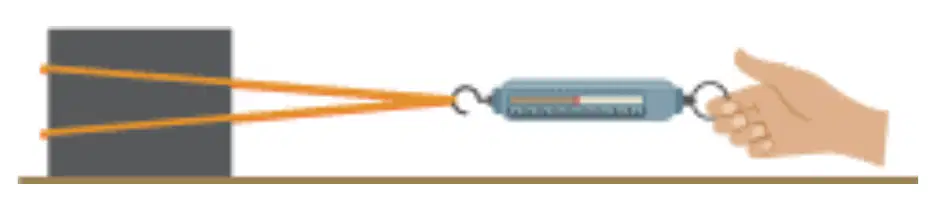
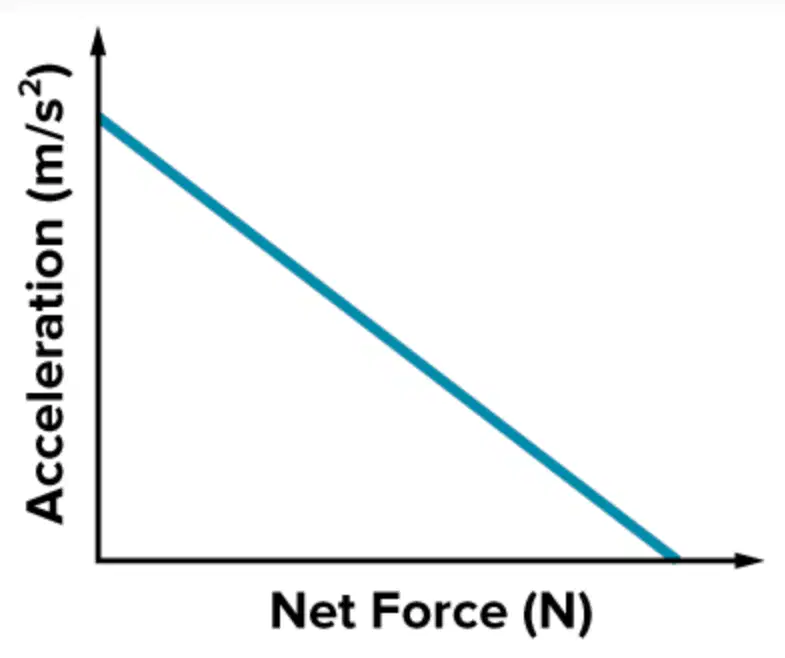
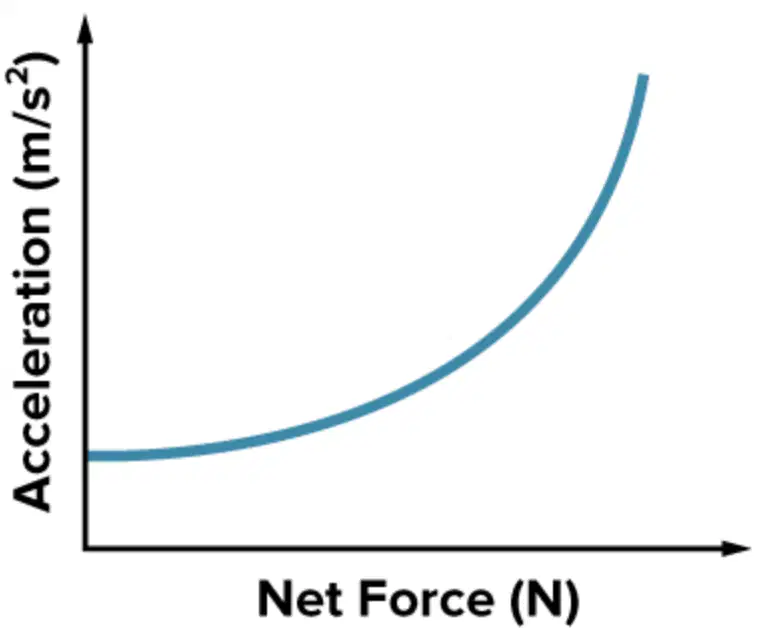
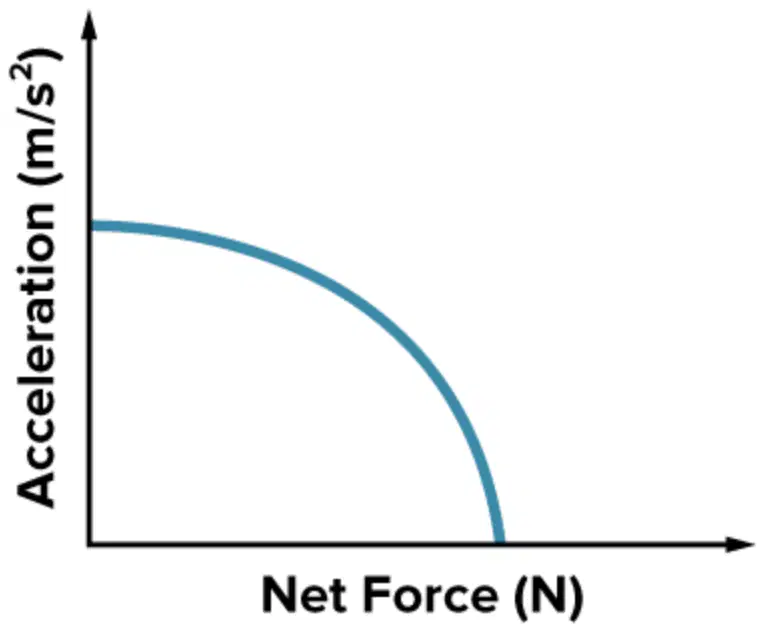
A student drags a block across a frictionless table by a spring scale to measure the force on the block. They also have a sensor on the block to measure its acceleration.
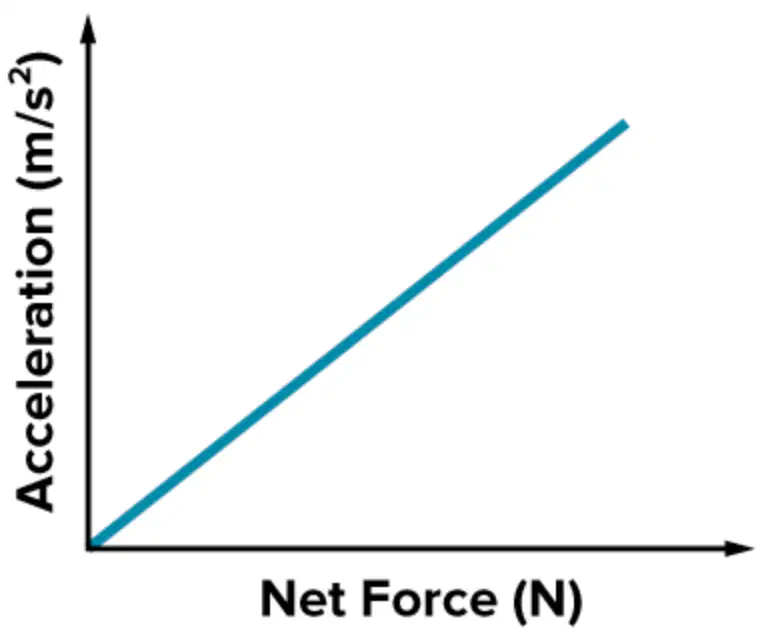
Which graph accurately shows the relationship between the next force on a block and its acceleration?
When a student rides a skateboard on a level surface, Newton’s three laws of motion act simultaneously. Which statement accurately describes how one of Newton’s laws of motion applies to the skateboarder?
Newton’s third law of motion states that when the skateboarder pushes on the ground, the ground pushes back on the skateboarder.
Newton’s second law of motion states that the acceleration of the skateboarder decreases as the net force increases.
Newton’s first law states that the skateboarder accelerates because the forces on the skateboarder are balanced.
Newton’s second law of motion states that there is a net force on the skateboarder when they move at constant speed.
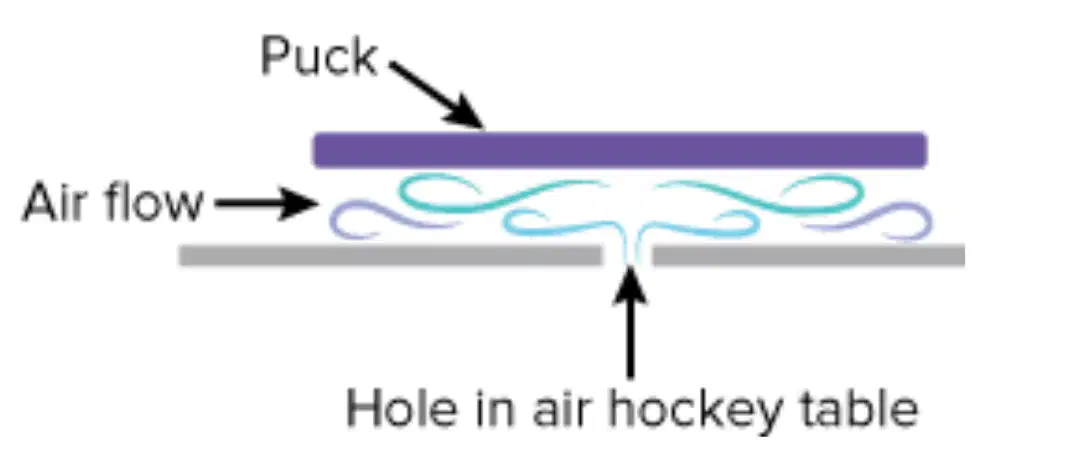
A system consists of an air hockey table, puck, and the air flow from the table. The puck hovers on the air until it is hit. Then the puck accelerates. When the puck collides with the side of the table, it changes direction.
All three of Newton’s laws of motion act simultaneously within this system. When does Newton’s first law of motion apply to the hockey puck?
when the puck speeds up after it is hit
when the puck changes direction
when the puck hovers on the air before it is hit
when the puck collides with the table and the table exerts a force on the puck
You push a 15 kg cart on a flat surface. The net force applied is 5 N. What is the acceleration of the cart?
0.3 m/s2
3 m/s2
15 m/s2
75 m/s2
While accelerating, a cargo ship loses a number of cargo containers, reducing its total weight by half. If the force applied is constant, what effect will the loss of the cargo containers have on the its acceleration?
The acceleration will be reduced by half.
The acceleration will be doubled.
The acceleration will be unchanged.
There is not enough information to know how the acceleration will be affected.
A mom and her two children rode bumper cars at an amusement park. The mom and her young daughter rode in one car while her older son rode in the other bumper car. When the cars collided as shown in the image, which of Newton’s Laws explains that when the bumper cars collide, the force that each bumper car applies to the other car is also applied to itself?
Newton’s first law of motion about inertia
Newton’s second law of motion about force, mass and acceleration
Newton’s third law of motion about action and reaction forces
None of the Newton’s laws of motion are about this concept

