
NEW
Font size
 Worksheets
Unit 2/3 Test Electrons & Periodic Table
Total questions: 32
Worksheet time: 37mins
What is the electron configuration of a neutral carbon atom?
1s22s22p2
1s22s22p4
1s22s23p2
1s22s22p6
Which of the following elements has the smallest atomic radius?
Lithium (Li)
Beryllium (Be)
Boron (B)
Carbon (C)
Describe the trend in atomic radius as you move down a group in the periodic table.
It decreases
It increases
It remains constant
It fluctuates
Which of the following elements is most electronegative?
Hydrogen (H)
Carbon (C)
Nitrogen (N)
Oxygen (O)
Explain why ionization energy generally increases across a period from left to right.
Increased nuclear charge attracts electrons more strongly
Decreased nuclear charge allows electrons to spread out
Additional electron shells are added
Electrons are lost, reducing size
Predict the electron configuration of a chlorine atom
1s22s22p63s23p5
1s22s22p63s23p6
1s22s22p63s23p4
1s22s22p63s23p3
Which of the following statements best explains why electronegativity decreases down a group?
Electrons are added to the same energy level
Electrons are added to higher energy levels, increasing distance from the nucleus
Nuclear charge decreases
Electrons are removed from the outer shell
What is the general trend of ionization energy as you move down a group in the periodic table?
It increases
It decreases
It remains constant
It fluctuates
Identify the element with the electron configuration [Ar]4s23d104p5 .
Bromine (Br)
Krypton (Kr)
Selenium (Se)
Arsenic (As)
How does the electron configuration of noble gases differ from that of other elements?
Noble gases have completely filled valence shells
Noble gases have partially filled d subshells
Noble gases have no s subshells
Noble gases have filled f subshells
Which of the following elements would you expect to have the highest first ionization energy?
Lithium (Li)
Beryllium (Be)
Boron (B)
Carbon (C)
Which of the following elements has the largest atomic radius?
Helium (He)
Neon (Ne)
Argon (Ar)
Xenon (Xe)
Explain why alkali metals have low ionization energies.
They have a single electron in their outer shell, which is easily removed
They have high nuclear charge
They have small atomic radii
They have high electronegativity
Which of the following best describes the trend in electronegativity as you move across a period from left to right?
It decreases
It increases
It remains constant
It fluctuates
Which of the following elements is expected to have the highest electronegativity?
Fluorine (F)
Chlorine (Cl)
Bromine (Br)
Iodine (I)
Of the halogens, which has the smallest radius?
F
Br
He
At
Which of the following elements is a noble gas?
Oxygen (O)
Neon (Ne)
Nitrogen (N)
Hydrogen (H)
Which of the following elements has the highest first ionization energy?
Sodium (Na)
Magnesium (Mg)
Aluminum (Al)
Phosphorus (P)

What happens to Group 1 metals when they are put into water?
Group 1 metals dissolve in water without any reaction.
Group 1 metals explode upon contact with water.
They do not react because they are noble gases.
They melt and become liquid.
What is the following electron configuration written in shorthand form?
1s2 2s2 2p6 3s2 3p6 4s2 3d10 4p4
[Ar] 4s2 3d10 4p2
[Ar] 4s2 3d10 4p6
[Ar] 4s2 3d10 4p4
[Ar] 4s2 3d6 4p4
Which of the following is the correct electron configuration for a neutral sulfur atom?
1s22s22p63s23p4
1s22s22p63s23p6
1s22s22p63s23p3
1s22s22p63s23p5
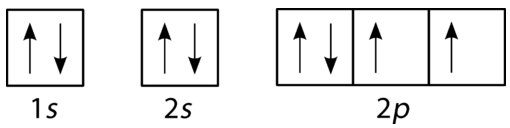
This orbital diagram represents:
C
B
N
O

Which element is pictured?
neon
fluorine
magnesium
argon
What is the correct noble-gas notation for the electron configuration of an atom of chlorine?
a. [Ar]3s2 3p5
b. [Ne]3s2 3p4
c. [Ar]3s2 3p4
d. [Ne]3s2 3p5

Who is the father of the periodic table?
Dmitri Mendeleev
Niels Bohr
Isaac Newton
Albert Einstein
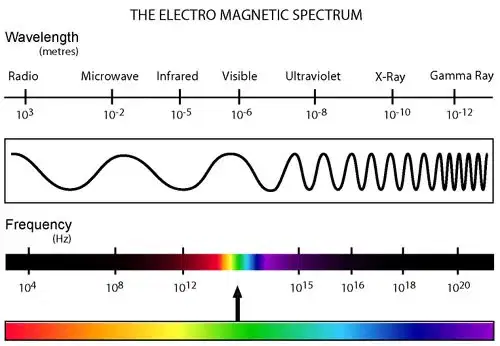
The electromagnetic waves with the highest frequencies and the shortest wavelength are called
radio waves
gamma rays
x-rays
visible light
What color has the highest energy?
red
violet
green
orange

This could be the dot diagram of
Si
Br
B
S
How would you draw a Lewis dot diagram for Magnesium?


On the periodic table the group number gives you the
number of total electrons
number of energy levels
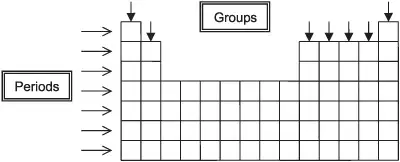
On the periodic table the period number give you the
The number of valence electrons
The number of total electrons

The symbols W, X, Y, and Z represent four elements shown on the outline of a periodic table.
Which element has the highest atomic size?

