
 Worksheets
Unit 1 - Nature of Matter
Total questions: 28
Worksheet time: 19mins
Science is much different than philosophy because ___.
philosophy forms conclusions, but science does not
science starts with a conclusion, then forms arguments to support it
only science attempts to understand how nature works
science uses experiments to test ideas, philosophy does not
The philosopher ___ believed that matter was made of the four classical elements (fire, earth, water, and air) while ___ believed that matter was made of tiny particles.
Democritus | Aristotle
Aristotle | Democritus
Brown | Priestly
Priestly | Brown

Robert Boyle did not believe that water was one of the basic elements that all substance was made of. To test this, he conducted an experiment where he ran an electric current through water. He placed two test tubes above each of the terminals of the electricity source and collected that gas that came out. He repeated the experiment a total of three times, each time using the same amount of water and the same level of electric current. His experimental results are shown to the left.
The statement "Robert Boyle did not believe that water was one of the basic elements" is an example of a __.
conclusion
independent variable
hypothesis
constant
Robert Boyle did not believe that water was one of the basic elements that all substance was made of. To test this, he conducted an experiment where he ran an electric current through water. He placed two test tubes above each of the terminals of the electricity source and collected that gas that came out. He repeated the experiment a total of three times, each time using the same amount of water and the same level of electric current. His experimental results are shown to the left.
What was the DEPENDENT VARIABLE in this experiment?
the electricity
the water
the test tubes
the gas produced in each test tube

Robert Boyle did not believe that water was one of the basic elements that all substance was made of. To test this, he conducted an experiment where he ran an electric current through water. He placed two test tubes above each of the terminals of the electricity source and collected that gas that came out. He repeated the experiment a total of three times, each time using the same amount of water and the same level of electric current. These are his experimental results:
What was Boyle's SAMPLE SIZE?
6
3
1
2

Robert Boyle did not believe that water was one of the basic elements that all substance was made of. To test this, he conducted an experiment where he ran an electric current through water. He placed two test tubes above each of the terminals of the electricity source and collected that gas that came out. He repeated the experiment a total of three times, each time using the same amount of water and the same level of electric current. These are his experimental results:
Boyle decided to add up each of the volumes of gas produced in test tube 1 for all the trials. Following the rules of addition, what is the total volume?
19.0mL
19mL
19.2mL
19.21mL

Robert Boyle did not believe that water was one of the basic elements that all substance was made of. To test this, he conducted an experiment where he ran an electric current through water. He placed two test tubes above each of the terminals of the electricity source and collected that gas that came out. He repeated the experiment a total of three times, each time using the same amount of water and the same level of electric current. These are his experimental results:
How many significant figures are in the three measurements taken in test tube #2?
1
2
3
4

Robert Boyle did not believe that water was one of the basic elements that all substance was made of. To test this, he conducted an experiment where he ran an electric current through water. He placed two test tubes above each of the terminals of the electricity source and collected that gas that came out. He repeated the experiment a total of three times, each time using the same amount of water and the same level of electric current. These are his experimental results:
We now know the two gases released in this experiment are hydrogen and oxygen. Water has a formula of H2O, and the decomposition of water is written like this: 2H2O → 2H2 + O2. Given this, which test tube contains which gas?
Both test tube contain a mix of both gases
Test tube #1 - Oxygen; Test tube #2 - Hydrogen
Test tube #1 - Hydrogen;
Test tube #2 - Oxygen
There is no way to tell by looking at the volumes in each test tube
The separation of water into hydrogen and oxygen gas is an example of a __.
physical property
physical change
chemical property
chemical change
Hydrogen and oxygen gas are only composed of one type of particle, so they are classified as __.
ions
elements
phlogiston
compounds

Identify the item to the left:
Neutral atom
Polar Molecule
Nonpolar molecule
Ion

Identify the item to the left:
Polar molecule
Neutral Atom
Ion
Mixture of more than one of the things mentioned

Identify the item to the left:
Nonpolar Molecule
Neutral Atom
Ion
Mixture of more than one of the other things mentioned

Identify the item to the left:
Polar Molecule
Nonpolar Molecule
Ion
Neutral Atom
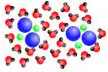
Identify the item to the left:
Polar Molecule
Neutral Atom
Nonpolar Molecule
Mixture of more than one of the other things mentioned
Which of these substances would dissolve in a nonpolar solvent, such as ether?
A polar compound like table salt
ions
A nonpolar compound like wax
All of these would dissolve in ether
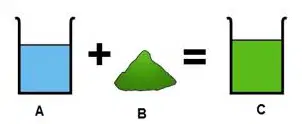
How would the substances in the diagram to the left be correctly classified?
A=Solvent; B=Solute; C=Solution
A=Solution; B=Solvent; C=Solute
A=Solute; B=Solvent; C=Solution
A=Solution; B=Solute; C=Solvent
Match each description with the vocabulary term.
Whether a substance can float in a gas or liquid
Buoyancy
A substance that is made of unstable atoms that will disintegrate, releasing particles and energy
Radioactive
The amount of space an object takes up
Volume
This property is found in a few metals such as iron, nickel, and cobalt
Attraction to a magnet
Which of these would be classified as a physical property that could be measured qualitatively?
Temperature
Volume
Radioactivity
Color
Which of these would be classified as a chemical property that could be measured quantitatively?
pH
Solubility
Volume
Flammability
As a polar molecule, water molecules will attract each other. This property is known as __.
Buoyancy
Adhesion
Cohesion
Solubility
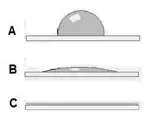
Which of the experimental results in this diagram would occur when water is placed on a NONPOLAR surface, creating high cohesion and low adhesion?
A
B
C
You want to separate a mixture of water and sand particles. Water molecules are very small and are in the liquid state of matter at room temperature, while sand molecules are larger and in the solid state.
Which of these techniques would most directly take advantage of these properties?
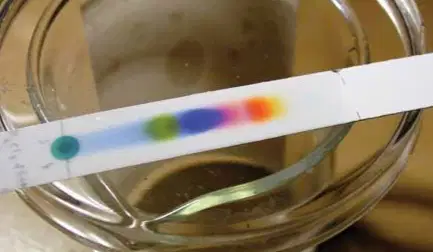
Chromatography
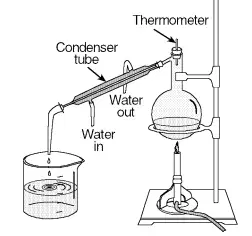
Distillation
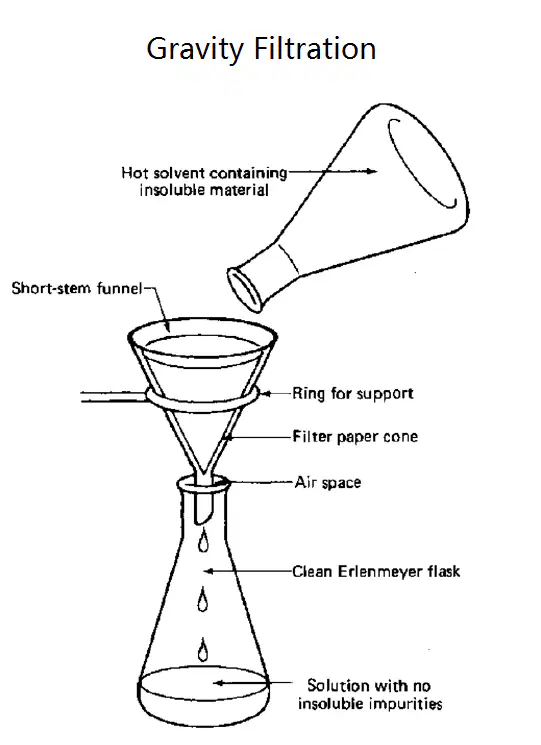
Filtration
Match each description with the vocabulary term.
The ability of a substance to transfer heat and/or electricity
Conuctivity
The amount of matter in a substance
Mass
Can be burned
Flammable
The concentration of H+ ions in a solution
pH


What is the BEST tool to separate gravel from sand?
use a magnet
use tweezers
pour the mixture through filter paper
use a strainer or sieve

boiling water is an example of a...
physical change
physical property
chemical change
chemical property
What happens to a substance during a physical change?
The substance changes into a different substance with different properties.
The substance changes its shape or state but remains the same substance.
The substance loses all its properties.
The substance becomes a mixture of two different substances.

