
Font size
 Worksheets
Chapter 3 Test Improvements
Total questions: 23
Worksheet time: 14mins
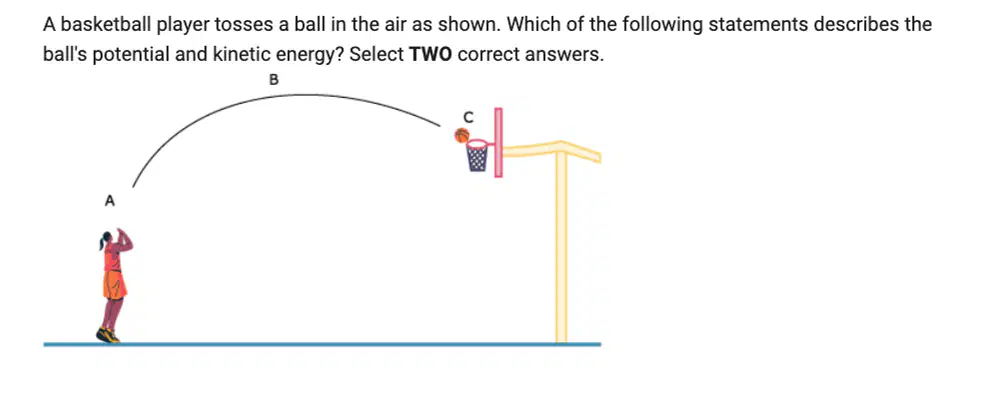
A basketball player tosses a ball in the air as shown. Which of the following statements describes the ball's potential and kinetic energy? Select TWO correct answers.
A. The ball increases potential energy between points A and B.
B. The ball increases kinetic energy between points A and B.
C. The ball decreases potential energy between points A and B.
D. The ball decreases kinetic energy between points A and B.
E. The ball decreases kinetic energy between points B and C.
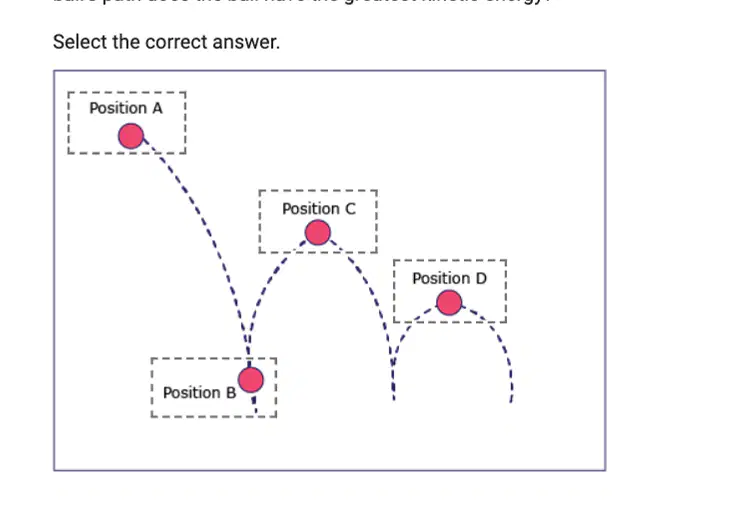
The path that a ball takes after it is dropped is shown in the image below. At which position in the ball's path does the ball have the greatest kinetic energy? Select the correct answer.
A. Position A
B. Position B
C. Position C
D. Position D
When you charge your cell phone, why does it stay on even when unplugged?
A. Because of the gravitational potential energy stored in the battery.
B. Because of the elastic potential energy stored in the battery.
C. Because of the chemical potential energy stored in the battery.
D. Because of the kinetic energy stored in the battery.
How does snapping a rubber band relate to mechanical energy?
The rubber band transforms itself into kinetic energy.
The rubber band has elastic potential energy stored in it when pulled back.
The rubber band has gravitational potential energy stored in it when pulled back.
The rubber band has kinetic energy stored in it when pulled back.
Which action in a science lab transforms electrical energy into thermal energy? Select TWO correct answers.
warming liquid in a test tube over a bunsen burner
using a burner to boil a beaker of water
growing plants on a window sill
mixing two chemicals
powering on a heat lamp to keep bird eggs warm
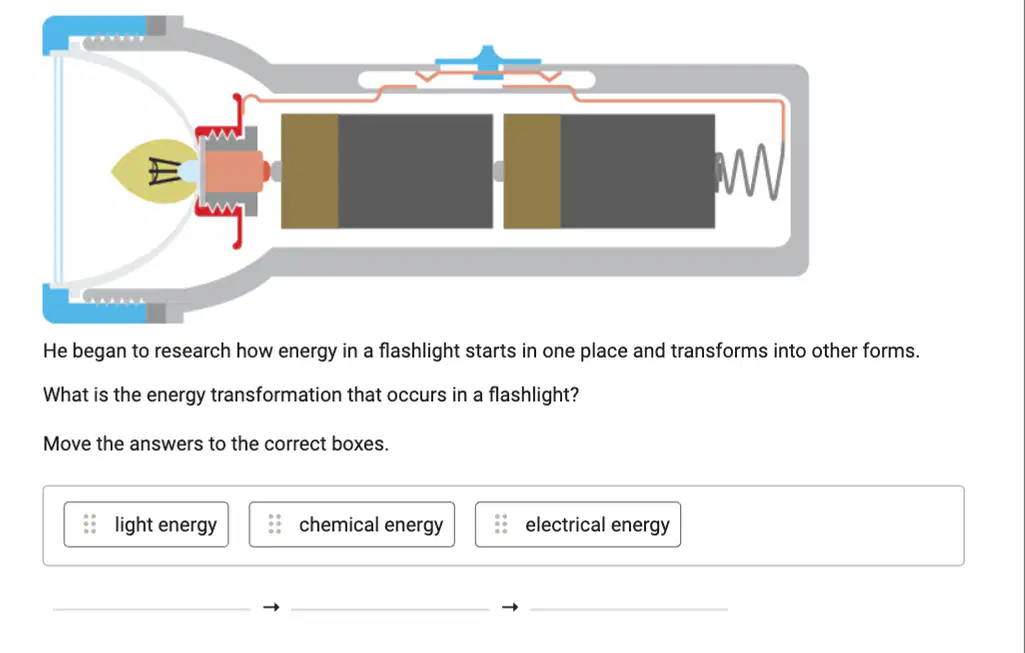
What is the energy transformation that occurs in a flashlight? Move the answers to the correct boxes.
chemical energy
electrical energy
light energy
What happens to the solar energy absorbed by plants during photosynthesis?
It is recycled by the plant and returned to the atmosphere.
It is converted into oxygen and glucose.
It is stored as heat within the plant for cellular functions.
It is transformed into chemical energy.
As a plant goes through the process of photosynthesis -
radiant energy is changed into potential energy
thermal energy is exchanged for kinetic energy
radiant energy is converted into chemical energy
heat energy is transferred into potential energy
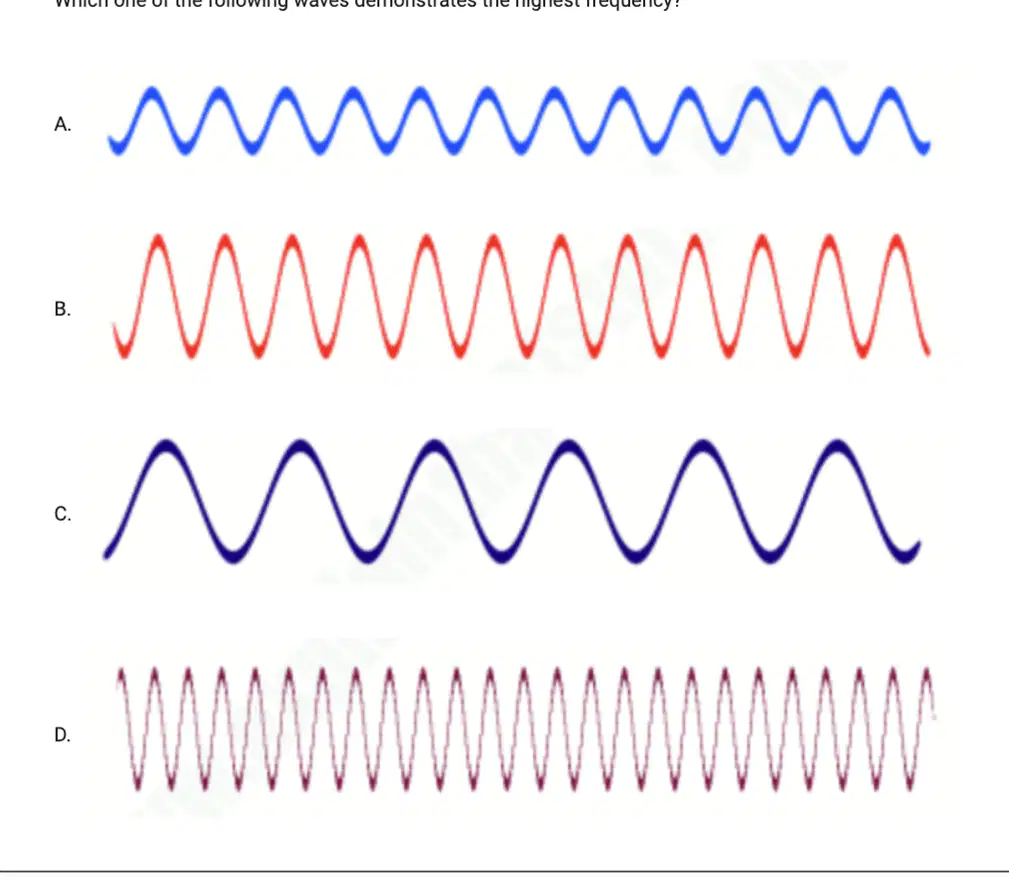
Which one of the following waves demonstrates the highest frequency?
A. [Image of wave A]
B. [Image of wave B]
C. [Image of wave C]
D. [Image of wave D]
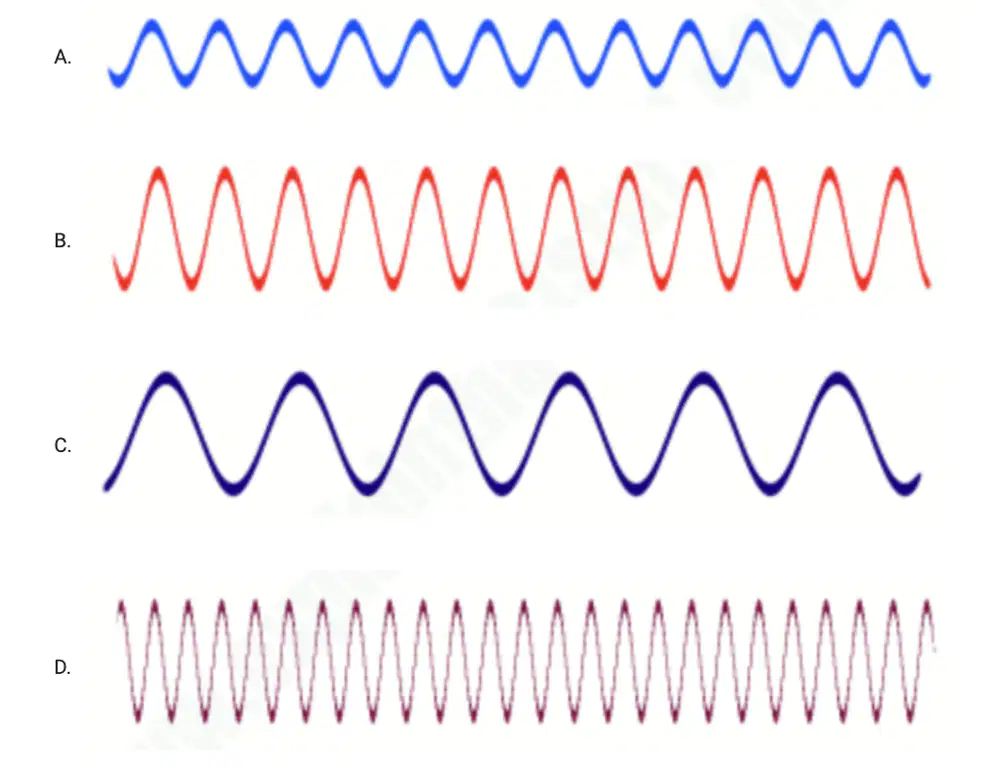
Which one of the following waves demonstrates the longest wavelength?
A. [Image of wave]
B. [Image of wave]
C. [Image of wave]
D. [Image of wave]
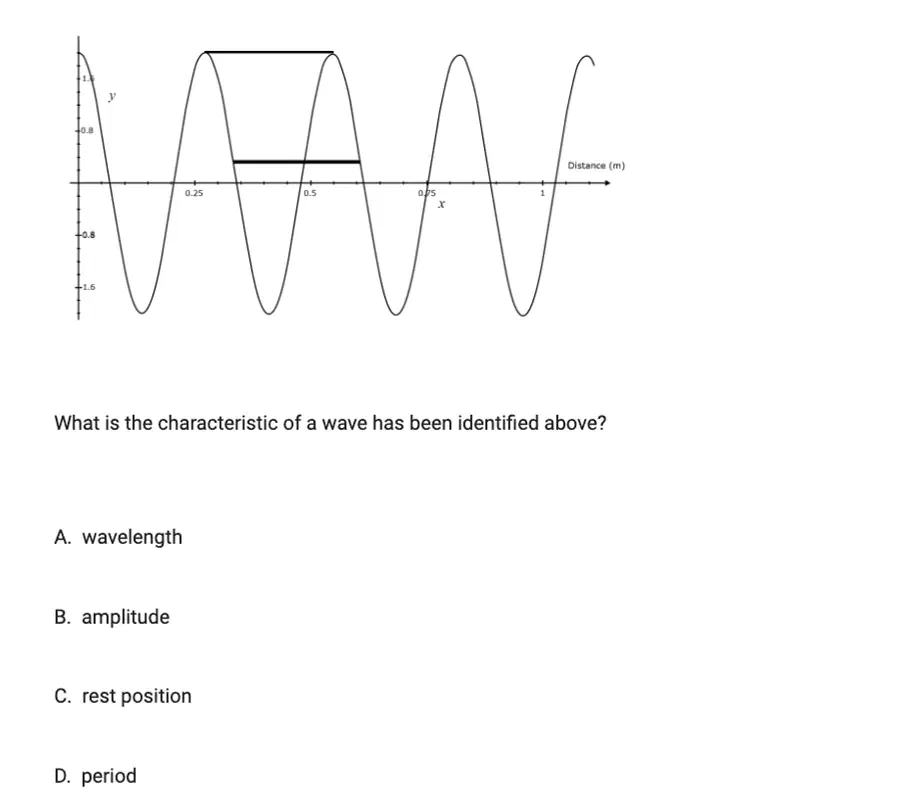
What is the characteristic of a wave has been identified above?
wavelength
amplitude
rest position
period
How can the amplitude of a wave be determined?
By measuring the distance between the two highest points on a wave
By subtracting the value for the lowest point from the value for the highest point on a wave.
By measuring the distance between the lowest and the highest point on a wave.
By measuring the maximum distance that the particles of the medium move from the resting position when the wave passes through it.
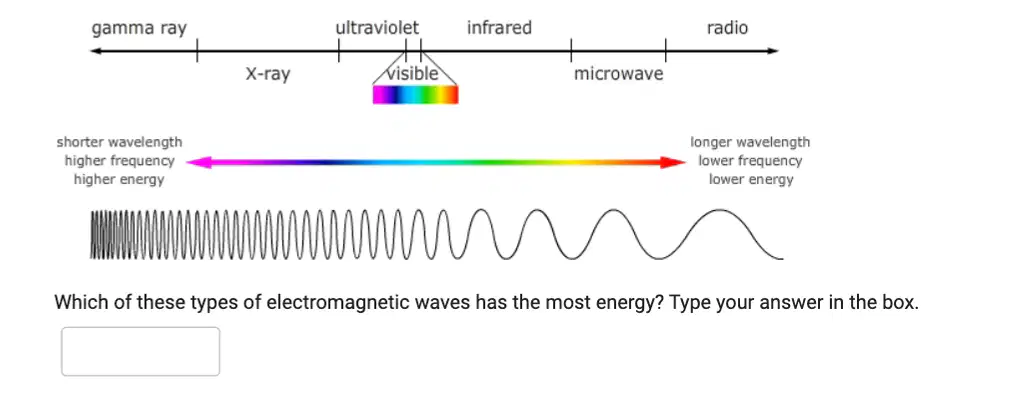
Which of these types of electromagnetic waves has the most energy?
Gamma ray
X-ray
Ultraviolet
Microwave
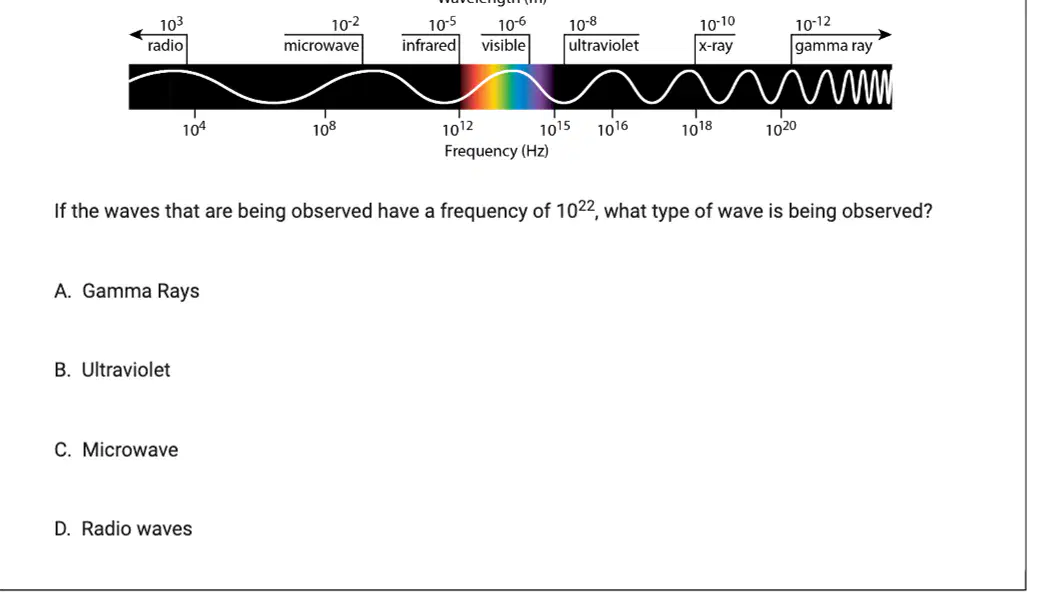
If the waves that are being observed have a frequency of 10^22, what type of wave is being observed?
A. Gamma Rays
B. Ultraviolet
C. Microwave
D. Radio waves
Scientists continue to study how different chemicals reflect and absorb light. Which products are most likely to benefit from this research?
sunscreen lotions
gasoline additives
basketball sneakers
antibiotic medicines
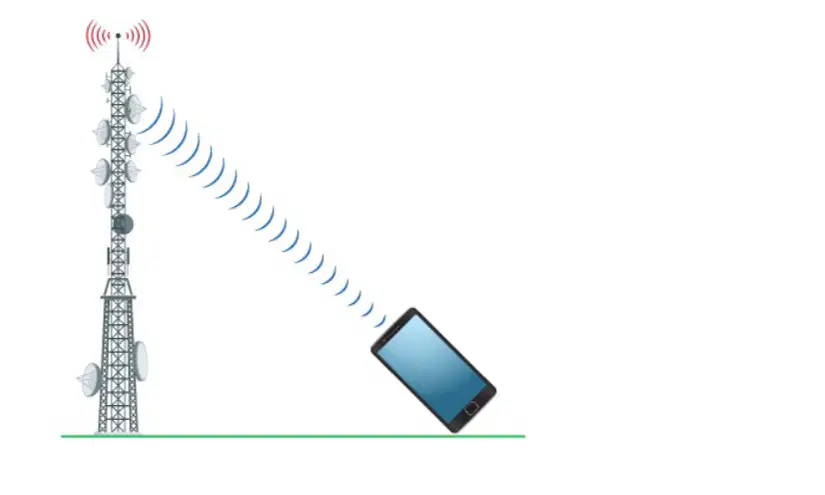
Which application of electromagnetic waves is depicted in the following image?
Radiation therapy
Wireless communication
Medical imaging
Fiber optics
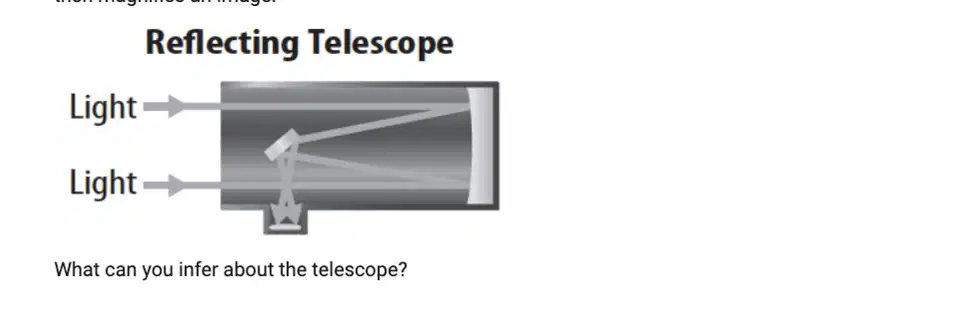
The diagram below shows a reflecting telescope. The telescope gathers and focuses visible light, and then magnifies an image. What can you infer about the telescope?
A. It is used to study the entire range of wavelengths in a star's spectrum.
B. It is used to study the highest form of energy emitted by stars.
C. It is used to study stars that emit radiation that can be seen by the human eye.
D. It is used to study the shortest wavelengths emitted by stars.
Which has the greatest potential energy?

The energy in the picture is being transformed from ____ to ____.
Electrical to light
Electrical to solar
mechanical to sound
Thermal to Radiant

Which wave has more energy? Why?
Top wave because the amplitude is smaller
Bottom wave because the amplitude is larger
They are the same because the wavelengths are equal

When a lion eats a zebra and then uses the energy from the zebra to run, the lion's body converts =-
chemical energy to mechanical energy
electrical energy to chemical energy
chemical energy to light energy
mechanical energy to chemical energy

What energy transformations occur when propane gas is used to lift the balloon?
Mechanical -> light -> chemical
Chemical -> mechanical -> thermal
Thermal -> chemical -> light
Chemical -> thermal -> mechanical
Electrical Energy
Electrical Outlet
Chemical Energy
Battery
Mechanical Energy
Movement
Thermal Energy
Heat

