
 Worksheets
Quiz-3
Total questions: 27
Worksheet time: 50mins

What is the Range of this linear function?
-6 ≤ y ≤ 6
0 ≤ y ≤ 6
0 ≤ x ≤ 6
-6 ≤ x ≤ 6

What is the Domain of this linear function?
−6≤x≤6
0≤y≤6
0≤y≤6
−6≤y≤6

What is the range of this relation?

What is the domain?
x≥0
x>0
All real numbers
{0, 1, 2, 3, 4,...}

Is this a function ?
is {-1, 0 , 1}?
If f(x) = 2x + 5, find f(2a-1).
(a)
f(x) = x2 + ax − 8 . If f(-3) = 13, determine the value of a.
12
-12
-4
4
If f(x) = 5x + 2, determine f(x+1) and simplify if possible.
5x+7
5x+3
5x2+2


What is the relative maximum?
(1,2)
(2,2)
(0,-2)

What is the relative minimum?
(1,2)
(2,2)
(0,-2)
No relative minimum

Identify all local minima
(3.25, 2.25)
(2.25, 4.5)
(−.5, −7.5)
(5,6)

What is the absolute minimum?
Does not exist
(−3, −2)
(2, 0)
(−∞,−∞)

Find the x-intercept(s) of the graph shown.
(Pick all answers that apply)
(-3.3, 0)
(5.6, 0)
(-5, 0)
(0, 4)
Find the y-intercept(s) of the graph shown.
(-3.3, 0)
(5.6, 0)
(-5, 0)
(0, 4)
Find the interval(s) of increase of the graph shown.
(-6, -4)
(-4, -2)
(-2, 2)
(2, 5)
(5, 6)
Find the interval(s) of decrease of the graph shown.
(There is more than one answer)
(-6, -4)
(-4, -2)
(-2, 2)
(2, 5)
(5, 6)
Find the interval(s) where the graph remains constant.
(-6, -4)
(-4, -2)
(-2, 2)
(2, 5)
(5, 6)


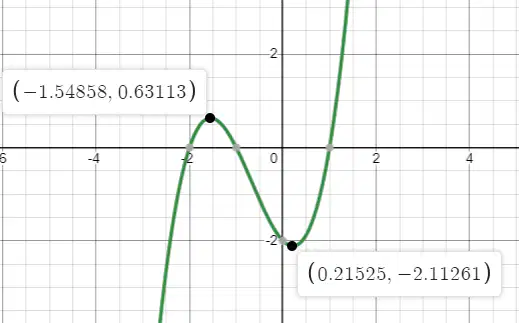
At what x-value does f(x) have the absolute minimum?
x = -1.54
x = .63
x = -2.11
The function has no absolute min
What are the zeros of f(x)=2∣x−2∣−6 ?
x=4,x=3
x=3,x=0
x=5,x=-1
x=3,x=-1
Find the y-intercept of f(x)=−∣x−13∣+5
(0,18)
(18,0)
(0,-8)
(-8,0)
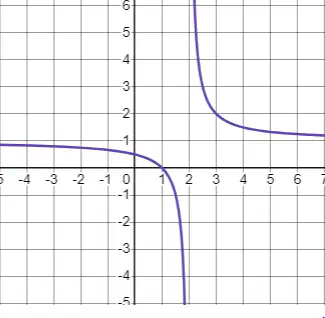
What are the intervals of increase and decrease ?
Interval of increase:
(-∞,2)U(2,∞)
Interval of decrease: DNE
Interval of decrease:
(-∞,2)U(2,∞)
Interval of increase: DNE
Interval of increase:
(-∞,1)U(1,∞)
Interval of decrease: DNE
Interval of decrease:
(-∞,1)U(1,∞)
Interval of increase: DNE
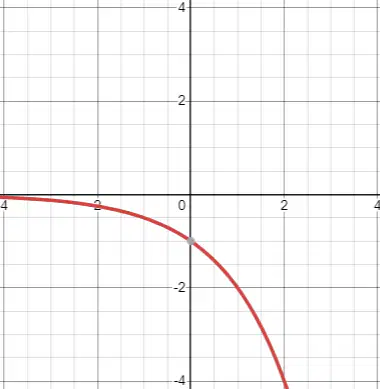
Find the Intervals of increase and decrease
Interval of increase: DNE
Interval of decrease:
(-∞,∞)
Interval of increase: DNE
Interval of decrease:
(-∞,0)
Interval of increase: DNE
Interval of decrease:
(0,∞)
Interval of decrease: DNE
Interval of increase:
(-∞,0)

