
 Worksheets
FAME 10.3.24 Music Theory Diagnostic Assessment
Total questions: 69
Worksheet time: 1hrs 25mins
What is the name of the symbol that indicates the pitch of written notes?
Clef
Staff
Note
Bar
Which note is represented by the first line of the treble clef staff?
E
G
F
A
What is the time signature that indicates four beats per measure, with each beat being a quarter note?
3/4
4/4
2/4
6/8
Identify the key signature with one sharp.
G major
D major
A major
C major
Which of the following is a half step above C?
D
C#
B
E
Explain how a dotted quarter note is counted in 4/4 time.
1 beat
1.5 beats
2 beats
0.5 beats
Which of the following scales is a minor scale?
C major
A minor
G major
F major
Describe the difference between a major and a minor chord.
Major chords are louder than minor chords.
Major chords have a brighter sound, while minor chords have a darker sound.
Major chords are played faster than minor chords.
Major chords use more notes than minor chords.
If a piece of music is in the key of D major, which of the following chords would likely be used?
E minor
F# minor
C major
A minor
Analyze the chord progression: C - G - Am - F. What is the function of the G chord in this progression?
Tonic
Subdominant
Dominant
Mediant
Given the melody in C major: C - E - G - A - F - E - D - C, identify the climax note.
C
G
A
F
Plan a simple 8-bar melody in 4/4 time using the C major scale. Which note would you start and end on to create a sense of resolution?
G
E
C
D
Evaluate the effect of changing a piece from a major key to its relative minor key.
It becomes faster.
It sounds more cheerful.
It sounds more somber.
It becomes louder.
What is the role of the bass line in a piece of music?
To provide harmony
To establish rhythm
To support the melody
To create dissonance
In a 12-bar blues progression, which chord is typically used in the 5th bar?
I
IV
V
vi
What is the interval between the notes C and G?
Perfect Fourth
Perfect Fifth
Major Third
Minor Sixth
Which note is a whole step above A?
B
A#
C
G
In a piece of music, what is the function of a rest?
To indicate a pause in the music
To increase the tempo
To change the key signature
To add a new instrument
What is the function of a time signature in music?
To indicate the key of the piece
To show the tempo of the piece
To specify the number of beats in each measure
To determine the dynamics of the piece
Which of the following notes is a whole step below E?
D
C#
F
G
What is the effect of adding a sharp to a note?
It lowers the pitch by a half step
It raises the pitch by a half step
It doubles the duration of the note
It changes the note to a rest
What is the effect of adding a flat to a note?
It raises the pitch by a half step
It lowers the pitch by a half step
It doubles the duration of the note
It changes the note to a rest
Which of the following is a characteristic of a waltz?
4/4 time signature
3/4 time signature
2/4 time signature
6/8 time signature
What is the function of a key signature in music?
To indicate the tempo of the piece
To show the dynamics of the piece
To specify the key of the piece
To determine the time signature
What is the term for gradually getting louder in music?
Crescendo
Decrescendo
Forte
Piano
Which instrument is part of the string family?
Flute
Violin
Trumpet
Clarinet
What is the term for the speed of the beat in a piece of music?
Rhythm
Tempo
Harmony
Melody
What is the interval between the notes C and G?
Perfect Fifth
Major Third
Minor Sixth
Perfect Fourth
Which of the following is a characteristic of a minor scale?
It has a raised seventh note
It has a lowered third note
It has a raised fourth note
It has a lowered fifth note
What is the term for gradually getting louder in music?
Decrescendo
Staccato
Crescendo
Legato
What is the relative minor key of C major?
A minor
E minor
D minor
B minor
Which of the following is a common time signature in music?
3/4
5/4
7/8
4/4
What is the term for gradually getting louder in music?
Decrescendo
Staccato
Crescendo
Legato
What is the interval between the notes A and C?
Major third
Minor third
Perfect fourth
Major second
Interval is the distance or space between...
2 notes
3 notes
4 notes
5 notes
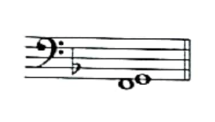
Please name the interval.
Minor 2nd
Major 2nd
Minor 3rd
Major 3rd
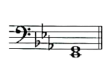
Please name the interval.
Minor 2nd
Major 2nd
Minor 3rd
Major 3rd
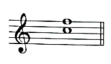
Please name the interval.
Major 4th
Perfect 4th
Perfect 5th
Minor 4th
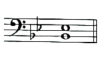
Please name the interval.
Diminished 4th
Major 4th
Perfect 4th
Augmented 4th
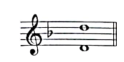
Please name the interval.
Perfect 8ve
Perfect 8th
Major 8th
Minor 8th
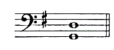
Please name the interval.
Major 5th
Perfect 5th
Minor 6th
Major 6th
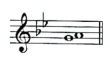
Please name the interval.
Minor 2nd
Major 2nd
Minor 3rd
Major 3rd
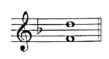
Please name the interval.
Minor 6th
Major 6th
Minor 7th
Major 7th
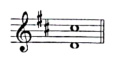
Please name the interval.
Minor 6th
Major 6th
Minor 7th
Major 7th
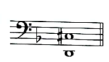
Please name the interval.
Minor 6th
Major 6th
Minor 7th
Major 7th
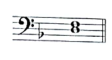
Please name the interval.
Minor 3rd
Major 3rd
Minor 6th
Major 6th
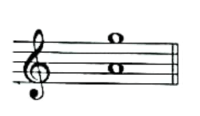
Please name the interval.
Minor 6th
Major 6th
Minor 7th
Major 7th
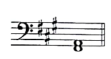
Please name the interval.
Minor 2nd
Major 2nd
Minor 3rd
Major 2nd
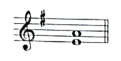
Please name the intervals.
Diminished 4th
Perfect 4th
Diminished 5th
Perfect 5th

What is the name of the key?
G major
C major
D major
A major

What is the name of the key?
F major
Bb major
Eb major
Ab major

What is the name of the key?
G major
C major
D major
F major

What is the name of the key?
Bb major
C major
F major
E major

What is the name of the key signature?
D major
G major
C major
F major

What is the name of the key signature?
D major
C major
F major
G major

What is the key signature?
F major
Eb major
Bb major
Ab major

What notes are sharp?
B E
F C
F G
C G

What notes are flat?
F B
F C
E A
B E

What note is sharp?
F
C
B
G

What note is flat?
F
D
B
E

What notes are sharp?
F C G
C G D
B E A
F G D

What notes are flat?
F C B
B E A
E G B
B E D

With this key signature, you play C#'s:
True
False

What is the name of the key signature:
C major
F major
G major
A major

With this key signature, you play Eb's:
True
False

With this key signature, you play G#'s:
True
False

With this key signature, you play Bb's:
True
False
What is the order of sharps? (Type your answer with one space between each letter)
(a)
What is the order of flats? (Type your answer with one space between each letter)
(a)

