
 Worksheets
CCNA 1 v7 Ethernet Concepts Quiz
Total questions: 25
Worksheet time: 13mins
What is the purpose of the OSI physical layer?
performing error detection on received frames
exchanging frames between nodes over physical network media
transmitting bits across the local media
controlling access to media
Which characteristic describes crosstalk?
the weakening of the network signal over long cable lengths
the distortion of the transmitted messages from signals carried in adjacent wires
the distortion of the network signal from fluorescent lighting
the loss of wireless signal over excessive distance from the access point
Which procedure is used to reduce the effect of crosstalk in copper cables?
designing a cable infrastructure to avoid crosstalk interference
avoiding sharp bends during installation
wrapping the bundle of wires with metallic shielding
twisting opposing circuit wire pairs together
What are two characteristics of fiber-optic cable?
It combines the technique of cancellation, shielding, and twisting to protect data.
It is not affected by EMI or RFI.
It typically contains 4 pairs of fiber-optic wires.
It is more expensive than UTP cabling is.
What is a primary role of the Physical layer in transmitting data on the network?
determine the path packets take through the network
control data access to the media
create the signals that represent the bits in each frame on to the media
provide physical addressing to the devices
Which two devices commonly affect wireless networks?
home theaters
cordless phones
microwaves
external hard drives
What is the function of the CRC value that is found in the FCS field of a frame?
to verify the physical address in the frame
to compute the checksum header for the data field in the frame
to verify the logical address in the frame
to verify the integrity of the received frame
Which statement describes a characteristic of the frame header fields of the data link layer?
They vary depending on protocols.
Ethernet frame header fields contain Layer 3 source and destination addresses.
They include information on user applications.
They all include the flow control and logical connection fields.
What action will occur if a switch receives a frame with the destination MAC address FF:FF:FF:FF:FF:FF?
The switch shares the MAC address table entry with any connected switches.
The switch sends the frame to a connected router.
The switch does not forward the frame.
The switch forwards it out all ports except the ingress port.
What is the auto-MDIX feature on a switch?
the automatic configuration of full-duplex operation over a single Ethernet copper or optical cable
the ability to turn a switch interface on or off accordingly if an active connection is detected
the automatic configuration of an interface for a straight-through or a crossover Ethernet cable connection
the automatic configuration of an interface for 10/100/1000 Mb/s operation
Which type of UTP cable is used to connect a PC to a switch port?
console
straight-through
rollover
crossover
What is contained in the trailer of a data-link frame?
error detection
data
physical address
logical address
What is the PDU of Data Link Layer
What is a characteristic of the LLC sublayer?
It provides the logical addressing required that identifies the device.
It provides delimitation of data according to the physical signaling requirements of the medium.
It places information in the frame allowing multiple Layer 3 protocols to use the same network interface and media.
It defines software processes that provide services to the physical layer.
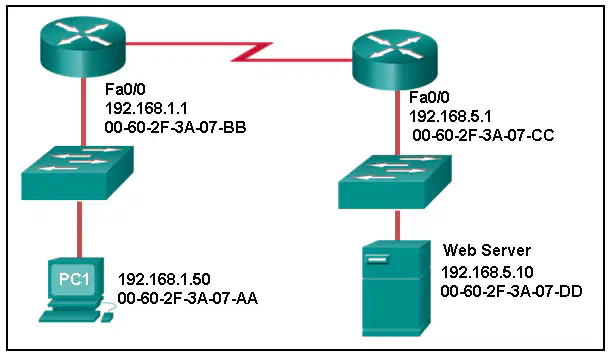
Refer to the exhibit. What is the destination MAC address of the Ethernet frame as it leaves the web server if the final destination is PC1?
00-60-2F-3A-07-AA
00-60-2F-3A-07-BB
00-60-2F-3A-07-CC
00-60-2F-3A-07-DD
What are two examples of the cut-through switching method? (Choose two.)
store-and-forward switching
fast-forward switching
CRC switching
fragment-free switching
Which frame forwarding method receives the entire frame and performs a CRC check to detect errors before forwarding the frame?
What is the purpose of the FCS field in a frame?
Which switching method has the lowest level of latency?
Fast-Forward
Which is a multicast MAC address?
5C-26-0A-4B-19-3E
FF-FF-FF-FF-FF-FF
01-00-5E-00-00-03
00-26-0F-4B-00-3E
What does the term “attenuation” mean in data communication?
Attenuation is the reduction of signal strength as distance increases.
What OSI physical layer term describes the capacity at which a medium can carry data?
What OSI physical layer term describes the amount of time, including delays, for data to travel from one point to another?
What action will occur if a host receives a frame with a destination MAC address it does not recognize?
The host will discard the frame.
What OSI physical layer term describes the measure of usable data transferred over a given period of time?
Goodput

