
 Worksheets
Algebra II Term Benchmark Study Guide
Total questions: 144
Worksheet time: 8hrs 31mins

What is the DOMAIN of the graph?
[−7,5)
[−3, 1]
[−3, 1)
[−7, 5]
What is the DOMAIN of the graph?
[−7,5)
[−3, 1]
[−3, 1)
[−7, 5]
What is the RANGE of the graph?
(−7,5)
[−7,5)
[−3, 1)
(−3,1)
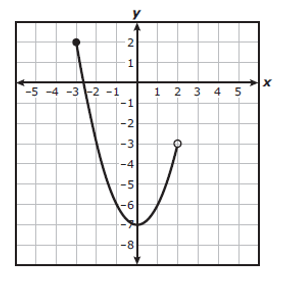
What is the DOMAIN?
[−3, 2)
[−7, 2)
(−3, 2)
(−7, 2)
What is the RANGE?
(−7, 2)
[−7, 2]
[−3, 2)
(−3, 2)

What is the DOMAIN?
(−∞, ∞)
(−∞, 6]
[−10, ∞)
[−10, 10]
What is the RANGE?
(−∞, 6]
[−10, 6]
[−10, ∞)
(−∞, ∞)

What is the DOMAIN of this linear function?
[−6, 6]
[0, 6]
(−∞, ∞)
No Solution

What is the RANGE of this linear function?
(−∞, ∞)
[0, 6]
[−6, 6]
No Solution
What is the DOMAIN?
−3≤x<2
−∞<x<∞
−7≤x≤2
−∞<x≤2
What is the RANGE?
−3≤y<2
−∞<y<∞
−7≤y≤2
−∞<y≤2

What is the DOMAIN of the graph?
−3≤x≤3
−∞<x<∞
−2≤x≤10
−3≤x<∞

What is the RANGE of the graph?
−3≤y≤3
−∞<y<∞
−2≤y≤10
−3≤y<∞

What is the RANGE of the function?
−∞<y<∞
1<y<3
−∞<y<3
2<y<∞
Identify the graph with a x-intercept of 3 and a y-intercept of - 1


Identify the graph with a x-intercept of -2 and y-intercept of 2


What is the y-intercept?
12
-3
8
0

4x - 5y = 40
y intercept is 8
y intercept is 20
y intercept is 10
y intercept is -8

What is the maximum value (y-value only)?
5
0
-5
2

What is the minimum value (y-value only)?
-1
0
-5
-3

Grace is tracking the temperature over a week. What is the minimum temperature recorded (y-value only)?
-5
-3
0
-1

How many extrema are there in this graph?
2 max, 2 min
3 max, 2 min
2 max, 3 min


Determine end behavior of function with the given graph
x→−∞; f(x) → −∞ x→+∞; f(x)→+∞
x→−∞; f(x)→+∞ x→+∞; f(x)→−∞
x→−∞; f(x)→−∞ x→+∞; f(x)→ −∞
x→−∞; f(x)→+∞ x→+∞; f(x)→+∞

Determine end behavior of function with the given graph
x→−∞; f(x) → −∞ x→+∞; f(x)→+∞
x→−∞; f(x)→+∞ x→+∞; f(x)→−∞
x→−∞; f(x)→−∞ x→+∞; f(x)→ −∞
x→−∞; f(x)→+∞ x→+∞; f(x)→+∞

Determine end behavior of function with the given graph
x→−∞; f(x) → −∞ x→+∞; f(x)→+∞
x→−∞; f(x)→+∞ x→+∞; f(x)→−∞
x→−∞; f(x)→−∞ x→+∞; f(x)→ −∞
x→−∞; f(x)→+∞ x→+∞; f(x)→+∞

Determine end behavior of function with the given graph
x→−∞; f(x) → −∞ x→+∞; f(x)→+∞
x→−∞; f(x)→+∞ x→+∞; f(x)→−∞
x→−∞; f(x)→−∞ x→+∞; f(x)→ −∞
x→−∞; f(x)→+∞ x→+∞; f(x)→+∞

x→ ∞, y→⁻∞
x→⁻∞, y→∞
x→∞, y→⁻∞


What is the increasing interval on the function shown?
(−∞, 1)
(−∞, 2)
(2, ∞)
(1, ∞)

When is the function decreasing?
(30, 55)
(40, 60]
(15, 40)
(60, -40)

What is the decreasing interval on the function shown?
(−∞, −3)
(−∞, −4)
(−4, ∞)
(−3, ∞)

Where is this graph increasing or decreasing?
Increasing: (−7, −3)
Decreasing: (−7, 2)
Increasing: (0, 2)
Decreasing: (−3, 0)
Increasing: (−3, 0)
Decreasing: (0, 2)
Increasing: (−7, 2)
Decreasing: (−7, −3)
Where is this graph increasing or decreasing?
Increasing: (−∞, −2)
Decreasing: (−2, ∞)
Increasing: (−2, ∞)
Decreasing: (−∞, −2)
Increasing: (−∞, 6)
Decreasing: (6, ∞)
Increasing: (−10, −2)
Decreasing: (−2, 6)
Where is this graph increasing or decreasing?
Increasing: (−6, −3), (0, 3)
Decreasing: (−3, 0), (3, 6)
Increasing: (−3, 0), (3, 6)
Decreasing: (−6, −3), (0, 3)
Increasing: (−2, 6), (0, 3)
Decreasing: (2, 4), (0, 3)
Increasing: (2, 4), (0, 3)
Decreasing: (−2, 6), (0, 3)

What is the increasing interval(s) on the function shown?
−∞<x<−15 or 9<x<−15
−2<x<9 or 2<x<∞
−∞<x<−2 or 0<x<2
−2<x<0 or 2<x<∞
What is the decreasing interval(s) on the function shown?
−∞<x<−15 or 9<x<−15
−2<x<9 or 2<x<∞
−∞<x<−2 or 0<x<2
−2<x<0 or 2<x<∞
Label the transformations that a, b, c, & d represent in a function.
What are the following transformations?
g(x) = - (x+2)
reflection over the y axis and 2 units to the right
reflection over the x axis and 2 units right
reflection over the y axis and 2 units left
reflection over the x axis and 2 units left
g(x) = f(-x) - 4
-2f(x - 1) + 2
−f(x+3)+4
Describe the transformations:
Shifted left 3 units
Shifted up 4 units
Reflection over the y-axis
Shifted right 3 units
Shifted up 4 units
Shifted right 3 units
Shifted up 4 units
Reflection over the x-axis
Shifted left 3 units
Shifted up 4 units
Describe the transformations
g(x+4)−6
4 Units Left
6 Units Up
4 Units Left
6 Units Down
4 Units Right
6 Units Up
4 Units Right
6 Units Down
If g(x) is formed by transforming f(x), how would we stretch f(x) vertically by a factor of 3?
f(x)=3(5x−4)+2
Multiply 3 by 3
Divide 3 by 3
Multiply 5 by 3
Divide 5 by 3
If g(x) is formed by transforming f(x), how would we find g(x)=3(x) ?
f(x)=3(5x−4)+2
Multiply 3 by 3
Divide 3 by 3
Multiply 5 by 3
Divide 5 by 3
If g(x) is formed by transforming f(x), how would we stretch f(x) horizontally by a factor of 3?
f(x)=3(5x−4)+2
Multiply 3 by 3
Divide 3 by 3
Multiply 5 by 3
Divide 5 by 3
If g(x) is formed by transforming f(x), how would we find g(x)=(31x) ?
f(x)=3(5x−4)+2
Multiply 3 by 3
Divide 3 by 3
Multiply 5 by 3
Divide 5 by 3
If g(x) is formed by transforming f(x), how would we shrink f(x) horizontally by a factor of 3?
f(x)=3(5x−4)+2
Multiply 3 by 3
Divide 3 by 3
Multiply 5 by 3
Divide 5 by 3
If g(x) is formed by transforming f(x), how would we find g(x)=(3x) ?
f(x)=3(5x−4)+2
Multiply 3 by 3
Divide 3 by 3
Multiply 5 by 3
Divide 5 by 3
If g(x) is formed by transforming f(x), how would we shrink f(x) vertically by a factor of 3?
f(x)=3(5x−4)+2
Multiply 3 by 3
Divide 3 by 3
Multiply 5 by 3
Divide 5 by 3
If g(x) is formed by transforming f(x), how would we find g(x)=31x ?
f(x)=3(5x−4)+2
Multiply 3 by 3
Divide 3 by 3
Multiply 5 by 3
Divide 5 by 3
If g(x) is formed by transforming f(x), how would we shift f(x) up by 3 units?
f(x)=3(5x−4)+2
Add 3 to 2
Subtract 3 from 2
Subtract 3 from -4
Add 3 to -4
If g(x) is formed by transforming f(x), how would we find g(x)=x+3 ?
f(x)=3(5x−4)+2
Add 3 to 2
Subtract 3 from 2
Subtract 3 from -4
Add 3 to -4
If g(x) is formed by transforming f(x), how would we shift f(x) down by 3 units?
f(x)=3(5x−4)+2
Add 3 to 2
Subtract 3 from 2
Subtract 3 from -4
Add 3 to -4
If g(x) is formed by transforming f(x), how would we find g(x)=x−3 ?
f(x)=3(5x−4)+2
Add 3 to 2
Subtract 3 from 2
Subtract 3 from -4
Add 3 to -4
If g(x) is formed by transforming f(x), how would we shift f(x) left by 3 units?
f(x)=3(5x−4)+2
Add 3 to 2
Subtract 3 from 2
Subtract 3 from -4
Add 3 to -4
If g(x) is formed by transforming f(x), how would we find g(x)=(x+3) ?
f(x)=3(5x−4)+2
Add 3 to 2
Subtract 3 from 2
Subtract 3 from -4
Add 3 to -4
If g(x) is formed by transforming f(x), how would we shift f(x) right by 3 units?
f(x)=3(5x−4)+2
Add 3 to 2
Subtract 3 from 2
Subtract 3 from -4
Add 3 to -4
If g(x) is formed by transforming f(x), how would we find g(x)=(x−3) ?
f(x)=3(5x−4)+2
Add 3 to 2
Subtract 3 from 2
Subtract 3 from -4
Add 3 to -4
y = g(x) to y = - g(x + 6) - 10
Shifted down 10 units
Shifted left 6 units
Shifted up 10 units
Shifted left 6 units
Shifted up 10 units
Shifted right 6 units
Shifted down 10 units
Shifted left 6 units
In the graph of the function y=x², which equation moves the graph down 5 units?
y = x2 - 5
y = x2 + 5
y = (x - 5)2
y = (x + 5)2
y=(x+2)2+4
*Mark all that apply.
reflection across x-axis
left 2
up 4
right 2
Select all the equations that show a vertical shift from its parent function.
y=∣x+1∣
y=x3+4
y=x−10
y=(x−3)2
y=x2−1
Select all equations that show a horizontal shift from its parent function.
y=∣x−4∣
y=(x−9)3
y=x2+8
y=∣x∣−5
y=x+1
Describe the transformations:
y = x2 to y = 2(x+3)2 - 5?
Horizontal Stretch by 2, shift 3 units left and 5 down
Horizontal Stretch by 2, shift 5 units left and 3 up
Vertical Stretch by 2, shift 3 units left and 5 down
Vertical Shrink by 1/2, shift 5 units left and 3 up

Choose the equation that best matches the graphed function.
f(x)=∣x−4∣+3
f(x)=∣x−3∣+4
f(x)=∣x−4∣−3
f(x)=∣x+4∣+3


f(x) is shown. If g(x)=−4⋅f(x)−2 which of the following graphs shows g(x)?


Even, odd, or neither?
Even
Odd
Neither

Is the table even, odd or neither?
Even
Odd
Neither

Is the table even, odd or neither?
Even
Odd
Neither
Is the table even, odd or neither?
Even
Odd
Neither
v2 + 6v + 5 = 0
z2 - 6z - 27 = 0
Solve the following quadratic...
x2 + 12x + 20 = 0
x = 5, 4
x = 2, 10
x = -5, -4
x = -2, -10

Find the zeros of the following quadratic function.
f(x) = x2 − x −30
{x = -5, 6}
{x = -6, 5}
{x = -3, 10}
{x = -10, 3}
Find the x-intercept(s) of the following quadratic.
x2 − 12x =− 36
(6, 0)
(6, 0) and (-6, 0)
(-6, 0)
no x-intercepts
Solve for x.
5(x - 3)2 + 1 = 81
x = -1, 7
x = -7, 1
x = ± 9
x = 3, 10
Solve for x.
-7(x + 3)2 + 63 = 0
x = 0, 6
x = -6, 12
x = -6, 0
x = 6, 12
2x2 + 17x + 21 = 0

x2+5x +8 =0
Solve the given equation using the Quadratic Formula. Make sure you fully simplify your answer.
2−5±57
25±57
2−5±i7
25±i7
x2−6x +12 =0
Solve the given equation using the Quadratic Formula. Make sure you fully simplify your answer.
3±i3
3± 3
26±−12
3±i
−x2+6x −10 =0
Solve the given equation using the Quadratic Formula. Make sure you fully simplify your answer.
−2−6±76
3±i
−3±i
−26±76
3x2−3x +13 =0
Solve the given equation using the Quadratic Formula. Make sure you fully simplify your answer.
6−3±7i3
63±7i3
6−3±i163
63±i163
What does the discriminant determine?
Whether the graph goes up or down
The vertex
The number of Solutions
The y-intercept
What is the discriminant in the Quadratic Formula?
-b + 4ac
b - 4ac
-b2 - 4ac
b2 - 4ac
If the discriminant is positive, how many real solutions does the graph have?
2
1
0
If the discriminant is negative, how many real solutions does the graph have?
2
1
0
If the discriminant is zero, how many real solutions does the graph have?
2
1
0
Find the discriminant: 2a2 - 5a + 5 = 0
44
65
-15
-144
How many real solutions does 2a2 - 5a + 5 = 0 have?
2
1
0

±
x2 + 6x = 5
k2 − 12k + 23 = 0


When factoring x2−10x+25 = 49 what goes into the blank (x−....)2=49
5
10
7
25
Which equation shows vertex form of a quadratic function?
f(x)=a(x−h)2+k
f(x)=ax2+bx+c
f(x)=a(x−r1)(x−r2)
x=−2ab
What transformations have occurred in the function: f(x)=−3(x−1)2+6
Reflection across the x-axis; Vertical stretch of 3; Right 1; Up 6
Horizontal compression of 3; Left 1; Down 6
Horizontal stretch of 1; Reflection across the x-axis; Up 6
Reflection across the x-axis; Vertical stretch of 3; Left 1; Up 6
Which graph has factors of (x+1) and (x-3) ?


(2x−1)(3x+4)
Find the equivalent expression.
6x2−5x−4
6x2+5x−4
6x+11x+4
6x+5x−4
6x2−11x−4
y = x2 + 6x + 2
What is the axis of symmetry in the function f(x) = (x-1)2 +2
x = 1
x = -1
x = 2
x = -2
Identify the extrema and the domain of the function y = -2(x+1)2 + 4
Max: 4, Domain: All Real Numbers
Min: -4, Domain: All Real Numbers
Max: 2, Domain: All real numbers when x is greater than 4
Min: -2, Domain: All real numbers when x is less than 4

Given the function y=(x±h)2+2
what is the value of h?
3
-3
2
-2

Given the equation f(x)=2(x−2)2±k
What is the value of k?
1
2
1.5
2.5


Match the equation with the graph:
y = (x - 2)2 + 4
y = -(x - 4)2 + 2
y = -(x - 2)2 + 4
y = -(x + 2)2 + 4

Which quadratic has COMPLEX roots?


Describe the transformation from the parent graph
Reflect over x, right 3, down 4
Reflect over y, right 3, down 4
Reflect over x, right 3, up 4
Reflect over y, left 3, down 4

Which quadratic function is represented by the graph?
y = –(x – 4)2 + 5
y = –(x + 4)2 + 5
y = –2(x – 4)2 + 5
y = –2(x + 4)2 + 5
None of these
1. Which of the following may represent the graph of y=2x2+8x+11 ?


What are the increasing and decreasing intervals for the function f(x) = (x+2)2-1?
Increasing: (−∞, −2)
Decreasing: (−2, ∞)
Increasing: (−2, ∞)
Decreasing: (−∞, -2)
Increasing: (−1, ∞)
Decreasing: (−∞, -1)
Increasing: (−∞, −1)
Decreasing: (−1, ∞)
What are the increasing and decreasing intervals for the function: g(x)=−2(x−3)2+1 ?
Increasing: (−∞, 3)
Decreasing: (3, ∞)
Increasing: (−∞, 1)
Decreasing: (1, ∞)
Increasing: (2, ∞)
Decreasing: (-∞, 2)
Increasing: (1, ∞)
Decreasing: (-∞, 1)
What is the decreasing interval on the function shown?
(−∞, 1)
(−∞, 2)
(2, ∞)
(1, ∞)

How many real and imaginary solutions does this graph have?
one real solution
no imaginary solutions
two real solutions
two imaginary solutions
one real solution
one imaginary solution

How many real and imaginary solutions does the quadratic have?
Two imaginary solutions
One real solution
One imaginary solution
Two real solutions
One real solution
No imaginary solutions
A rocket is launched in the air. The graph below shows the height of the rocket ℎ in meters after t seconds. Place the labels on the graph to show the characteristics of the graph.
decreasing interval
increasing interval
Minimum
Maximum
x-intercept
vertex
x-intercept
y-intercept
Write a quadratic function that represents a parabola that opens upward and has -intercepts (12 , 0) and (4 , 0).
y = (x - 12)(x - 4)
y = (x + 12)(x + 4)
y = - (x - 12)(x - 4)
y = - (x + 12)(x + 4)
Write a quadratic function that represents a parabola that opens downward and has -intercepts (-5 , 0) and (1 , 0).
y = (x + 5)(x - 1)
y = (x - 5)(x - 1)
y = - (x + 5)(x - 1)
y = - (x - 5)(x - 1)
Determine the axis of symmetry of the parabola with x intercepts ( -5, 0) and ( 7 , 0)
x = 1
x = 0
x = -1
x = 2
A rocket is launched with a velocity equation given by
v = -4t2
Does the rocket reach a maximum or minimum velocity?
maximum
minimum
The height of the ball after x seconds is given by the equation f(x)=12x−0.8x2
What is the maximum height of the ball?
7.5 feet
7.5 seconds
45 seconds
45 feet
What is the RANGE of the function
f(x)=(x+4)2−1(−4, ∞)
(−∞, ∞)
(−1, ∞)
(−∞, −1)

What is the domain of this quadratic function?
(−∞,∞)
[4, ∞)
(−∞, 2)
(−∞, 4]

What is the range of this quadratic function?
[4, ∞)
(−∞,4)
(−∞, 4]

