
Font size
 Worksheets
Supernovae
Total questions: 25
Worksheet time: 19mins
Why don't we need to worry about the sun becoming a supernova?
The sun already became a supernova.
It is spinning too slowly.
It doesn't have the right elements.
It is not big enough.
When the energy production (nuclear fusion) of a star stops, what does gravity do to it?
collapse the core
cause it to spin rapidly
shed the outer layers
produce a blue light
When our sun dies, it will leave behind a white dwarf star composed of the elements:
hydrogen and helium
silicon and oxygen
carbon and oxygen
iron and nitrogen
Since most stars orbit in pairs, if one of the stars is a white dwarf, it can steal material from the other star and explode as a Type ____ supernova.
II
3G
Ia
X
Where does most of the iron in the universe come from?
Iron is fused in the core of some white dwarf stars and released during a Type 1a supernova.
Iron is created as light leaves a star and interacts with the star's atmosphere.
Recycled metal on Earth is launched into space.
Iron was created during the big bang.
What happens to a massive star's core when it starts producing iron?
The core becomes unstable and begins to expand.
Iron fusion releases energy, causing the star to brighten.
The core collapses as iron fusion consumes energy instead of releasing it.
The star's core becomes a black hole immediately.
Neutron stars also rotate very rapidly. We call these ____.
quasars
pulsars
black holes
gamma ray bursts
The Crab Nebula is an example of a _____. It rotates 30 times per second and will continue doing that for millions of years.
red dwarf
YHG
pulsar
white dwarf
What element's spectral lines are commonly observed in the emission spectrum of a Type II supernova?
Hydrogen
Helium
Plutonium
Carbon
Which type of supernova is characterized by the absence of hydrogen in its emission spectrum?
Type Ia
Type IIP
Type IIL
Type III
How does a supernova impact the surrounding interstellar medium?
It cools it down significantly
It has no significant impact
It enriches it with heavy elements
It creates a vacuum in space
What is a neutron star, and how is it related to supernovae?
A star made entirely of neutrons, often the result of a Type Ia supernova
A star made entirely of neutrons, often the result of a Type II supernova
A hypothetical star with no relation to supernovae
A star that emits only neutrons
What is the significance of the "Chandrasekhar limit" in the context of supernovae?
It is the maximum mass of a star that can become a supernova
It is the minimum mass of a white dwarf above which it will explode as a Type Ia supernova
It is the distance from a supernova at which its impact on the Earth would be catastrophic
It is the maximum brightness of a supernova
How long can the afterglow of a supernova last?
A few days
Several months
Up to a few years
Forever
What is the "light curve" of a supernova?
The path light takes as it escapes the supernova
The shape of the supernova remnant
A graph showing the change in brightness of the supernova over time
The spectrum of light emitted by the supernova
Which of the following elements is NOT produced in significant amounts by the supernova nucleosynthesis process?
Uranium
Oxygen
Silicon
Hydrogen
What is the Crab Nebula, and how was it formed?
A nebula formed from the remnants of a supernova observed in 1054 AD
A nebula formed from the remnants of a galaxy collision
A nebula that is the birthplace of new stars, unrelated to supernovae
A theoretical nebula predicted to form from a future supernova
How does a supernova contribute to the chemical evolution of the universe?
By consuming all the hydrogen in the universe
By producing and dispersing heavy elements necessary for the formation of planets and life
By destroying heavy elements
By creating black holes that consume nearby matter
Which two things typically result from a Supernova II?
Black Hole and Nova
Black Hole and Neutron Star
Neutron Star and Supernova II
All of the above

Which of the following is a distinguishing property of a neutron star?
Spinning Rapidly
Strong Magnetic Field
Density beyond belief
All of the above
What conditions must exist for a black hole to form?
When the core remnants of a Supernova I are greater than 3 solar masses.
When core remnants of a Supernova II are less than 3 solar masses.
When core remnants of a Supernova II are greater than 3 solar masses.
When the core remnants of any type of Supernova are greater than 1 solar mass.

Type II supernovae occur when a star with at least ____ times the mass of our sun explodes.
1.5
3
8
Which light curve graph is typical for a supernova?
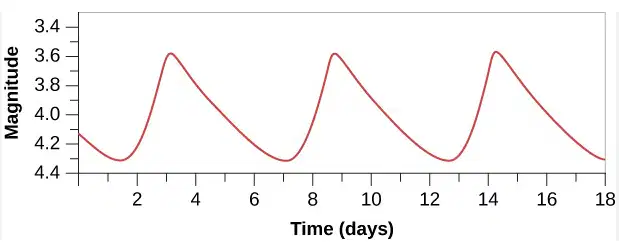


Which of the following are examples of stars that are expected to supernova?
Betelgeuse
Eta Carinae
Antares
Sun
According to the Chandrasekhar limit, a white dwarf star bigger than ____ times the mass of the Sun will supernova.
1.4
3
8
100

