
 Worksheets
Unit 2 Exam Review
Total questions: 17
Worksheet time: 25mins
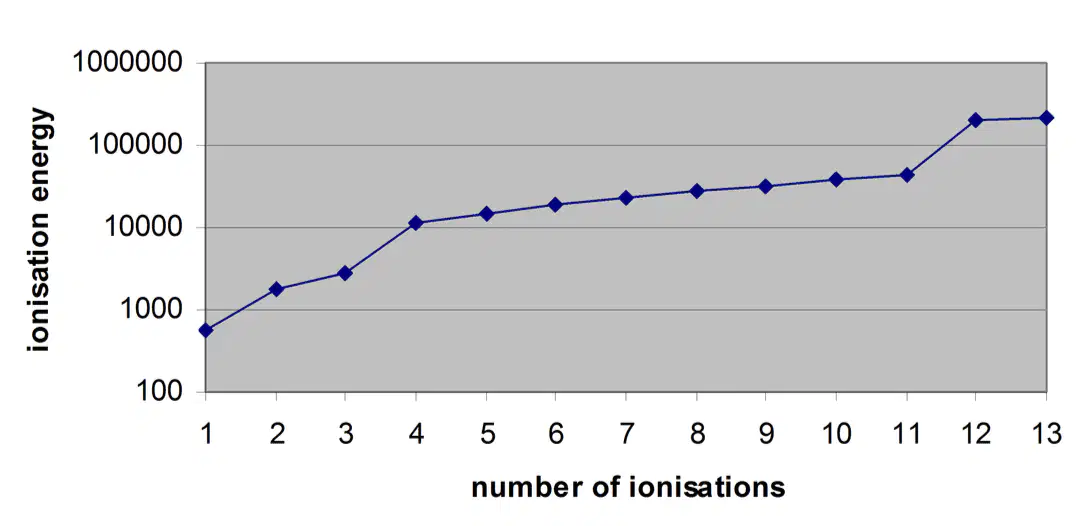
Which of the following statements about this graph of successive ionization energies of a single atom is TRUE?
The atom is in group 13.
The atom has 3 valence electrons.
The atom will ionize to form an anion.
The atom has 10 core electrons.
Which of the following ions is isoelectronic to Neon (Ne)?
Mg2+
Be2+
O2-
Cl-
Which of the following statements is true about elements with high electronegativity?
They are more likely to gain electrons during chemical reactions.
They tend to form cations easily.
They have a smaller effective nuclear charge.
They experience a weaker attraction between the nucleus and valence electrons.

Select the piece of evidence that best supports the statement: When comparing two atoms, the ionization energy decreases when the shielding effect increases.
Comparison of the ionization energy data points for As and Br
Comparison of the ionization energy data points for Ar and K
Comparison of the ionization energy data points for B and C
Comparison of the ionization energy data points for Li and Na
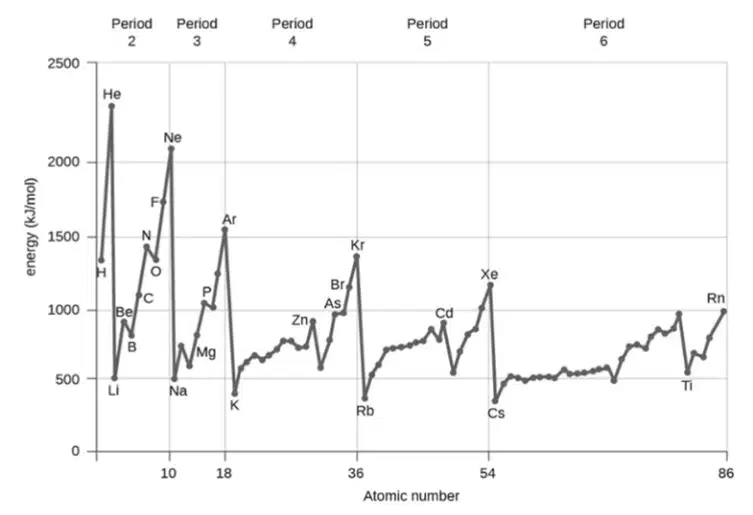
Which is the best explanation for why this occurs?
Effective nuclear charge increases as you move from left to right across a period
Electron shielding remains constant as you move from left to right across a period
Electron shielding stays the same as you move from top to bottom down a group
Effective nuclear charge and electron shielding are not involved in why the ionization energy changes
When copper becomes a cation, it will lose electrons from which subshell?
1s2 2s2 2p6 3s2 3p6 4s2 3d9
3s
3p
4s
3d
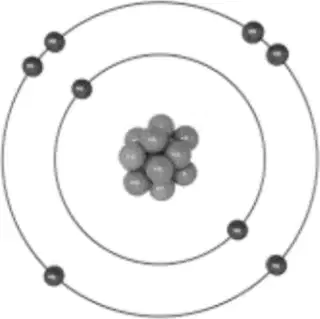
Which group number does the atom in the diagram belong to?
A. 2
B. 6
C. 16
D. 18
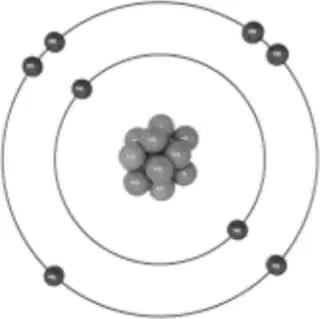
Which of the following has the same number of valence electrons as the atom in the diagram?
Neon (Ne)
Phosphorus (P)
Iodine (I)
Selenium (Se)
What charge will this Nitrogen have when it ionizes to its most stable ionic form? (HINT: How many VALENCE electrons does it need to be "stable"?)
3–
5–
0 because it already has a full octet and will not ionize.
3+
What causes the shielding effect to remain constant as additional valence electrons are added across a period?
The atomic radius increases as valence electrons are added
The charge on the nucleus is constant across a period
The valence electrons are added to different energy levels of the period
The number of core electrons does not change as electrons are added to valence subshells of the period.
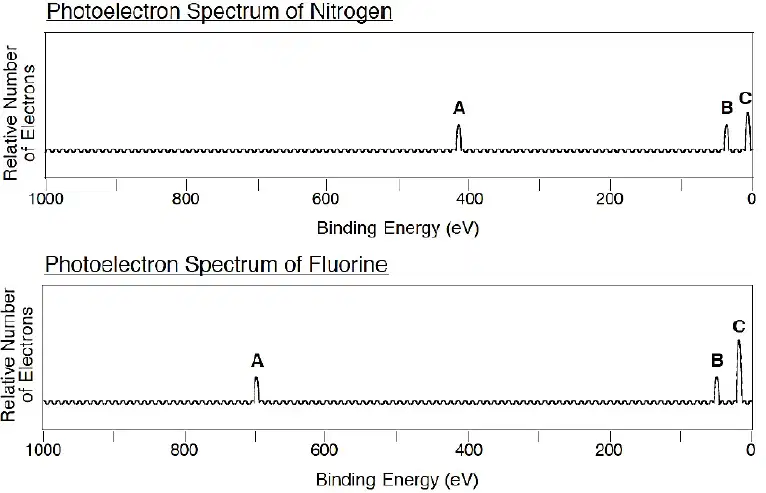
Where would you expect the binding energy of the 2s electrons in OXYGEN to be, given the PES graphs for Nitrogen and Fluorine?
"Between ______eV and _______ eV"
Shielding/ core elctrons do NOT change between Nitrogen and Fluorine, so what is contributing to the differences in their binding energies?
Does atomic radius INCREASE as you move across a period from left to right? (for example, does it increase as you go from Na to Cl?) Why?
Agree or disagree: The anion O2- has a SMALLER atomic radius than a neutral O atom.
Why do you agree or disagree?
Label the peaks of the PES graph with their electron configuration
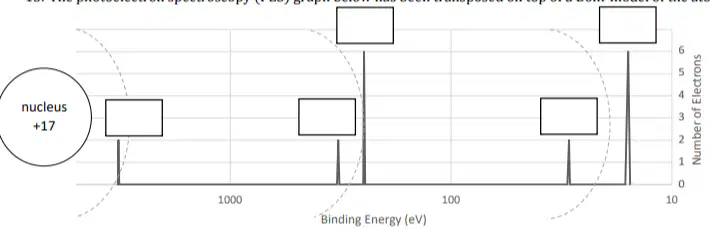
What element is shown here based on the NUCLEUS?
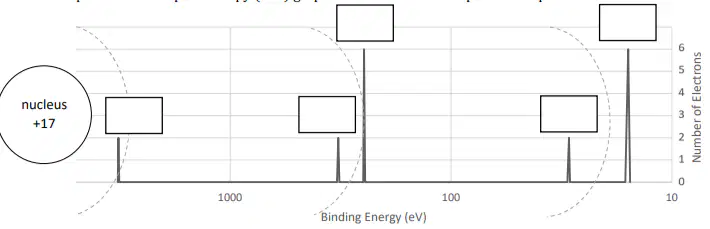
Is this atom neutral, or is it a charged ion? How do you know?

