wayground logo

Free Printable Worksheets

NEW

Font size

S
M
L
XL
Worksheets

Unit 2 Exam Review

Total questions: 45

Worksheet time: 45mins

Name
Class
Date
1.
Which of the following sequences corresponds to a correct trend in ionization energy?
a)
Cl > S > P > Al
b)
Sr > Ca > Mg > Be
c)
Rb > K > Na > Li
d)
Rb > Sr > I > Xe
2.
Which element has the greater ionization energy?
a)
Strontium
b)
Boron
3.
Which element has the greater ionization energy?
a)
Lead
b)
Silicon
4.
Put the following in order of increasing ionization energy:Neon, Lithium, Carbon
a)
Lithium, Carbon, Neon
b)
Carbon, Lithium, Neon
c)
Neon, Carbon, Lithium
d)
Lithium, Neon, Carbon
5.
What is ionization energy?
a)
Energy required to remove an electron
b)
Energy needed to split an electron
c)
Energy required to add an electron
6.

Ionization energy __________ as you go across a period

a)

stays the same

b)

decreases

c)

increases

7.

Ionization energy __________ as you go down a group.

a)

stays the same

b)

decreases

c)

increases

8.

Which element has the greater ionization energy?

a)

Magnesium (Mg)

b)

Phosphorus (P)

9.

Which element has the greater ionization energy?

a)

Iodine (I)

b)

Chlorine (Cl)

10.

The vertical (up and down) columns in the Periodic Table are called

a)

groups

b)

towers

c)

periods

d)

atomic numbers

11.
Which of the following will have a larger radius than Zinc?
a)
Gallium
b)
Aluminum
c)
Magnesium
d)
Strontium
12.
As you move down the periodic table atoms get bigger.  This is because ____________.
a)
The atoms have more mass.
b)
The atoms have more protons.
c)
The atoms have more energy levels
d)
The atoms have more nuetrons
13.
As you move across the periodic table atoms tend to get smaller because, ______________.
a)
the atoms have more mass.
b)
the atoms have less mass
c)
the atoms have more protons.
d)
the atoms have less electrons.
14.
The atom with the largest atomic radius in Group 18 is - 
a)
Ar
b)
He
c)
Kr
d)
Rn
15.

Which statement correctly and completely identifies a trend?

a)

Atomic radius decreases across a period and increases down a group.

b)

Electronegativity decreases across a period and decreases down a group.

c)

Ionization energy increases across a period and increases down a group.

d)

Ionic radius increases across a period and increases down a group.

16.
Which periodic group has the smallest atomic radius?
a)

Alkali metals (Group 1)

b)

Halogens (Group 17)

c)

Noble Gases (Group 18)

d)

Transition metals (middle of table)

17.
Which one has the largest radius?
a)
Lithium (Li, atomic #3)
b)
Boron (B, atomic #5)
c)
Neon (Ne, atomic #10)
d)
Nitrogen (N, atomic #7)
18.

When an atom gains an electron, the size of atom

a)

will increase

b)

will decrease

c)

will not change

19.

When an atom loses an electron the size of atom

a)

will increase

b)

will decrease

c)

will not change

20.

This circles in this diagram could represent

a)

Sulfur

b)

Potassium

c)

Phosphorous

d)

Bromine

21.
What atom matches this electron configuration?
1s22s22p63s2
a)
Neon
b)
Magnesium
c)
Aluminum
d)
Potassium
22.
What electron configuration matches an oxygen atom?
a)
1s22s22p63s2, 3p64s23d104p5
b)
1s22s22p4
c)
1s22s22p6
d)
1s22s22p63s23p64s23d1
23.
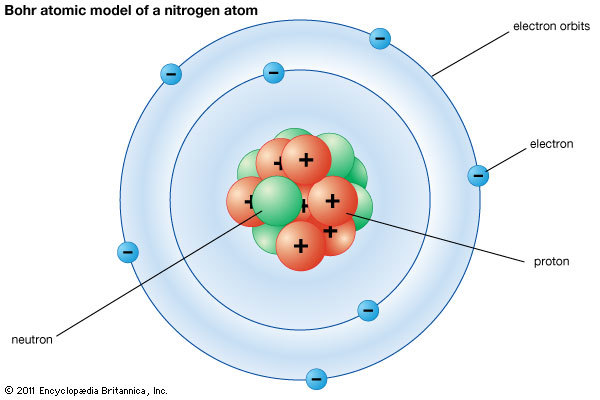
What atom is represented here?
a)
Carbon
b)
Nitrogen
c)
Oxygen
d)
Fluorine
24.
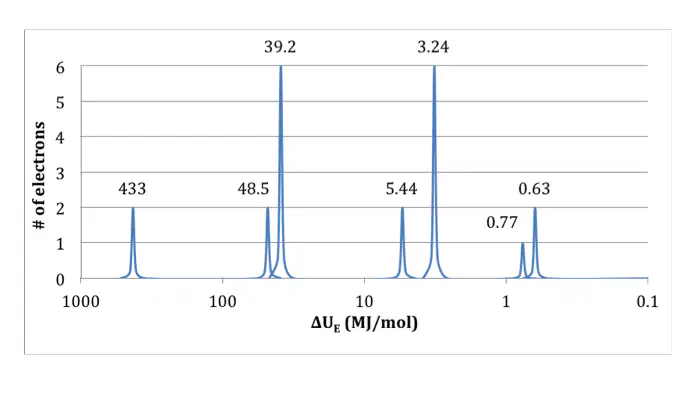
Which element is represented by this PES graph?
a)
titanium
b)
scandium
c)
calcium
d)
potassium
25.
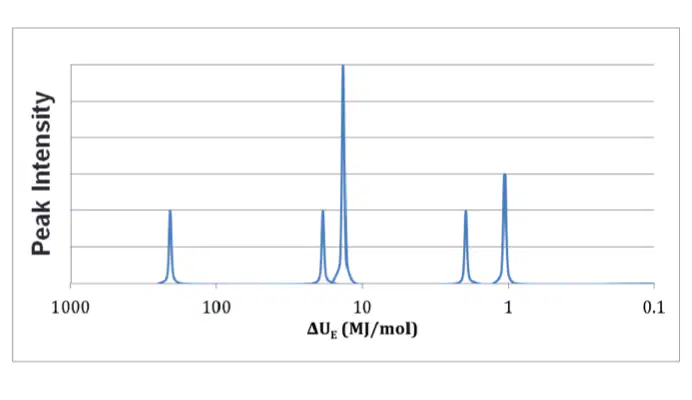
Which element is represented by this PES graph?
a)
phosphorus
b)
silicon
c)
aluminum
d)
sulfur
26.
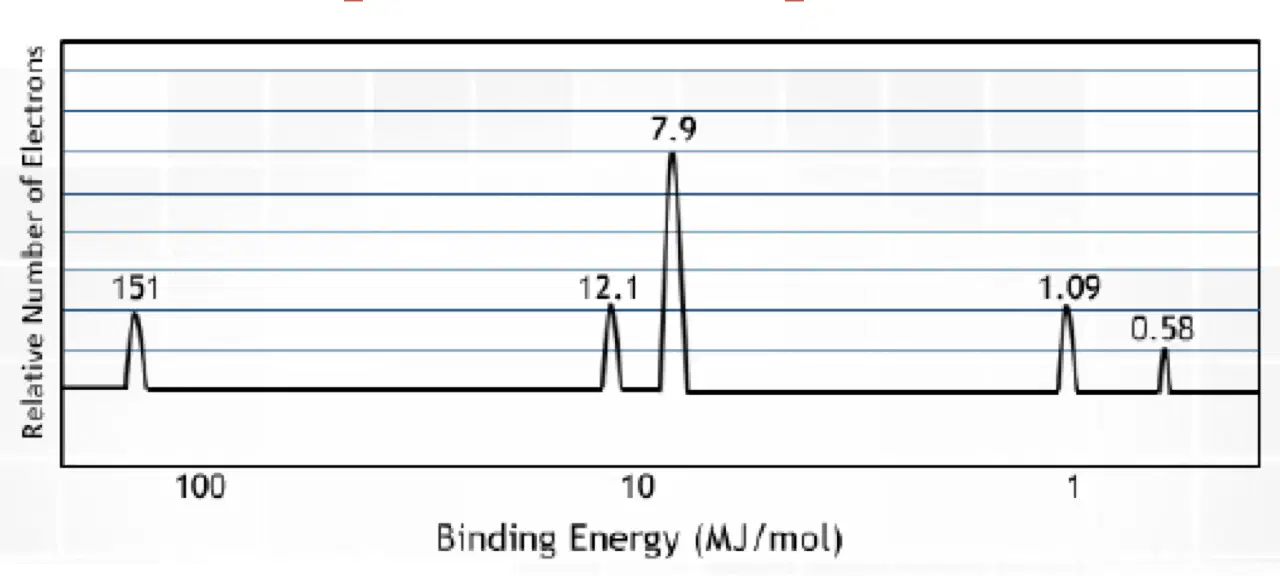
What is the electron configuration for this PES graph?
a)
1s2 2s2 2p6 3s2 3p3
b)
1s2 2s2 2p6 3s2 3p2
c)
1s2 2s2 2p6 3s2
d)
1s2 2s2 2p6 3s2 3p1
27.
Cations are
a)
negative ions
b)
gained electrons
c)
positive ions
d)
inner shell electrons
28.
How many valence electrons does Carbon have?
a)
4
b)
12
c)
6
d)
14
29.
How many valence electrons does magnesium have?
a)
1
b)
2
c)
12
d)
24
30.
How many valence electrons does Lithium have?
a)
1
b)
2
c)
3
d)
4
31.
what charge will an aluminum ion have?
a)
3+
b)
2+
c)
2-
d)
3-
32.

What is the ion formed from Sulfur?

a)

S+2

b)

S-2

c)

S+6

d)

S-6

33.

What is a negative ion called?

a)

anion

b)

cation

c)

covalent

d)

isotope

34.

What is a positive ion called?

a)

anion

b)

cation

c)

isotope

d)

covalent

35.
An atom becomes _______ when it loses electrons.
a)
Positive
b)
Negative
c)
Neutral
d)
Invinsible
36.
Elements on the LEFT side of the periodic table will most likely form:
a)
Positive ions
b)
Negative ions
c)
Neutral Ions
d)
None of these
37.
Which of the following has a -3 charge?
a)
Boron
b)
Fluorine
c)
Nitrogen
d)
Neon
38.
Group 17 always has ions with a charge of 
a)
+1
b)
+2
c)
-1
d)
-2
39.

Anions are...

a)

Positive

b)

Negative

c)

Neutral

40.

Cations are...

a)

Positive

b)

Negative

c)

Neutral

41.
Valence electrons are: 
a)
Electrons farthest away from the nucleus
b)
Electrons closest to the nucleus
c)
Electrons that just come and go - they don't stay with the atom
42.

What will be the charge of this atom after it has been ionized?

a)

-2

b)

-1

c)

+1

d)

+2

43.

Cations are made by _______ electrons from an atom.

a)

adding

b)

removing

44.

Which atom has the LOWEST ionization energy (energy to remove an electron)

a)
b)
c)
45.

Which atom has the HIGHEST ionization energy (energy to remove 1 electron)

a)
b)
c)