
 Worksheets
Unit 2 Topic 1 Review Bayou Bridges
Total questions: 20
Worksheet time: 20mins
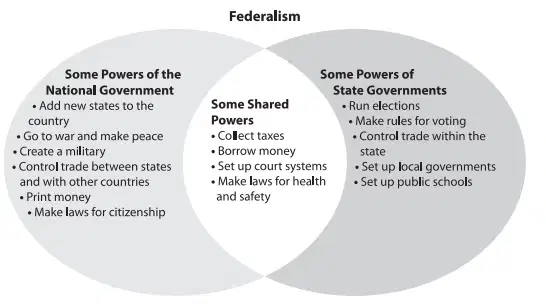
Based on the diagram, which powers do only the states have? Select the two correct answers.
controlling trade between states
setting up public schools
creating a military
collecting taxes
running elections
In his farewell speech, President Obama said "I learned that change only happens when ordinary get involved and they get engaged [interested], and they come together to demand it."
What is he encouraging people to do?
Show civic virtues like voting
Become citizens
Use checks and balances
Use separation of powers
Which branch of the government makes laws?
Legislative Branch
Executive Branch
Judicial Branch
Which leaders are nominated by the President?
Representatives
Senators
Justices
Which branch of the government decides whether a law is constitutional?
Legislative Branch
Executive Branch
Judicial Branch

Which of the following are ways you can serve your community, state, or nation? Choose ALL the correct answers.
volunteering
voting
being in the military
littering
Choose two characteristics that show a good citizen.
respecting rights and property
being honest and trustworthy
speeding down the roads
leaving all of your trash at the park
What does the Executive Branch do?
Makes laws
U.S. Capitol Building
Interprets/ explains laws
Carries out laws
Why is it important to keep the three branches separate?
to give one branch more power
to make sure that one person has all the power
to give citizens all the power
to make sure one branch DOESN'T have all the power
How long does a Justice keep his/her job?
2 years
4 years
As long as s/he lives
This branch of government has the power to overrule the President's veto with a 2/3 vote.
The legislative branch
The executive branch
The judicial branch
What is the Constitution?
A list of our past presidents
A written plan that forms how our government will work
A timeline of US history
A letter from the first president
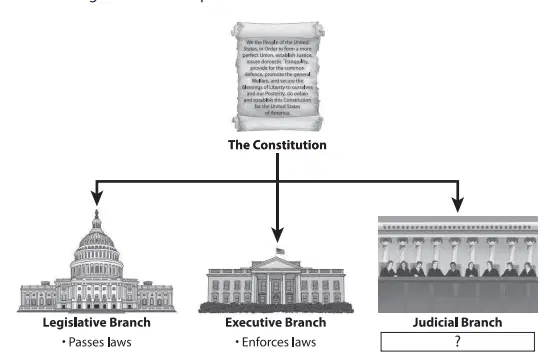
What principal of the U.S. Constitution is shown in the diagram?
separation of powers (each branch has a little power)
checks and balances (branches can check the power of other branches)
civic virtues (being a good citizen)
federalism (split power between the national and state governments)
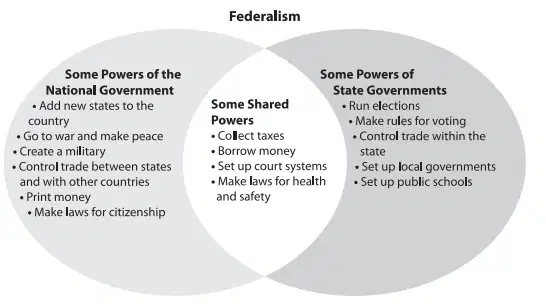
Based on the diagram, which power does only the national government have?
collect taxes
run elections
set up public schools
print money
Which branch of the government includes the Senate?
Legislative Branch
Executive Branch
Judicial Branch
Which statement best describes the relationship between state governments and the federal government under the U.S. Constitution?
Congress must work with states to pass laws.
States must follow laws passed by the U.S. Congress.
The president share judicial power with state governors.
A state senator is more powerful than the president.
President Reagan said that many types of people have voted in our history from Founding Fathers and the men of Valley Forge to the people of today. What was he trying to say about voting?
It was more important in the past than it is today.
It only works if millions of Americans do it.
It is part of a long American tradition.
It is not very important.
Which of these activities is the nest example of good citizenship?
Attending a play
Buying goods for cheap
Putting money in your savings account
Serving on a jury
What is the purpose of voting in elections?
to decide whether someone can start a new company
to decide if companies should hire more employees
to decide who will represent citizens in government
to decide which laws citizens can stop following

