
 Worksheets
AQA Physics P1 & 2 EOUT
Total questions: 26
Worksheet time: 49mins
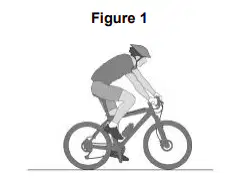
Figure 1 shows a cyclist riding along a straight, level road at a constant speed.
Complete the sentences. As the cyclist rides along the road, the (a) energy store in the cyclist’s body decreases. As the speed of the cyclist increases the (b) energy store of the cyclist increases.
Two factors that determine work are
force
acceleration
mass
distance
velocity
The unit of force is (a)

The unit of work is (a)
In a machine, most energy is wasted to the....
Thermal store of the environment due to friction.
Thermal store of the environment due to gravity
Electrostatic energy store due to forces
Gravitational potential energy store
The equation for ENERGY is:
Energy = time / power
Energy = Power x time
Energy = Power / time
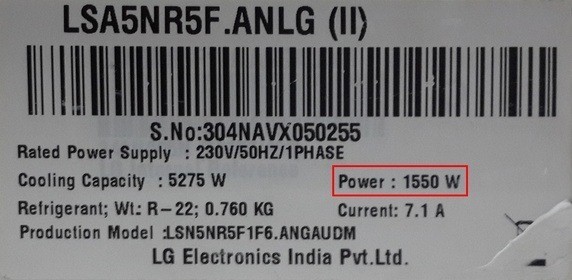
A microwave has a power rating of 1550 W. It transfers (a) Joules per second.
A lamp has a 10 W power rating. It is left on for 3 seconds. How much energy in Joules did it use?
(a)
A crane lifts a 100kg box 20m. What is the gravitational potential energy in Joules gained by the box?
Gravitational Field Strength = 10N/kg
(a)
A student lifts a 250g apple a distance of 1m. How much work is done? (What is the gain in GPE?)
g.f.s = 10N/kg
(a)
What is the equation that links kinetic energy (Ek), mass (m) and velocity (v)?
Kinetic Energy = 0.5 x Mass x Velocity², or Ek=0.5 x m x v2
Kinetic Energy = 0.5 x Mass² x Velocity, or Ek=0.5 x m2 x v
Kinetic Energy = 0.5 x Mass² / Velocity, or Ek=0.5 x m2 / v
If the 0.3 kg marble was moving at 6 m/s at the bottom of the ramp, how much kinetic energy did the marble have?
5.4 J
1.8 J
3 J
6 J

A
B
C
D
Sort the following energy resources into renewable and non renewable
Coal
Oil
Natural Gas
Nuclear
Wind
Solar
Tidal
Hydroelectric
Geothermal
Biofuel
Define the term finite in relation to renewable and non renewable energy resources
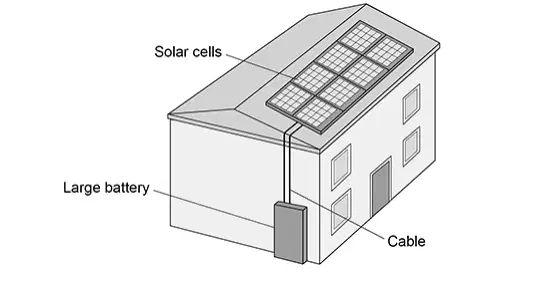
The figure below shows a house with a solar power system. The solar cells generate electricity. When the electricity generated by the solar cells is not needed, the energy is stored in a large battery.
At one time, the total power input to the solar cells was 7.8 kW.
The efficiency of the solar cells was 0.15
Calculate the useful power output of the solar cells.
(a)
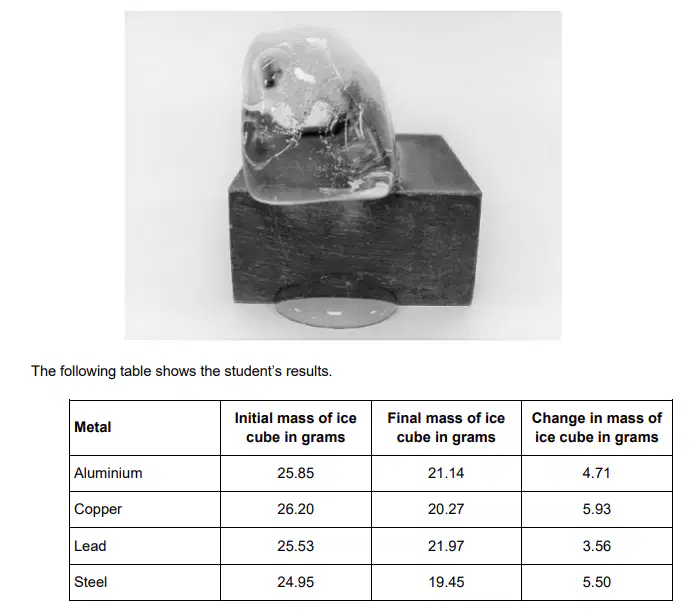
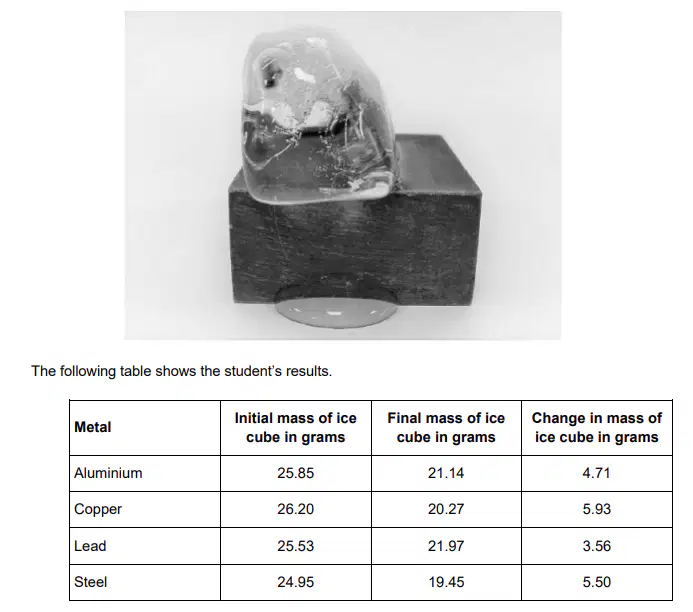
A student investigated the thermal conductivity of different metals.
This is the method used:
1. Measure the mass of an ice cube.
2. Put the ice cube on a metal block which is at room temperature.
3. Measure the mass of the ice cube after one minute.
4. Repeat with other blocks of the same mass made from different metals.
The initial temperature of each ice cube was –15 °C Why was it important that the initial temperature of each ice cube was the same?
Initial temperature was a continuous variable.
Initial temperature was a control variable.
Initial temperature was the dependent variable.
Initial temperature was the independent variable.

Which metal had the highest thermal conductivity? Give a reason for your answer
Suggest one source of random error in the student’s investigation
Nuclear power stations generate electricity through nuclear fission. Electricity can also be generated by burning shale gas. Shale gas is natural gas trapped in rocks. Shale gas can be extracted by a process called fracking. There is some evidence that fracking causes minor earthquakes. Burning shale gas adds carbon dioxide to the atmosphere.
Describe the advantages of nuclear power compared with the use of shale gas to generate electricity.
A ball is thrown into the air.
Describe the energy stores and transfers in the ball as it travels upwards?
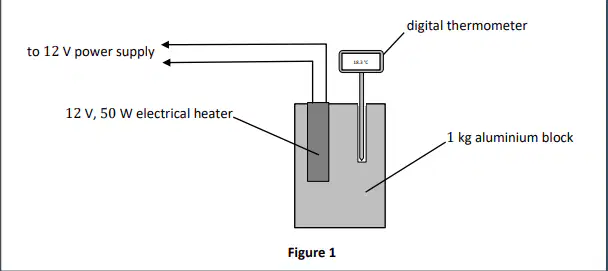
A student is conducting an experiment to investigate the specific heat capacity of the aluminium block.
Suggest one way that the student could improve the equipment set up to increase the accuracy of their results.

A small community of people live in an area in the mountains. The houses are not connected to the National Grid. The people plan to buy an electricity generating system that uses either the wind or the flowing water in a nearby river.
Information about the two electricity generation systems is given in Figure 2.
Compare the advantages and disadvantages of the two methods of generating electricity.
Use your knowledge of energy sources as well as information from Figure 2
(6 marks)

