
 Worksheets
Unit 2 Review Meteorology 2024
Total questions: 40
Worksheet time: 28mins
Surface Ocean currents are primarily caused by
temperature and salinity
Global Wind Patterns
convection
continental drift
Deep Ocean currents are primarily caused by
temperature and salinity
wind
gravity
precipitation
which of these characteristics will produce the most dense water?
high salinity, high temperature
high salinity, low temperature
low salinity, high temperature
low salinity, low temperature
Differences in water temperature create movement in the Ocean because
bodies of water at different temperature have different densities.
warm water is pulled more by the force of gravity then cold water is.
warm and cold water mix until they reach the same temperature.
The ocean just likes to "move-it move-it".

Why is it warmer in Charleston than it is in San Diego even though they are the same distance from the Equator?

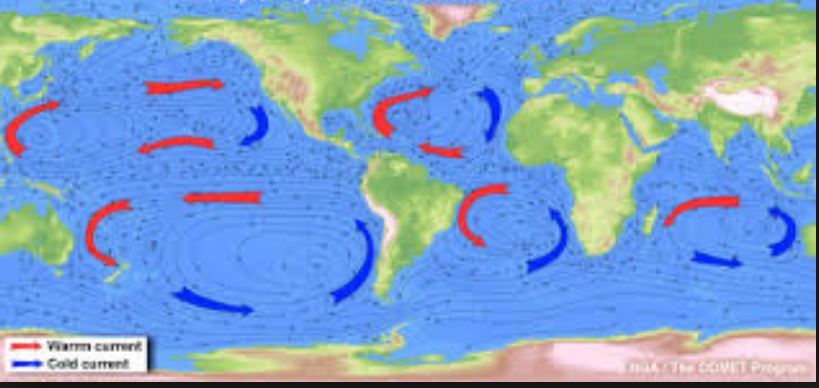
Ocean currents affect climates around the world. Based on the map, which area MOST likely has a warmer climate than expected?
1
2
3
4

Winds occur because hot air rises and cool air sinks in a process called...
conduction
convection
radiation
magnetism

What causes wind?
differences in air pressure
differences in gravity
difference in oxygen
differences in the thermosphere
What causes differences in air pressure?
even heating of the Earth
Even cooling of the earth
uneven heating of the earth
global warming

Air at the poles is colder and denser so it_______________.
rises
circulates
stagnates
sinks

In heat transfer, heat always flows from the _______________ substance to the _______________ substance.
hotter to colder
colder to hotter
hotter to hotter
colder to colder
What is convection ? (Choose all answers that apply)
method of transfer of heat in fluids
method of transfer of heat in solids
transfer of heat due to movement of molecules
transfer of heat due to vibration of molecules

A deep ocean current forms when ocean water becomes denser and sinks. Based on the illustration, which of the following statements describes the relationship between density and temperature?
Cold water is denser than warm water.
Warm water is denser than cold water
Warm and cold water have equal densities.
The density of water is not affected by temperature.

The Gulf stream carries _____________ water from the east coast of The United States to the West coast of Europe.
Cold
Freezing
Warm
Fresh


Which of the following currents are WARM currents?
Labrador Current
California Current
Gulf Stream
Brazil Current
Peru Current


Which of the following can be inferred from the graph?
Global temperatures have been steadily rising since the mid 1900s
Global temperatures have been steadily declining since the mid 1900s
Global temperatures have mostly stayed the same since the mid 1900s
Scientists are unable to take accurate global temperature measurements

Which statement best describes the climate of the two cities
Both locations are influenced by a warm current making them warm.
Hopedale is influenced by a cold ocean current making it colder and Stornoway is influenced by a warm ocean current making it warmer.
They have the same climate because they have the same latitude.
Stornoway is influenced by a cold ocean current making it colder and Hopedale is influenced by a warm ocean current making it warmer.

How do ocean currents affect weather patterns?
The control high and low tide
They trap heat at the equator so it doesn't go anywhere.
They move water to areas having droughts
They distribute heat from the equator to the Poles.
They don't affect weather patterns.

Where do warm currents originate from?
the Equator
the poles
Hawaii
Iceland
How do ocean currents affect weather patterns?
The control high and low tide
They trap heat at the equator so it doesn't go anywhere.
They move water to areas having droughts
They distribute heat from the equator to the Poles.
They don't affect weather patterns.

Describe the prevailing winds in this situation
strong winds blowing west to east
strong winds blowing east to west
weak winds blowing west to east
weak winds blowing east to west

The picture represents a(n) ___ event.
El Nino
La Nina
Non-El Nino (normal conditions)
Which weather conditions are associated with El Nino?
increased temperature, increased precipitation
decreased temperature, increased precipitation
increased temperature, decreased precipitation
decreased temperature, decreased precipitation
Both El Nino and La Nina have this in common
Influence birds that migrate over the ocean
Influence rainy / dry weather world wide
The weather at the polar regions
The directions that ships travel in the oceans

