
 Worksheets
Changes in Matter - Matter Test Review
Total questions: 20
Worksheet time: 40mins
Rotting food is an example of?
physical change
chemical change
Rust is an example of?
physical change
chemical change
Which of these is a physical change?
baking bread
rust
cutting wood
spoiled milk
What type of a change creates a new substance?
physical change
chemical change
An hour after cutting an apple into slices, a chef observes that the apple slices have a brown color. How are the changes to the apple best classified?
The cutting of the apple and change in its color are physical changes.
The cutting of the apple and change in its color are chemical changes.
The cutting of the apple is a chemical change, and the change in its color is a physical change.
The cutting of the apple is a physical change, and the change in its color is a chemical change.
Water is boiled and turns into vapor. The vapor is cooled and changes back into water. Which best describes what has occurred?
a physical change, because the matter changed its state.
a chemical change, because the matter changed its state
a physical change, because a new substance is formed
a chemical change, because a new substance is formed
In which can the original substances involved in the change MOST LIKELY be recovered?
a piece of iron rusting
a pan of cookies baking
a piece of wood burning
a container of juice freezing
Which best explains why boiling water is an example of a physical change?
The heat causes steam.
Heat is added, causing evaporation.
Heating the water causes solids to form.
The water changes from a liquid to a gas.
Tonya observes a mixture of two clear liquids in a container to see if a chemical change occurs. Which observation demonstrates the mixture is undergoing a chemical change?
The mixture remains at a constant temperature.
A gas forms after the liquids are mixed.
One liquid floats on top of the other.
The mixture does not change color.
When coffee is poured into a cup of ice, the ice begins to melt and mix with the coffee. Which statement BEST describes the change?
The ice melting is a chemical change because the water changes form.
The ice melting is a physical change because the water may be frozen again.
The water and coffee mixing is a chemical change becuase the liquids change color.
The water and coffee mixing is a physical change because the mixture forms bubbles.
Lily makes a fruit salad to bring to a party. She mixes one cup of grapes, one cup of apples, one cup of bananas and one cup of frozen strawberries. She wonders if she has made a new substance as the strawberries are frozen. Which claims and evidence statement is correct?
Yes, she made a new substance as the strawberries will thaw out in the fruit salad.
Yes, she made a new substance as she put many ingredients together and ended up with a fruit salad.
No, she did not make a new substance as the individual ingredients did not change.
No, she did not make a new substance as food cannot change into a new substance.
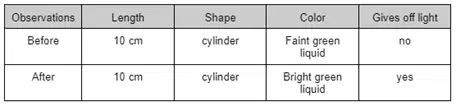
Lily took a glow stick to a camping trip. She recorded her observations before and after she snapped the glow stick. Did Lily make a new substance?
Yes, a new substance was made as the glow stick gave off light.
Yes, a new substance was made as the glow stick was green.
No, a new substance was not made as the glow stick stayed the same length.
No, a new substance was not made as the shape of the container stayed the same.
Manny combines vegetable oil and water. He stirs the ingredients and then observes that the oil forms a layer on top of the water. What is the best conclusion Manny can make?
Oil dissolves in water, making a mixture.
Oil dissolves in water, making a solution.
Oil does not dissolve in water, making a solution.
Oil does not dissolve in water, making a mixture.
A teacher had two clear liquids, Liquid A and Liquid B. The teacher filled one beaker with Liquid A, and then added Liquid B, drop by drop, until solid crystals suddenly formed on the bottom of the beaker. Which of these is the MOST LIKELY explanation for what happened?
Liquid A changed phases from a liquid to a solid state.
Liquid B evaporated, leaving behind solids that had been dissolved in it.
Liquid A and Liquid B combined to form a new solid substance.
Liquid A and Liquid B did not mix because they had different properties.

In a science class today, students study how substances change when they are combined. They assemble the materials shown below, all of which are safe food materials from the school kitchen. Based on your observations of combinations A and B above, select all of the statements below that is true.
Before any substances are added to the bag, students make observations and record them in the “Before” row of the table below. They also measure the mass of each bag. Next, students add the same number of drops to each bag. They first add the drops of water to the bag with salt (A), and then they add the same number of drops of vinegar to the bag of baking soda (B). As soon as they combine the materials in each sealed bag, the students make observations and record them in the “During” row of the table below. Finally, after any changes from the combinations have been observed and nothing else is happening in the bag, students make observations and record them in the “After” row of the table below. They also measure the mass of the bag at this point.
According to the data, what most likely occurred?
The baking soda and water went through a chemical change.
The water and salt went through a chemical change.
The vinegar and water went through a chemical change.
The baking soda and vinegar went through a chemical change.

