
 Worksheets
Summative Assessment 3 (10/09/24)
Total questions: 70
Worksheet time: 35mins
Why is material and component selection important in engineering?
It reduces the need for testing.
It ensures optimal functionality, durability, and cost-effectiveness.
It simplifies the design process.
It eliminates the need for environmental considerations.
How does material selection affect product longevity?
It has no effect on longevity.
It can significantly increase longevity.
It only affects the initial cost.
It reduces the need for maintenance.
What is a key consideration for balancing performance with budget constraints?
Environmental conditions
Cost considerations
Safety factors
Sustainability requirements
What is a key consideration for ensuring user and product safety?
Functionality requirements
Environmental conditions
Safety factors
Manufacturability
Which property is essential for specific applications involving light?
Thermal
Optical
Mechanical
Electrical
What is an example of a polymer?
Aluminum
Glass
Rubber
Fiberglass
What is the first step in the engineering design process for material selection?
Evaluate options using selection criteria
Research potential materials and their properties
Define needs and requirements
Select the best fit for the application
Which step involves researching potential materials and their properties?
Define needs and requirements
Research potential materials and their properties
Evaluate options using selection criteria
Select the best fit for the application
Which step comes after evaluating options using selection criteria?
Define needs and requirements
Research potential materials and their properties
Select the best fit for the application
Repeat the steps
Which step involves using selection criteria?
Define needs and requirements
Research potential materials and their properties
Evaluate options
Select the best fit for the application
What does lifecycle assessment evaluate?
Material's environmental effects from production to disposal
Material's color
Material's weight
Material's cost
What is the benefit of having data on material properties?
It helps in making informed decisions in product design and development
It increases the cost of production
It reduces the need for testing
It provides aesthetic value
Which material is described as lightweight, affordable, but with lower strength?
Steel
Aluminum
Carbon Fiber
Titanium
What safety issue can arise from using the wrong materials?
Improved user experience
Safety hazards
Enhanced durability
Reduced maintenance
What can frequent replacements or repairs lead to?
Reduced costs
Increased costs
Enhanced efficiency
Improved quality
Which property determines material performance under stress?
Optical
Mechanical
Thermal
Chemical
What does the physical property of a material affect?
Light transmission
Corrosion resistance
Weight and heat transfer
Expansion characteristics
Which property is related to heat resistance and expansion characteristics?
Mechanical
Optical
Thermal
Chemical
What is a key factor in determining the mechanical properties of a material?
Corrosion resistance
Light transmission
Strength and hardness
Heat resistance
What mechanical property describes the ability of a material to be stretched into a wire?
Malleability
Stiffness
Ductility
Brittleness
Which property measures a material's resistance to permanent shape change?
Plasticity
Toughness
Hardness
Elasticity
What is the purpose of a static tension test?
To measure compressive strength
To measure tensile strength
To measure shear strength
To measure torsional strength
Which strength is tested using a shear test?
Tensile strength
Compressive strength
Shear strength
Flexural strength
Which of the following is an example of an elastic material?
Copper
Modeling dough
Rubber band
Clay
Why are toughness and ductility important in material selection?
They prevent corrosion.
They enhance color and texture.
They prevent sudden failures and allow shaping.
They increase electrical conductivity.
Which property includes formability and machinability?
Optical
Chemical
Mechanical
Manufacturability
Which property is crucial for specific applications involving light?
Optical
Chemical
Mechanical
Manufacturability
Which property is important for heat transfer in materials?
Optical
Chemical
Physical
Manufacturability
What is a common use for materials with high thermal conductivity?
Insulation
Wiring
Heat sinks and cookware
Electronics
Which factor does NOT influence conductivity?
Purity
Crystal structure
Temperature
Color
What is a common use of rubber in household items?
As a thermal conductor
As an electrical insulator
As a sound amplifier
As a light reflector
Which property makes Styrofoam a good thermal insulator?
High density
Low thermal conductivity
High electrical conductivity
High reflectivity
What causes corrosion in metals?
Physical abrasion
Chemical reactions with the environment
Electrical currents
Magnetic fields
What is the primary concern of corrosion in chemical processing plants?
Aesthetic appearance
Safety and longevity of equipment
Weight reduction
Increased flexibility
How do machinability and formability impact production?
They increase the weight of products
They reduce the need for skilled labor
They impact production efficiency and cost-effectiveness
They increase the time required for production
How does machinability affect the use of machine tools?
It makes machine tools unnecessary
It determines how easily materials can be shaped using machine tools
It increases the cost of machine tools
It reduces the need for machine tools
Material testing in the automotive industry helps in developing components that are:
Heavy and durable
Lightweight and strong
Expensive and luxurious
Colorful and attractive
Which of the following is a technique used in quality control?
Pareto Diagram
Financial Analysis
Market Research
Product Design
What is one of the main purposes of quality control?
To increase production speed
To detect issues before products are shipped
To reduce employee workload
To enhance marketing strategies
What does QC stand for in the context of the document?
Quick Check
Quality Control
Quantity Control
Questionable Content
Which of the following is NOT a benefit of quality control mentioned in the text?
Prevents defects
Ensures consistency
Increases product variety
Enhances customer trust
Which aspect of quality control helps in preventing product recalls?
Enhancing customer trust
Ensuring consistency
Increasing production speed
Reducing costs
How does quality control contribute to customer satisfaction?
By lowering prices
By ensuring product quality
By offering more discounts
By reducing delivery times
Which method involves a company-wide effort to improve quality?
Statistical Process Control (SPC)
Six Sigma
Total Quality Management (TQM)
Lean Manufacturing
Which method focuses on maximizing effectiveness and minimizing downtime?
Statistical Process Control (SPC)
Six Sigma
Total Quality Management (TQM)
Lean Manufacturing
Which method is a data-driven approach to improve all processes?
Statistical Process Control (SPC)
Six Sigma
Total Quality Management (TQM)
Lean Manufacturing
What is the focus of Statistical Process Control (SPC)?
Maintain process stability and control
Reduce defects to a level of 3.4 defects/million opportunities
Maximize effectiveness
Optimize flow of materials and information
What is the first step in the quality control process?
Inspection
Testing
Setting Standards
Corrective Actions
How does continuous improvement contribute to the quality control process?
By defining quality benchmarks
By ensuring product performance
By monitoring the process for long-term success
By checking the product against standards
Which step is directly responsible for addressing any issues found during the process?
Testing
Corrective Actions
Inspection
Continuous Improvement
In the food industry, quality control ensures:
Product durability
Compliance with health regulations
Medical devices meet safety standards
Overlapping QC principles
Which of the following is NOT a benefit of quality control in manufacturing?
Ensuring product durability
Ensuring product safety
Meeting safety standards for medical devices
Overlapping QC principles
What is the primary purpose of Statistical Process Control (SPC)?
To increase production speed
To ensure efficient process operation with less waste
To reduce employee workload
To enhance marketing strategies
How does SPC contribute to quality management?
By increasing the number of products
By allowing early detection of process variations
By reducing the need for statistical tools
By focusing solely on product design
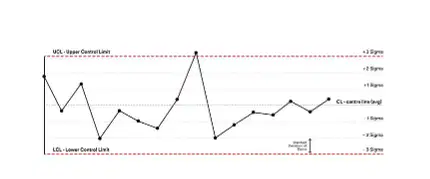
What is the purpose of control charts in SPC?
To measure process capability
To monitor process variation over time
To set process specifications
To calculate process efficiency
What do the upper and lower control limits (UCL, LCL) represent in a control chart?
The process average
The target value
±3 standard deviations
The specification limits
What does the central line in a control chart represent?
The upper control limit
The lower control limit
The process average or target value
The specification limit
What does a c-chart count in a control chart?
Defective items
Defects on an item
Total items
Sample size
What is one application of SPC in the manufacturing industry?
Monitoring patient wait times
Ensuring consistent dimensions of car parts
Reducing medication errors
Improving hospital layouts
How is SPC used in the healthcare industry?
To design car parts
To monitor infection rates
To control product quality
To manage supply chains
What is the primary purpose of using control charts in Statistical Process Control (SPC)?
To measure employee performance
To track financial expenses
To monitor process stability and variability
To design new products
What should you focus on when interpreting control charts effectively?
Data points within control limits
Data points outside control limits
The color of the chart
The size of the chart
What might indicate an out-of-control situation in a control chart?
Points within control limits
Random patterns
Points exceeding control limits
Consistent color changes
Which of the following is an advantage of SPC?
Initial implementation costs and training
Improved product quality and consistency
Requires consistent data collection and analysis
Limited effectiveness in highly variable processes
What is a limitation of SPC?
Enhanced customer satisfaction
Early detection of process variations
May not capture all sources of variation
Data-driven decision making
How does SPC help in process management?
By increasing initial costs
By reducing waste and rework costs
By requiring more training
By limiting data analysis
What is required for effective SPC implementation?
Enhanced customer satisfaction
Consistent data collection and analysis
Reduced waste and rework costs
Improved product quality and consistency
What is the main reason for selecting specific engineering materials for construction?
Color of the material
Cost-effectiveness
Material availability
Material properties matching the application requirements
How does material selection impact the design of a product?
Material selection impacts the design of a product by influencing its aesthetics, functionality, durability, cost, and manufacturability.
Material selection only affects the color of the product
Material selection has no impact on product design
Material selection does not influence the cost of the product
What does it mean for an object to be ductile?
Able to stretched without losing toughness
Hard and breaks easily
Able to be hammered out of shape without breaking
The compactness of a material