
 Worksheets
SAP FI - Certificate
Total questions: 80
Worksheet time: 40mins
Name
Class
Date
1.
Which of the following is a technical year-end closing activity in SAP S/4HANA?
a)
A. Ledger balances must be carried forward.
b)
B. Foreign currency valuation must be posted.
c)
C. Balance sheet adjustments must be posted.
d)
D. Accruals must be posted.
2.
Which elements define the integration of asset acquisitions with the general ledger? (Choose two.)
a)
A. Asset class
b)
B. Depreciation keys
c)
C. Valuation area
d)
D. Depreciation area
3.
A general ledger account has a foreign currency setting of CAD. The company code currency is USD. The controlling area currency is EUR.
Which currencies can you post to this account?
a)
A. You can post to the account in any currency and it will be converted into CAD.
b)
B. You can only post to the account in CAD and USD.
c)
C. You can only post to the account in CAD, USD, and EUR.
d)
D. You can only post to the account in CAD.
4.
You forgot to add a new general ledger account to the financial statement version.
What impact does this have on the net profit and net loss?
a)
A. The balance of the new account is added to the notes in the financial statement item section and is excluded from the calculation.
b)
B. The balance of the new account is added to the non-assigned section and is included in the calculation.
c)
C. The balance of the new account is added to the non-assigned section and is excluded from the calculation.
d)
D. The balance of the new account is added to the notes in the financial statement item section and is included in the calculation.
5.
You want to create a substitution in Financial Accounting.
Which parts do you have to define for each step of the substitution? (Choose two.)
a)
A. Substitution values
b)
B. Prerequisite statement
c)
C. Callup point
d)
D. Check statement
6.
You are responsible for configuring document splitting.
What are some of the key settings? (Choose two.)
a)
A. Field status variant
b)
B. Document number range
c)
C. Business transaction variant
d)
D. Document type
7.
Which date is used to determine the depreciation start date?
a)
A. Posting date
b)
B. Baseline date
c)
C. Document date
d)
D. Asset value date
8.
In customizing, at which levels can you assign the print program to the correspondence type? (Choose two.)
a)
A. At client level
b)
B. At system level
c)
C. At business partner level
d)
D. At company code level
9.
What does the document type control? (Choose two.)
a)
A. Whether text is required on line item level
b)
B. Which posting keys are allowed for postings
c)
C. Which account types are allowed for postings
d)
D. Whether negative postings are permitted
10.
Which statements best describe a profit center? (Choose two.)
a)
A. It is an object for which separate balance sheet and P&L statements are created only when used in conjunction with segments.
b)
B. It is the only object that can be uniformly derived using segments.
c)
C. It is an object for which separate balance sheet and P&L statements can be created, independently from segments being maintained or not.
d)
D. It is the only object from which segments can be uniformly derived.
11.
Which of the following should you consider when defining asset number ranges? (Choose two.)
a)
A. Asset number ranges are defined for asset classes and are company code specific.
b)
B. Each asset number range must be assigned to a unique asset class.
c)
C. Each asset class can have either an internal or external number range.
d)
D. Asset number ranges are defined at chart of depreciation level.
12.
Which field can you change on a posted invoice?
a)
A. Tax code
b)
B. Statistical internal order
c)
C. Special G/L indicator
d)
D. Baseline date
13.
Which parameters can you specify directly when you create a new correspondence type? (Choose three.)
a)
A. Number of date fields required
b)
B. Reason code required
c)
C. Document number required
d)
D. Account required
e)
E. Company code required
14.
What are the characteristics of a company in SAP S/4HANA? (Choose two.)
a)
A. It is responsible for costs and revenues within an organization.
b)
B. It represents separate areas of operation within an organization.
c)
C. It can be assigned to a company code.
d)
D. It is considered for consolidation.
15.
You need to post customer invoices via interface from a non-SAP system. You want to define a new document type with a specific document number range that matches the document numbers of the source system.
How do you define the document number range?
a)
A. You must use external number assignment.
b)
B. You can use internal or external number assignment.
c)
C. You must use internal number assignment.
d)
D. You can use internal or external number assignment, but it has to be continuous.
16.
What do you need to do to configure a new exchange rate type in SAP S/4HANA? (Choose two.)
a)
A. Maintain exchange rates daily.
b)
B. Set up the relationship between currencies using translation ratios.
c)
C. Specify the company code currency as the base currency.
d)
D. Specify a purpose for the exchange rate type.
17.
You want to edit a dunning proposal.
Which actions can you perform? (Choose three.)
a)
A. Change a document.
b)
B. Block a line item.
c)
C. Lower the dunning level of an item.
d)
D. Block an account.
e)
E. Raise the dunning level of an account.
18.
What does the document splitting functionality do?
a)
A. It enriches all customer and vendor line items with the defined splitting characteristics in the relevant subledgers.
b)
B. It enriches all relevant balance sheet account lines with the defined splitting characteristics.
c)
C. It enables the automatic creation of additional posting documents for each defined splitting characteristic.
d)
D. It enables the automatic creation of an additional posting document in case the original document contains more than 999 line items.
19.
How do you identify an asset master record as an asset under construction?
a)
A. The asset capitalization date is empty.
b)
B. The ordinary depreciation start date is empty.
c)
C. The asset belongs to a specific asset class.
d)
D. The depreciation key is empty.
20.
What do you define when configuring asset classes? (Choose three.)
a)
A. Number ranges
b)
B. Screen layout rules
c)
C. Transaction types
d)
D. Account determination
e)
E. Posting keys
21.
Which of the following are valid settlement receivers when you perform settlement for an asset under construction on a line item basis? (Choose
two.)
a)
A. Fixed asset
b)
B. Profit center
c)
C. Cost center
d)
D. Functional area
22.
In your SAP S/4HANA system, you report financial values for three separate accounting principles. You post an acquisition for an asset that is capitalized in a single accounting principle.
If you use the application to post integrated asset acquisitions, how many documents will the system post?
a)
A. 4
b)
B. 1
c)
C. 2
d)
D. 3
23.
What are key reasons for preferring a new implementation of SAP S/4HANA rather than a system conversion from SAP ERP? (Choose two.)
a)
A. You want to deploy SAP S/4HANA Cloud.
b)
B. You want to clean up your system and use SAP Best Practices.
c)
C. You want to integrate the system into SAP Cloud Platform.
d)
D. You want to use document splitting for the General Ledger.
24.
Which of the following statements best describes how customer down payments are integrated with Sales & Distribution (SD)?
a)
A. A down payment request is created as an FI noted item, which automatically generates an SD billing document.
b)
B. A down payment request is created as an FI noted item, which automatically generates an SD sales order.
c)
C. A down payment request is created as an SD sales order, which is automatically posted in FI as a noted item.
d)
D. A down payment request is created as an SD billing document, which is automatically posted in FI as a noted item.
25.
Besides using the profit center, which options does General Ledger Accounting with document splitting provide to assign a segment to the posting
line? (Choose two.)
a)
A. BAdI implementation (FAGL_DERIVE_SEGMENT)
b)
B. Assignment of default segments to G/L accounts
c)
C. Standard account assignment using constants
d)
D. Definition of validation rules
26.
You are asked to explain how assets under construction work in SAP S/4HANA.
What should you highlight? (Choose two.)
a)
A. It is impossible to use assets under construction with Investment Management.
b)
B. It is possible to calculate and post depreciation in the balance sheet depreciation area for assets under construction.
c)
C. It is possible to post credit memos, even after assets under construction are fully capitalized.
d)
D. It is possible to post special tax depreciation and investment support for assets under construction.
27.
What dunning-related data do you maintain on the business partner master record? (Choose two.)
a)
A. Dunning block
b)
B. Dunning area
c)
C. Dunning interval
d)
D. Dunning key
28.
You are starting the fiscal year-end process in Asset Accounting in SAP S/4HANA.
What are the year-end closing program checks for Asset Accounting? (Choose two.)
a)
A. Posting periods are closed for asset G/L accounts.
b)
B. Asset master data is complete and without errors.
c)
C. The fixed asset fiscal year change is complete.
d)
D. Depreciation is posted in full for all assets.
29.
You are configuring asset-related postings of depreciation areas in Asset Accounting for a company code that uses the ledger approach to parallel
valuation.
Which of the following settings would lead to an error?
a)
A. Area posts depreciation only
b)
B. Area does not post
c)
C. Area posts APC immediately, depreciation periodically
d)
D. Area posts in real time
30.
At what level is the bank master data stored in SAP S/4HANA?
a)
A. At the company code level
b)
B. At the client level
c)
C. At the system level
d)
D. At the financial management (FM) area level
31.
When is it possible to set the open item management indicator in a general ledger account? (Choose two.)
a)
A. When an account is set up as a secondary cost element
b)
B. When an account is set up as a reconciliation account
c)
C. When an account has a zero balance
d)
D. When an account is set up as a balance sheet account
32.
Which of the following steps do you typically perform during a payment run with the automatic payment program? (Choose two.)
a)
A. Maintain open item selection parameters.
b)
B. Rank bank accounts for payment.
c)
C. Review the payment proposal exception list.
d)
D. Define maximum amounts to be paid per supplier.
33.
Which documents are needed to complete the 3-way match in procurement transactions? (Choose three.)
a)
A. Invoice receipt
b)
B. Down payment request
c)
C. Goods receipt
d)
D. Purchase order
e)
E. Purchase requisition
34.
Which steps are required to create a substitution in Financial Accounting? (Choose three.)
a)
A. Define the substitution rule with its different steps using the formula editor.
b)
B. Assign the substitution rule to the controlling area.
c)
C. Specify an authorization group.
d)
D. Select the correct call-up point.
e)
E. Select activation level 2.
35.
You are getting ready to post your first simple general ledger document using the SAP Fiori app for posting in a test environment.
What configuration items do you need to set up to post a simple document? (Choose two.)
a)
A. Number range and document types must be maintained.
b)
B. The posting period variant must be created and assigned.
c)
C. Users must be assigned to a tolerance group.
d)
D. Line item text templates must be maintained.
36.
On which levels can you maintain field status controls for business partners (BP)? (Choose two.)
a)
A. Company code
b)
B. BP role
c)
C. BP category
d)
D. BP type
37.
You are responsible for implementing Asset Accounting. You are provided with the legacy data of various assets and their grouping information based on classifications, useful life, and depreciation terms.
What configuration step would you initiate to maintain these categories in SAP S/4HANA?
a)
A. Configure depreciation keys and calculation keys.
b)
B. Define a depreciation area to transfer all the legacy data.
c)
C. Define asset classes and maintain their attributes.
d)
D. Define depreciation areas for each category of legacy asset.
38.
You are creating an asset master record by copying another asset, and you notice that the inventory number is copied over.
Which setting do you make on the screen layout maintenance page to ensure the inventory number is NOT copied over when you create a new
asset via copy?
a)
A. Remove the subnumber indicator
b)
B. Remove the main asset indicator
c)
C. Remove the reference indicator
d)
D. Remove the asset class indicator
39.
You post a purchase order.
For which expenses does the system calculate accruals? (Choose two.)
a)
A. Consulting services
b)
B. Insurance premiums
c)
C. Raw material purchases
d)
D. Fixed Asset purchases
40.
You want to configure the tax calculation procedures.
What are the main elements you need to define? (Choose three.)
a)
A. Tax code
b)
B. Account key
c)
C. Sequence of steps
d)
D. Tax category
e)
E. Condition type
41.
After you collect data in the Intercompany Reconciliation tool, what are the next steps of the reconciliation process?
a)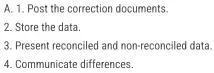
A
b)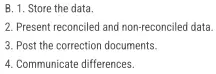
B
c)
C
d)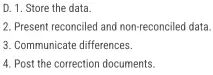
D
42.
What can you control with the reason code in Accounts Receivable? (Choose three.)
a)
A. The special G/L indicator for the down payment
b)
B. The exclusion of disputed residual items from credit limit checks
c)
C. The account where a residual item is posted
d)
D. The type of payment notice sent to a customer
e)
E. The document type of the payment
43.
For which account can you perform account clearing in SAP S/4HANA?
a)
A. For any account that is managed on an open item basis
b)
B. For any account that is assigned to a financial statement version
c)
C. For any G/L account defined as reconciliation account
d)
D. For any balance sheet account managed on a line item basis
44.
You want to define a validation for the combination of general ledger account and cost center.
For which call-up point do you define this validation?
a)
A. Document line
b)
B. Cost of sales accounting
c)
D. Complete document
d)
E. Document header
45.
Which fields of a financial accounting document influence the automatic payment program? (Choose three.)
a)
A. Payment method
b)
B. Payment transaction
c)
C. Terms of payment
d)
D. Payment type
e)
E. Baseline date
46.
You define custom currency type Z1 for your company code.
Which currency types must be stored in the Data Entry view? (Choose two.)
a)
A. Custom currency type Z1
b)
B. Company code currency
c)
C. Document currency
d)
D. Hard currency
47.
Which statements best describe extension ledgers in SAP S/4HANA? (Choose two.)
a)
A. Extension ledgers can have different currencies than the underlying ledger.
b)
B. Extension ledgers can be assigned their own fiscal year variant.
c)
C. Extension ledgers can be assigned their own posting period variant.
d)
D. Multiple extension ledgers can point to the same underlying ledger.
48.
What are the maintenance levels of a screen layout rule for asset master data? (Choose three.)
a)
A. Main asset number
b)
B. Asset class
c)
C. Asset subnumber
d)
D. Group asset
e)
E. Depreciation area
49.
Which parameter indicates that a line item can only be dunned with restrictions?
a)
A. Dunning block reason
b)
B. Dunning key
c)
C. Dunning area
d)
D. Grouping key
50.
Which business partner characteristic is mapped to the customer and supplier account groups?
a)
A. Business partner role
b)
B. Business partner type
c)
C. Business partner account group
d)
D. Business partner grouping
51.
You perform foreign currency valuation for open items of your supplier accounts. The valuations will be used only for period end reporting and
should then be reversed.
What account does the system use to post the valuation differences?
a)
A. Alternative reconciliation G/L account
b)
B. Adjustment G/L account for foreign currency
c)
C. Individual supplier accounts with special G/L indicator
d)
D. Supplier reconciliation G/L account
52.
You assign currency type 40 to your company code in ledger 0L.
Which source currency types can you select? (Choose two.)
a)
A. Document currency
b)
B. Company code currency
c)
C. Group currency
d)
D. Controlling area currency
53.
You are a group cash manager interested in the North American business market.
What are the personalization options available to you in SAP Fiori? (Choose two.)
a)
A. You can create a tile group with all the apps required for your daily business for easy access.
b)
B. You can adapt the launchpad color theme according to predefined values for the cash report.
c)
C. You can create a tile to take you directly to the cash position of the North American business market.
d)
D. You can manage user access to relevant apps for the North American accounts payable group that reports to you.
54.
In your system, you currently perform manual outgoing payments and you want to use the automatic payment program.
Which settings must you maintain as part of the configuration of the automatic payment program? (Choose two.)
a)
A. Payment terms
b)
B. Payment blocks
c)
C. Bank determination
d)
D. Paying company codes
55.
What are the features of the Accrual Engine in SAP S/4HANA? (Choose two.)
a)
A. All currencies of the general ledger are supported.
b)
B. The fiscal year variant of the general ledger is supported.
c)
C. Accrual postings with a maximum of two line items are supported.
d)
D. All accrual calculations must be reviewed and approved before posting.
56.
In your SAP S/4HANA system, you want to archive the G/L accounts that are not used by the business in any company code.
What are prerequisites to archiving all data of a G/L account? (Choose three.)
a)
A. The blocked for posting indicator is set for the G/L account.
b)
B. There are no transaction figures for the account.
c)
C. Transaction figures are older than a customizable amount of years.
d)
D. Set the deletion flag in the company code data of the G/L account.
e)
E. Set the deletion flag in the chart of accounts data of the G/L account.
57.
You have been asked to set up house banks as part of the implementation.
What information do you need? (Choose three.)
a)
A. Company code
b)
B. Bank master data
c)
C. Payment method
d)
D. Bank control key
e)
E. General ledger account
58.
You want to configure the default baseline date for the payment terms of an incoming invoice.
From which date can you derive the baseline date? (Choose three.)
a)
A. Document date
b)
B. Value date
c)
C. Goods receipt date
d)
D. Posting date
e)
E. Entry date
59.
To use the SAP Financial Closing cockpit, which steps are required? (Choose three.)
a)
A. Create a template.
b)
B. Release the task list.
c)
C. Define task dependencies.
d)
D. Create task groups.
e)
E. Define the person responsible for tasks.
60.
What are some features of SAP HANA? (Choose two.)
a)
A. SAP HANA is optimized to organize data using column stores.
b)
B. SAP HANA is optimized to work with aggregates and index tables.
c)
C. SAP HANA allows transactional and analytical processing from the same tables.
d)
D. SAP HANA is built on a hierarchical data model architecture.
61.
What are some of the benefits of the data handling in SAP S/4HANA? (Choose two.)
a)
A. The data is aggregated on the fly from any line item table.
b)
B. The data is available in real time at line item detail.
c)
C. The data is summarized into higher levels of aggregates to help system performance.
d)
D. The data is constantly auto archived to optimize memory usage
62.
You must run the foreign currency valuation for both US GAAP and IFRS, which leads to different values for the two different accounting
principles.
How can you set this up in the system?
a)
A. Define two valuation methods and assign the accounting principles to the new valuation methods.
b)
B. Define two valuation areas and two extension ledgers with relevant links to accounting principles.
c)
C. Define two valuation methods and assign the ledger groups to the new valuation methods.
d)
D. Define two valuation areas and two accounting principles with relevant links to ledgers.
63.
For which special G/L indicator do you specify a target special G/L indicator?
a)
A. Guarantee given
b)
B. Vendor down payment request
c)
C. Customer down payment
d)
D. Bill of exchange
64.
What items are NOT cleared by the automatic clearing program? (Choose three.)
a)
A. Items with withholding tax
b)
B. Noted items
c)
C. Items with sales and use tax
d)
D. Items with value-added tax
e)
E. Statistical postings
65.
How does the system perform the normal reversal of a journal entry?
a)
A. It creates an inverse posting by decreasing the transaction figures.
b)
B. It creates an inverse posting by increasing the transaction figures.
c)
C. It creates the inverse posting of a cleared document before resetting it.
d)
D. It creates an inverse posting by resetting the transaction figures.
66.
How can you perform transfers of assets between company codes with different charts of depreciation?
a)
A. Ensure the same depreciation areas are used in all charts of depreciation.
b)
B. Enter depreciation area mapping during intercompany transfer posting.
c)
C. Define a global transfer variant and assign all the depreciation areas to it.
d)
D. Configure the cross-company depreciation areas in Customizing.
67.
Your SAP S/4HANA system is integrated with controlling. You perform cost-of-sales accounting and you report your profit and loss per profit
center.
When posting a supplier invoice to a primary cost account, which field is mandatory by standard procedures?
a)
A. Segment
b)
B. Business area
c)
C. Profitability segment
d)
D. Functional area
68.
How do you configure depreciation areas in SAP S/4HANA? (Choose two.)
a)
A. Ensure all depreciation areas always post to the general ledger.
b)
B. Assign depreciation area 01 to the leading ledger.
c)
C. Ensure a ledger group is assigned to each accounting principle.
d)
D. Assign each accounting principle to a depreciation area.
69.
Which prerequisites must be fulfilled to allow for negative postings of journal entries? (Choose two.)
a)
A. The company code must allow negative postings.
b)
B. The reversal reason must be configured to allow negative postings.
c)
C. The reversal accounts must be configured to allow negative postings.
d)
D. The posting key must allow negative postings.
70.
How does the system determine the correspondence type of a payment notice?
a)
A. According to the reason code, as long as all the tolerance groups carry the same correspondence type
b)
B. According to the tolerance group, as long as all the reason codes carry the same correspondence type
c)
C. According to the tolerance group, as long as all the tolerance groups carry the same correspondence type
d)
D. According to the reason code, as long as all the reason codes carry the same correspondence type
71.
What is the recommended organizational unit for cost of sales accounting?
a)
A. Profit center
b)
B. Controlling area
c)
C. Profitability Segment
d)
D. Functional area
72.
What is shared between all deployment options for SAP S/4HANA (Cloud, On-Premise)? (Choose three.)
a)
A. Data model
b)
B. Upgrade intervals
c)
C. Code line
d)
D. Configuration scope
e)
E. User experience
73.
Which closing activities are performed for external reporting as per SAP best practices? (Choose two.)
a)
A. Regroup receivables and payables on the balance sheet.
b)
B. Update product cost estimates with standard prices.
c)
C. Perform valuations of open items in foreign currency.
d)
D. Run plan assessment cycles for profit centers.
74.
Which of the following statements are valid for financial document number ranges? (Choose three.)
a)
A. Financial document number ranges must be defined for the year in which they are used.
b)
B. Financial document number ranges are defined at company code level.
c)
C. The same financial document number range can be assigned to several document types.
d)
D. All financial document number ranges can contain numbers and/or letters.
e)
E. Financial document number ranges defined at client level should NOT overlap.
75.
You are running an international business and you want to set up separate legal entities to run operations and perform accounting activities.
Which organizational unit do you need to create for each legal entity?
a)
A. Company code
b)
B. Business area
c)
C. Company
d)
D. Consolidation unit
76.
How does SAP S/4HANA support the treatment of taxes? (Choose three.)
a)
A. It posts the tax amount to tax accounts.
b)
B. It checks the tax amount entered and automatically calculates the tax.
c)
C. It adjusts the tax codes and automatically updates the procedure.
d)
D. It checks the tax codes and automatically updates the tax rates based on changes by the tax authorities.
e)
E. It performs tax adjustments for cash discounts and other forms of deductions.
77.
What is the purpose of period interval 3 when you define open and closed periods?
a)
A. Posting to special purpose ledger
b)
B. Posting from CO to FI
c)
C. Posting to special periods
d)
D. Posting to the extension ledger
78.
You want to post journal entries in a special period.
Which conditions must be met? (Choose two.)
a)
A. You must enter a posting date in the last posting period.
b)
B. The special period must be open for posting in the period control.
c)
C. The last posting period must be open for posting in the period control.
d)
D. The balance carry-forward to the new fiscal year must have taken place.
79.
What is the difference between the ledger approach and the accounts approach to parallel valuation in Asset Accounting?
a)
A. In the ledger approach, you assign a ledger group to every depreciation area, unlike the accounts approach.
b)
B. In the ledger approach, you maintain additional depreciation areas to post the delta valuation of each accounting principle, unlike the accounts approach.
c)
C. In the accounts approach, you define a technical clearing account for integrated asset acquisitions, unlike the ledger approach.
d)
D. In the accounts approach, you assign a separate set of accounts for each accounting principle, unlike the ledger approach.
80.
Which of the following statements best describe a noted item? (Choose two.)
a)
A. It has an automatic statistical offsetting entry.
b)
B. It updates the subledger and the general ledger.
c)
C. It can be used to remind the user about due payments.
d)
D. It can be accessed by the payment program.
100 %

