Worksheets
Taxonomy
Total questions: 19
Worksheet time: 26mins
What is taxonomy?
The study of stars and planets
The science of classifying living things
The art of drawing animals
The process of growing plants
Why do we classify organisms?
To make them look pretty
To understand how they are related
To keep them in zoos
To sell them in markets
What is one way to identify organisms?
By their color
By their physical characteristics
By their habitat
By their diet
Which of the following is an example of a physical characteristic used to identify organisms?
Diet
Habitat
Wings
Behavior
What are internal structures in organisms?
Hair, fur, legs
Cells, blood, DNA
Fins, hooves, feet
Wings, antennae, eyes
Which of the following is an example of an external structure?
Backbone
Blood
Fur
DNA
How can we identify organisms using physical characteristics?
By their diet
By their habitat
By internal and external structures
By their behavior
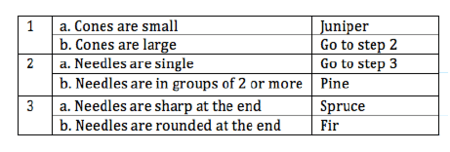
What tool is used to identify organisms by answering a series of questions?
Microscope
Dichotomous key
Periodic table
Calculator
What should you avoid using when working with a dichotomous key?
Internal Structures
External Structures
Color
Unicellular or Multicellular
What is an important step when using a dichotomous key?
Make sure the question separates the organisms into three groups.
Make sure the question separates the organisms into two groups.
Make sure the question separates the organisms into four groups.
Make sure the question separates the organisms into one group.
Which of the following is the correct order of classification from broadest to most specific?
Kingdom, Phylum, Class, Order, Family, Genus, Species
Species, Genus, Family, Order, Class, Phylum, Kingdom
Class, Kingdom, Phylum, Order, Family, Genus, Species
Genus, Species, Family, Order, Class, Phylum, Kingdom
What is the most general level of classification?
Genus
Family
Kingdom
Order
What is the most specific group in the classification system?
Kingdom
Phylum
Species
Class
How do you determine an organism's scientific name?
Kingdom & Phylum
Genus & Species
Class & Order
Phylum & Species
What is one reason why some organisms that look similar cannot reproduce together?
They are in different kingdoms.
They are not the same species.
They live in different habitats.
They have different diets.

What would the scientific name of this organism be?
Kingdom: Animalia
Phylum: Chordata
Class: Mammalia
Order: Carnivora
Family:Canidae
Genus: Canis
species: mesomelas
Mammalia carnivora
Canidae mesomelas
Canis mesomelas
Animalia chordata

Use the table to determine the scientific name of a rattlesnake written in the correct scientific format.
Crotalus Viridis
Crotalus Viridis
Crotalus viridis
Viperidae viridis