
NEW
Font size
 Worksheets
Energy Unit Pre-Test
Total questions: 28
Worksheet time: 2hrs 40mins
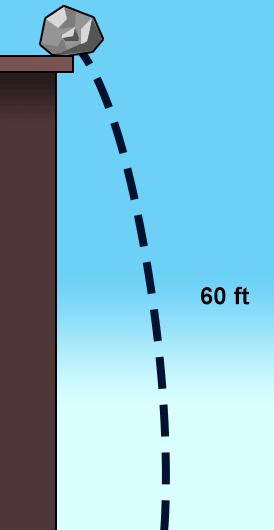
The rock in the picture is pushed over the edge and it begins to fall. Which type of energy conversion is taking place?
mechanical to heat
sound to mechanical
potential to kinetic
kinetic to potential

A ball is projected into the air. Where is potential energy the greatest?


Which point on the roller coaster's path represents the maximum potential energy?


When gasoline is burned in a car engine, ________ energy is converted into _________ energy.
heat, chemical
chemical, potential
mechanical, chemical
chemical, mechanical
Which diagram BEST represents a convection heating current?


Within the alarm clock seen here, energy is transformed. It is time to get up! The alarm clock goes off. What are the energy transformations taking place in your alarm clock?
electrical to magnetic to sound
electrical to mechanical to sound
electrical to mechanical to light
chemical to electrical to mechanical

Muscles convert chemical energy into
light energy.
nuclear energy.
mechanical energy.
electromagnetic energy.
What form of energy does a compressed spring have?
heat energy
kinetic energy
chemical energy
potential energy
Maria’s father started a fire in the fireplace. He crumpled some paper, lit a match, and soon the logs in the fireplace were burning. In this case, the stored chemical energy in the logs was changed into
electrical energy.
mechanical motion.
heat and light energy.
electrical and heat energy.
Conduction occurs more easily between solids and liquids. This is because the particles in gases are
farther apart and move faster.
closer together and move faster.
further apart and move more slowly.
closer together and move more slowly.
Energy is transferred in solids by conduction, which means that
heat travels in both directions.
heat travels from the cooler object to the hotter object.
heat travels from the hotter object to the cooler object.
heat does not travel between objects of different temperatures.

The light bulb converts electrical energy into light and _________.
chemical
electromagnetic
heat
nuclear

Which image exclusively represents the principle of radiation?
IV
III
II
I

A drawn bow possesses mechanical energy in the form of _______________. After the arrow is released, the energy is transformed into _________________.
potential energy; mechanical energy
elastic potential energy; kinetic energy
gravitational potential energy; kinetic energy
elastic kinetic energy; mechanical kinetic energy
A pole vaulter runs forward, plants his pole, rises in the air and lands. What point represents his greatest amount of gravitational potential energy?
when he initially lands
as he runs forward to plant the pole
just before he starts to fall to the ground
after take-off as the pole expands and lifts the vaulter toward the bar
electric generators converts mechanical force into
mechanical energy
magmatism
electric current
electric energy
a motor converts electrical current into
chemical energy
chemical force
mechanical force
mechanical life
What two factors affect an object's kinetic energy?
area and volume
mass and weight
weight and height
mass and speed
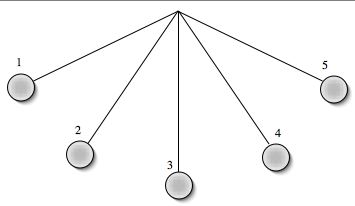
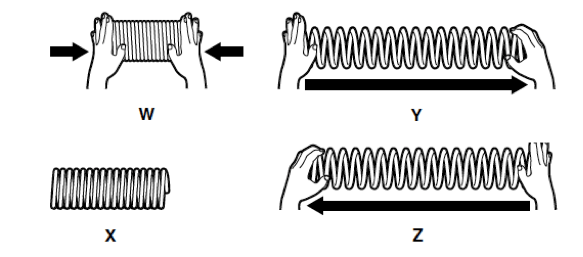
Elastic potential energy is energy stored in an object, such as a spring, due to the object being stretched or compressed. In which position is it most likely that the spring has lost its elastic potential energy?
W
Y
X
Z
Which picture is NOT an example of Chemical PE?

Which would have the LEAST gravitational potential energy (GPE)?
A ball sitting on the ground
Moon viewed from the Earth
An airplane flying 30,000 feet above the ground
A rock sitting on top of Mt. Everest
Energy that is transformed into thermal energy, is released into the surroundings and is difficult or impossible to recapture is called?
Disappointed Energy
Dissipated Energy
Lost Energy
Transformative Energy

