
Font size
 Worksheets
APES Unit 1 Review
Total questions: 167
Worksheet time: 6hrs 28mins


Which biome covers most of the land mass near Earth's equator?
Desert
Grassland
Tropical rainforest
Temperate forest

The rain forest soil is
poor and rocky
frozen soil
thick and nutrient rich
thin and nutrient poor

__________ primary productivity = the organic materials that remain after photosynthetic organisms in the ecosystem have used some of these compounds for their cellular energy needs (cellular respiration).
Gross
Total
Net
Secondary

__________ primary productivity is the total amount of energy that producers convert to chemical energy in organic molecules per unit of time.
Net
Total
Gross
Secondary

The total quantity of all living matter in an area is called:
Troposphere
Net Primary Productivity
Biomass
Ecosystem

Ecological efficiency from one trophic level to the next is generally:
1%
10%
75%
90%
Permafrost is an important factor in which biome?
Boreal Forest
Tundra
Coral Reefs
temperate rain forest
Which biome is characterized by shallow, nutrient-rich waters and mangrove forests?
Tropical Rainforests
Tundra
Coral Reefs
Estuary
Which biome has the highest soil nutrient levels?
Temperate Grassland
Boreal Forest
Tropical Rainforest
Temperate Deciduous Forest
An observer notes that the various birds in her yard feed on are using different parts of the tree for nesting sites and food. This is an example of _______________
division of labor
resource conservation
resource partitioning
mutualism
An ecosystem contains
only one species
multiple species
living and non-living components
all the similar biomes across the world
A population is best described as
only one species
multiple species
living and non-living components
all the similar biomes across the world
As simple diagram showing the transfer of energy from a producer to a primary consumer and on to a secondary consumer.
foodweb
consumer
food chain
omnivore

Which pair of biogeochemical cycles are most associated with inorganic fertilizer and sewage waste?
Carbon and Nitrogen cycles
Carbon and Sulfur cycles
Phosphorus and Nitrogen cycles
Sulfur and Nitrogen cycles
Sulfur and Water cycles

Which is NOT a process of the water cycle?
What is the largest reservoir for water?
the ocean
rocks and minerals
the atmosphere
glaciers
Where is the largest reservoir for the phosphorus cycle?
rocks and minerals
the ocean
the atmopshere
fossil fuels
What is the largest reservoir for nitrogen?
the ocean
rocks and minerals
the atmosphere
bacteria

Decomposition is part of all cycles except _______
the carbon cycle
the nitrogen cycle
the water cycle
the phosphorus cycle
The only organisms that can fix atmospheric nitrogen into chemical compounds are what?
virus
bacteria and lightening
carbon
none of these
The amount of primary productivity generated by all producers in a given ecosystem is called __________________________________
Gross primary production
Net primary production
Total cell respiration
Trophic levels
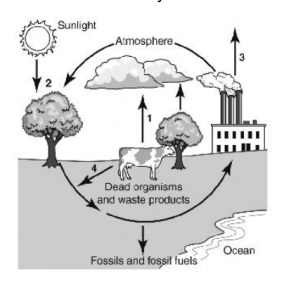
What is the very next thing that happens after fertilisers enter a river in eutrophication?
Fish die due to a lack of oxygen
Plants below the surface die due to a lack of sunlight
The number of aerobic bacteria increases
Fast growth of plants
In eutrophication, what directly causes the death of fish?
The plants use up oxygen in respiration
The fish are poisoned by high CO2 levels
Bacteria use up oxygen in respiration
The fish use up oxygen in respiration
In eutrophication, what does 'algal bloom' refer to?
The rapid increase in the number of bacteria
The rapid increase in the number of plants
The rapid decrease in the number of fish
The rapid increase in the amount of nitrates in the river
Eutrophication is defined as a change that occurs to an aquatic ecosystem. This change is mainly due to what?
Newly introduced fish
Depletion of the ozone layer
Increased nutrient concentration
Increase in atmospheric carbon dioxide.
An experiment is designed to determine if wheat grows better when it is planted alone or with clover. The design calls for 3 pans of each treatment. Pans A, B, and C contain only wheat. Pans D, E, and F contain clover and wheat planted in alternating rows. Each pan contains a total of
100 seeds. All treatments contain the same type of soil, are planted in the same size pan, are exposed to the same amount of sunlight, and are maintained at the same temperature throughout the course of the experiment.
The treatments planted with only wheat are the
sample size.
control.
environmental variable.
null hypothesis.
replication.
The concentration of carbon dioxide in the atmosphere
is increasing in part due to fossil fuel use.
has not significantly changed in the past 200 years.
is increasing in part due to deforestation.
has been decreasing since the 1800’s.
can not be reliably measured
The environment refers to
all conditions surrounding us on Earth.
species interactions that affect human life.
conditions that cause negative effects on our health.
interactions that harm the atmosphere.
the sum of all the conditions surrounding us that influence life.
The study of environmental science primarily considers
interactions among human systems and those found in Earth
the effect of human systems
abiotic factors that influence the state of our environment
factors that affect global climate change
An ecosystem is a location on Earth that includes
only biotic components
only abiotic components
interacting biotic and abiotic components
positive and negative feedback loops
Living in a sustainable way refers to
recycling all paper, plastic, and metals
using resources in a way that does not deprive future generations
using Earth's resources efficiently
eating locally whenever possible
Which of the following is a qualitative observation?
15 inches
a liquid
a green solution
6 feet 1 inches
Place the ecology levels of organization in proper order (smallest to largest)
organism > population > community > ecosystem > biosphere
community > organism > ecosystem > biosphere > population
organism > community > biosphere > population > ecosystem
population > biosphere > ecosystem > community > organism
A tapeworm lives in the small intestines where it feeds and grows, robbing the human of essential nutrients. This is a _____ type of relationship.
Commensalism
Parasitism
Symbiotic
Mutualism
The cattle egret follows herds of cattle and eat the insects that the cattle stir up as they move through the grassland. The cattle appear to be unaffected by the egrets. This is a _____ type of relationship.
Commensalism
Parasitism
Symbiotic
Mutualism
A positive feedback loop occurs
when a system responds to a change by returning to its original state
when feedback into a system decreases a rate of response
when a system is in a steady state
when feedback into a system increases a rate of response
Which is a biotic factor?
producers
pH
energy
humidity
What law best relates to energy loss within an ecosystem?
First law of thermodynamics
Second law of thermodynamics
Third law of thermodynamics
Law of conservation of matter
Which best describes the concept of net primary production?
total amount of energy available from the Sun
total amount of cellular respiration conducted within an ecosystem
energy captured minus energy lost
total amount of energy available from the producer

In which biome would you expect to find an area with an average temperature of 10oC and 200 cm of precipitation annually?
Temperate seasonal forest
Temperate rainforest
Woodland/shrubland
Tropical seasonal forest
In which biome would you expect to find an area with an average temperature of 4oC and 50 cm of precipitation annually?
Tundra
Boreal forest
Temperate grassland/cold desert
Woodland/shrubland
What factors are used to classify a biome?
average temperature
average precipitation
distinctive plants adapted to area
all of these are correct
Which biome is characterized by the presence of permafrost?
temperate seasonal forest
woodland/shrubland
tundra
boreal forest
Terrestrial biomes are defined by ____ and ____ variables.
temperature; precipitation
temperature; animals
precipitation; plants
animals; plants
What is a herbivore?
receives energy from the sun
only eats meat
only eats plants
eats both plants and meat
A keystone species is best defined as
an organism that eats all others
an organism that runs the fastest
an organism that keeps the food web stable
an organism that has the most advantages
Which of the following are examples of wetlands?
swamps
marshes
bogs
all of these are correct
Which biome has warm temperatures, high precipitation, and little seasonal variation due to its location near the equator?
Boreal forest
Tropical rainforest
Woodland/shrubland
Subtropical desert
The direction of an arrow in a food chain represents
the flow of energy from organism B to A
the movement of organisms
the directionality of the sun
the flow of energy from organism A to B
What is an omnivore?
receives energy from the sun
only eats meat
only eats plants
eats both plants and meat
Which of the following biogeochemical cycles does not have an atmospheric phase?
Hydrolic Cycle
Nitrogen Cycle
Sulfur Cycle
Carbon Cycle
Phosphorous Cycle
An ecosystem consists of
A physical environment within which a biological community lives
The species with which a biological community interacts
A biological community and its physical environment
the primary producers within a biological community
Producers rely on _____ to release chemical energy and consumers rely on ____ to release chemical energy.
Cellular Respiration; photosynthesis
Cellular Respiration; cellular respiration
photosynthesis; cellular respiration
photosynthesis; photosynthesis
In the Nitrogen cycle, what is one Natural way that Nitrogen gets into our soil?
Fertilizers
Human Waste through septic tanks
Decomposing animals
Industrial waste
In the _____, there is no wet/dry season. But we do see more lower plants with a thicker epidermis..
Tundra
Boreal
Savanna
Desert
Taiga
There are less nutrient rich soils in the Rain Forest due to the dense tree canopy and water runoff.
True
False
Which biome has the lowest average Temperature, and the lowest Precipitation?
Tundra
Savanna
Rainforest
Taiga
Diurnal and Nocturnal creatures share their resources through the use of which of the following processes?
Competition
Resource Partitioning
Different trophic levels
Coevolution
Diurnal and Nocturnal creatures share their resources through the use of which of the following processes?
Competition
Resource Partitioning
Different trophic levels
Coevolution
In a food pyramid, which organism can be found on the bottom?
Primary Consumers
producers
Secondary Consumers
Herbivores
One species benefits and the other is not affected is an example of which symbiotic relationship?
Parasitism
Commensalism
Mutualism
Predation
Human activities such as the ____ release large amounts of Carbon into our atmosphere.
Burning of fossil fuels
burning of wood
use of synthetic fertilizers
use of detergents
The concentration of carbon dioxide in the atmosphere
is increasing in part due to fossil fuel use.
has not significantly changed in the past 200 years.
is increasing in part due to deforestation.
has been decreasing since the 1800’s.
can not be reliably measured
The cattle egret follows herds of cattle and eat the insects that the cattle stir up as they move through the grassland. The cattle appear to be unaffected by the egrets. This is a _____ type of relationship.
Commensalism
Parasitism
Symbiotic
Mutualism
Most energy on Earth comes from
volcanoes
the sun
trees
water
fire
Exemplified by bees consuming nectar and carrying pollen from one flower to another
Commensalism
Parasitism
Mutualism
Predation
Competition

Which environment is characterized by the highest diversity of tree species?
A
B
C
D
E
Which environment is has permafrost as an underlying subsoil?
A
B
C
D
E
This biome is characterized by long dry seasons and is dominated by grasses, shrubs, and grazing animals.
Savanna
Boreal
Tropical Rainforest
Grassland

The location of the greatest remaining natural biodiversity
A
B
C
D
E
This freshwater biome is characterized by fast-flowing water that can originate from underground springs or runoff, which carries sediment and organic material.
Coral Reefs
Rivers
Freshwater Wetlands
Open ocean
This biome is considered to have the lowest primary productivity per square area
Open ocean
Wetlands
Coral Reefs
Rivers
The two major processes involved in the carbon cycle are
weathering and erosion
erosion and deposition
evaporation and transpiration
photosynthesis and respiration
fixation and denitrification
The two major processes involved in the nitrogen cycle are
weathering and erosion
erosion and deposition
evaporation and transpiration
photosynthesis and respiration
fixation and denitrification
Select the choice that best fits each statement.
Plant roots absorb ammonium ions and nitrate ions for use in making molecules such as DNA, amino acids, and proteins.
Denitrification
Assimilation
Ammonification
Nitrogen fixation
What is the main difference between phosphorus and the other major cycles?
Phosphorus exists in elemental form
Phosphorus does not have an atmospheric component
The phosphorus cycle occurs very rapidly
Phosphorus is not needed for life

The process in the hydrologic cycle in which water vapor is released from leaves into the atmosphere is called
Transpiration
Precipitation
Photosynthesis
Condensation
In a given ecosystem, producers convert solar energy into 15,000kcal of chemical energy stored in organic compounds. Which of the following is the most likely amount of energy available to primary consumers?
1.5 Kcal
150 kcal
1,500 kcal
13,500 kcal
Which of the following best describes the net primary productivity of an ecosystem?
Net primary productivity is the amount of energy captured by producers through photosynthesis over time.
Net primary productivity is the amount of energy lost by producers through respiration over time.
Net primary productivity is the amount of energy lost through respiration by producers subtracted from the gross primary productivity of an ecosystem.


An organisms special role or position, such as where it lives, how it eats or behaves, and how it interacts with other organisms and the environment.
ecosystem
food web
habitat
niche
An observer notes that the various birds in her yard feed on are using different parts of the tree for nesting sites and food. This is an example of _______________
division of labor
resource conservation
resource partitioning
mutualism
Which of the following ecosystems experiences harsh conditions due to conditions from tides?
Coral reef
Freshwater wetlands
Open ocean
Intertidal zone
What is the effect of deforestation on the carbon cycle?
Increase in the amount of CO2 in the atmosphere
Decrease in the amount of CO2 in the atmosphere
Increase in the amount of photosynthesis
Deforestation has no impact on the carbon cycle
The largest reservoir of nitrogen is the:
Oceans
Rivers
Rock, Lithosphere, & Land
Atmosphere
Nitrogen is added to the atmosphere by:
Denitrification
Fixation
Nitrification
Ammonification
Nitrogen is removed from the atmosphere by:
Denitrification
Fixation
Nitrification
Ammonification
Which of the following best illustrates an abiotic factor affecting a biotic component?
Composting manure is added to agriculture
Phosphorous content in soil affecting plant growth
Plants release oxygen into the atmosphere.
Plants preventing soil erosion
If gross primary productivity in a wetland is 3 kg C/m2/year and respiration is 1.5 kg C/m2/year, what is the net Primary Productivity of the wetland?
1.5 kg C/m2/year
2 kg C/m2/year
3 kg C/m2/year
4.5 kg C/m2/year
The gross primary productivity of an ecosystem is?
the total amount of biomass.
the total energy captured by photosynthesis.
the energy captured after accounting for respiration
the energy available to primary consumers.
If gross primary productivity is 5 gC/m2yr, and the producers need 1.5 gC/m2yr for their own respiration, what is the net primary productivity?
3.5 gC/m2yr
6.5 gC/m2yr
-3.5 gC/m2yr
7.5 gC/m2yr

What does every food chain start with?
producers
sun
consumer
decomposers
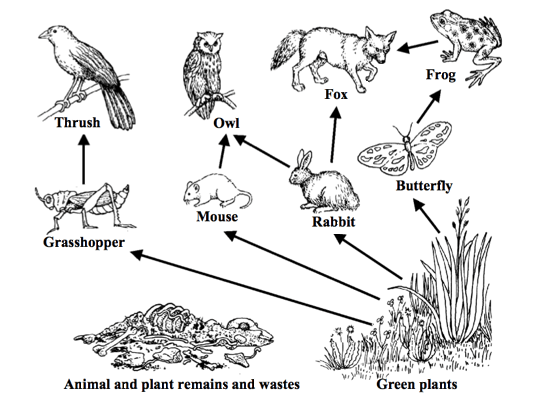
What law best relates to energy loss within an ecosystem?
First law of thermodynamics
Second law of thermodynamics
Third law of thermodynamics
Law of conservation of matter

Analyze and interpret the graph. What pattern do you see between the hare and lynx
As the prey density increases the number of predators increase
As the prey density decreases the number of predators increase
As the prey density increases the number of predators decrease
Both the prey density and predator density stay the same.
None of the above

According to the graph, what is causing the deer population to decrease
They got sick
The wolf population is decreasing
The wolf population increased
They ran out of food

Predator population lags behind prey population because......
Increase in predators leads to decrease in prey
Increase in predators leads to increase in prey
Increase in predators leads to decrease in producers
Increase in producers leads to increase in prey

What happens if a population grows past its carrying capacity?
The population keeps growing
The population starts to die off
The entire species will go extinct
The carrying capacity just increases
Energy enters a system as sunlight and a producer is able to produce 10 kilograms of tissue. If eaten, the producer would produce about ___ kilograms of a consumer tissue that would provide about ____ kilograms of tissue for a secondary consumer
100; 10
10; 1
100; 1
1; 0.1
At which trophic level are dragonflies that consume mosquitoes that feed on herbivorous mammals?
Primary Producers
Decomposers
Primary Consumers
Secondary Consumers
Tertiary Consumers


If there are 100 Kcal of energy available in the producers, how much energy would be available in the primary consumers?
10 Kcal
1 Kcal
100 Kcal
1000 Kcal
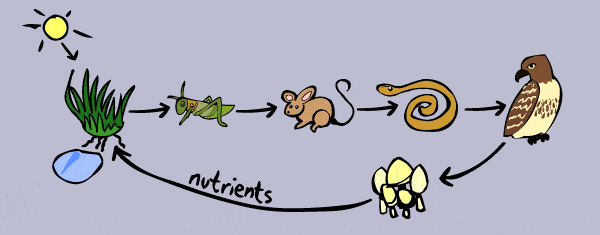
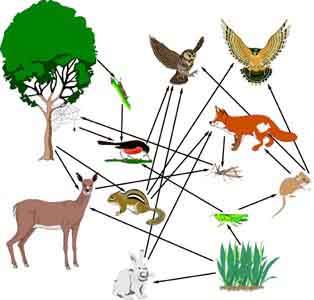

For animals, ______can include nesting space, shelter, types of food, and places to feed.

