
 Worksheets
Church Bells and Stained-Glass Windows Quiz
Total questions: 21
Worksheet time: 11mins
Who were the followers of Jesus known as?
Romans
Christians
Catholics
Orthodox
What happened to Christianity in the first 300 years after Jesus's life?
It became the official religion immediately.
It was not permitted in the Roman Empire.
It spread rapidly across Europe.
It was only practiced in secret.
Who was the leader of the western Church?
The emperor
The pope
The king
The bishop
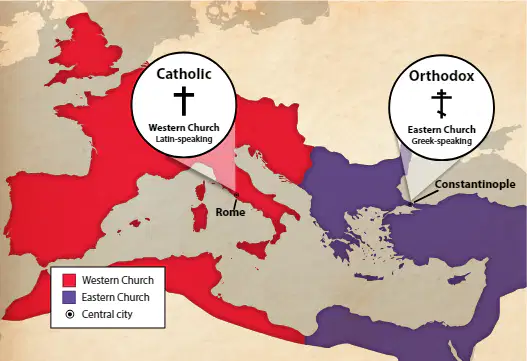
What were the two main branches of the Christian Church during the Middle Ages?
Protestant and Catholic
Catholic and Orthodox
Anglican and Lutheran
Methodist and Baptist
What was the purpose of holy days in the Middle Ages?
To celebrate birthdays
To mark important events in the life of Jesus and his followers
To have a day off work
To hold markets and fairs
What architectural style became popular in the Middle Ages for building churches?
Baroque
Romanesque
Gothic
Renaissance
What are some features of Gothic architecture?
Domes and columns
Tall towers, arches, rose windows, and spires
Flat roofs and small windows
Wooden beams and thatched roofs
Why did many Christians go on pilgrimages during medieval times?
To find new lands
To fulfill a vow to God or seek a cure
To become wealthy
To escape from wars
What was the primary role of monks in medieval Europe?
To lead armies
To devote their lives to the Church
To rule kingdoms
To trade goods
What is a monastery?
A type of castle
A building or collection of buildings that housed monks
A marketplace
A royal palace
What were women who devoted their lives to the Church called?
Monks
Priests
Nuns
Bishops
What were people called who held ideas that the Church leaders disagreed with?
Heretics
Saints
Prophets
Scholars
What did monks and nuns do during the Middle Ages to preserve ancient knowledge?
They used machines to print books.
They copied ancient writings by hand.
They destroyed old books.
They wrote new stories.
What did many books produced by monks and nuns contain?
Simple drawings
Exquisite art and design features
Blank pages
Maps
What is a young boy called when he starts training to become a monk?
Apprentice
Novice
Scholar
Squire
What are some of the things a novice learns during their training?
Cooking and dancing
Reading, writing, and farming
Painting and sculpting
Singing and acting
What must a novice vow to do if they decide to join the Church?
Travel the world
Live a humble and obedient life
Become a teacher
Start a family
What physical change identifies someone as a monk?
Wearing a special robe
Shaving the top of their head
Carrying a staff
Wearing a necklace
What was the primary language of the early Christian Church in the Western Roman Empire?
Greek
Latin
Aramaic
Hebrew
Who was the Roman Emperor that converted to Christianity, significantly influencing its spread across the Roman Empire?
Nero
Julius Caesar
Constantine the Great
Augustus
Which group played a significant role in the missionary work and the spread of Christianity to rural areas of the Roman Empire?
Roman soldiers
Christian monks
Pagan priests
Roman senators

