Wayground logo

Free Printable Worksheets

Font size

S
M
L
XL
Worksheets

Biochemical Cycles

Total questions: 28

Worksheet time: 21mins

Name
Class
Date
1.
How much of the atmosphere is composed of nitrogen gas?
a)
87%
b)
38%
c)
78%
d)
21%
2.
How do plants get the nitrogen they need?
a)
from the air
b)
from the soil or water in which they live
c)
from the Sun
d)
from broken-down rocks
3.
Organisms that break down dead plants & animals and release nitrogen back into atmosphere...
a)
bacteria
b)
plants
c)
animals
d)
producers
4.
This gas makes up 21% of the atmosphere
a)
ozone
b)
oxygen
c)
nitrogen
d)
water vapor
5.
Photosynthesis
a)
absorbs CO2
b)
releases CO2
6.
Respiration
a)
absorbs CO2
b)
releases CO2
7.
Which of the following is a consequence of excess carbon building up in Earth’s atmosphere?
a)
The amount of breathable oxygen available to living things decreases
b)
Global temperatures change, affecting normal weather patterns.
c)
The amount of solar energy reaching the earth’s surface decreases.
d)
Global air pressure increases making it more difficult for plants and animals to breathe.
8.
A particular golf course is using large amounts of nitrogen fertilizer. What process could move this nitrogen into a local stream?
a)
volatilization
b)
nitrogen fixation
c)
runoff
d)
ammonification
9.
How are burning of fossil fuels and volcanic eruptions similar with respect to their effects on the carbon cycle?
a)
Both remove carbon from the atmosphere.
b)
Both add carbon to the atmosphere.
c)
Both add carbon to the lithosphere.
d)
Both remove carbon from the lithosphere.
10.
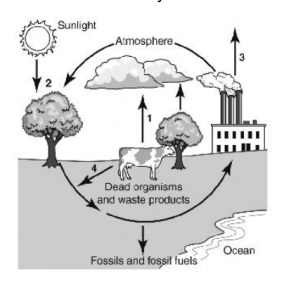
What is happening at 1?
a)
respiration: releasing CO2
b)
decomposing CO2 in the soil
c)
photosynthesis: absorbing CO2
d)
turning CO2 from the atmosphere into organic molecules
11.
In what process is Carbon turned transformed into chemical energy?
a)
Photosynthesis
b)
Respiration
c)
Primary Production
d)
Secondary Production
12.
The process where excess nutrients enter body of water causing overgrowth of aquatic plants and algae...
a)
Eutrophication
b)
Acid Precipitation
c)
Nitrogen Fixation
d)
Decomposition
13.
How nitrogen is "fixed" into useable form for plants...
a)
through action of bacteria only
b)
through lightning only
c)
through action of bacteria & lightning
d)
through photosynthesis
14.
How does carbon in a grass plant get into a lion?
a)
The lion eats the grass
b)
Carbon from grass doesn't end up in a lion. 
c)
The carbon ends up in the food the lion eats. 
d)
The lion breathes in carbon given out by the plant
15.
Which is the opposite of condensation?
a)
runoff
b)
evaporation
c)
precipitation
d)
transpiration
16.
Which of these is an example of precipitation?
a)
snow
b)
air
c)
clouds
d)
vapor
17.
What is it called when plants give off water vapor as a waste product?
a)
condensation
b)
evaporation
c)
sublimation
d)
transpiration
18.
97% of the Earth's water is  located in....
a)
ground wat
b)
the ocean
c)
lakes, rivers, and streams
d)
glaciers
19.

What would happen to the nitrogen cycle if all soil bacteria died?

a)

No nitrogen gas could be converted to a form plants can use.

b)

All nitrogen would become nitrate permanently.

c)

All nitrogen would become nitrate permanently.

20.

Label the following processes in the nitrogen cycle diagram (1-4):

assimilation

denitrification

nitrification

ammonification

21.

Label the following processes in the diagram:

assimilation

uplifting

weathering

sedimentation

22.
What role do decomposers play in the phosphorous cycle?
a)
absorb phosphorous 
b)
release phosphorous into atmosphere
c)
return phosphorous into the soil
d)
combustion
23.
Which of the following statements is true of the phosphorus cycle?
a)
Phosphorus enters the atmosphere as phosphates.
b)
The phosphorus cycle utilizes the processes of erosion, and weathering.
c)
Phosphates are used in carbohydrate and glucose storage.
d)
The phosphorus cycle utilizes bacteria to breakdown phosphates and make them available for plants.
24.
Phosphorous is passed from plants to ____ who eat them
a)
plants
b)
animals
c)
scavengers
25.

This is NOT a part of the phosphorus cycle.

a)

Phosphate is incorporated into sedimentary rocks

b)

Phosphate bound to soil

c)

Atmospheric phosphate

d)

Phosphate is absorbed from the soil by plants

26.

The phosphorus cycle occurs much more quickly than the carbon and nitrogen cycles.

a)

true

b)

false

27.

Carbon is cycled on a global scale. Why does phosphorus cycling tend to occur more locally?

a)

it primarily involves the weathering of rocks, which are mostly stationary

b)

it only involves land animals that cannot swim across oceans to transport the nutrient

c)

it occurs in areas where cloud formation is low, so it rarely gets trapped in water vapors

d)

all of the answers are correct

28.

What is the original, and biggest reservoir of phosphorus on the planet?

a)

live plants and animals

b)

groundwater

c)

the atmosphere

d)

rocks