
NEW
Font size
 Worksheets
MAT S213 Reviewer 2
Total questions: 20
Worksheet time: 9mins
What is the primary purpose of using Riemann sums in numerical integration?
To approximate the area under a curve
To find the exact value of an integral
To solve differential equations
To calculate the derivative of a function
Which of the following best describes the error estimation in numerical integration?
The sum of the absolute values of the derivatives of the function being integrated
The difference between the exact value of the integral and its numerical approximation
The maximum value of the function over the interval of integration
The number of subintervals used in the approximation method
To approximate the definite integral ∫02x2dx using the Trapezoidal Rule with 4 equal subintervals, what is the approximation?
3.5
3.0
2.5
2.75
When using Trapezoidal rule, the number of subintervals must be:
A prime number
An even integer
An odd integer
Any positive integer
Which of the following is true about Riemann sums?
They can approximate the area under a curve by summing the areas of rectangles.
They can only be used with continuous functions.
They provide an exact value for the area under a curve.
They are more accurate than the Trapezoidal Rule and Simpson's Rule for all functions.
For approximating definite integrals, the error in the Trapezoidal Rule generally decreases as:
The function becomes more quadratic
The function becomes more linear
The width of each subinterval increases
The number of subintervals increases
Which of the following statements is true regarding the use of numerical integration methods?
Numerical integration methods can only approximate integrals of polynomial functions.
Numerical integration methods are always less accurate than finding the exact integral.
Numerical integration methods are useful for approximating integrals when the antiderivative of the function is difficult or impossible to find.
Numerical integration methods are unnecessary when the antiderivative of the function can be easily found.
The Trapezoidal Rule and Simpson's Rule are examples of:
Differential calculus techniques
Numerical integration methods
Algebraic methods for solving equations
Analytical geometry tools
When calculating the numerical approximation of an integral using the Trapezoidal Rule, which of the following factors does not affect the accuracy of the approximation?
The smoothness of the function being integrated
The method used to calculate the function's values at the endpoints of the subintervals
The number of subintervals
The color of the graph of the function
What is the area of a rectangle with length a and width b?
a2
a + b
ab
b2
It is an approximate area of a region, obtained by adding up the areas of multiple simplified slices of the region.
Riemann sum
definite integral
summation notation
sum of a series
What polygon is used in the Riemann sum?
trapezoid
rectangle
triangle
rhombus
For a function that is strictly decreasing, a right hand Riemann Sum is which of the following:
Overestimate
Exact Solution
Underestimate
Unable to Determine

What does this picture represent?
Left Riemann Sum
Middle Riemann Sum
Right Riemann Sum
Trapezoidal Sum
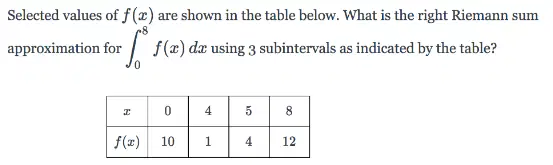
17
53
15
44
A Riemann Sum uses rectangles to
approximate the area under a curve. The more rectangles, the better the approximation.
approximate the area under a curve. The more rectangles, the worse the approximation.
approximate the area under a curve. The less rectangles, the better the approximation.
none of these
Using the Left Riemann Sum, approximate the area bounded by y=41x2+2 from x=0 to x = 4 when n= 4
15.5
12.15
13.25
11.5
∫012xdx
-1
0
1
2
∫12(3x2+4x3)dx
24
-8
-10
22
Evaluate ∫06πsin(x)cos(x) dx
81
61
41
32

