
 Worksheets
Atomic Structure Test - Chemistry
Total questions: 30
Worksheet time: 17mins
Name
Class
Date
1.
1. The chemical symbol for sodium is________
a)
na
b)
Na
c)
NA
d)
So
2.
2. Which subatomic particle has a positive charge?
a)
electron
b)
neutron
c)
alpha particle
d)
proton
3.
3. Which subatomic particle has a negative charge?
a)
alpha particle
b)
proton
c)
electron
d)
neutron
4.
4. Which subatomic particle has a no charge?
a)
alpha particle
b)
proton
c)
electron
d)
neutron
5.
5. Which statement about subatomic particles is true?
a)
Protons, neutrons, and electrons all have about the same mass.
b)
Unlike protons or neutrons, electrons have no mass.
c)
Neutrons have no charge and no mass.
d)
An electron has far less mass than either a proton or neutron.
6.
6. Which of the following is unique for any given element?
a)
the number of neutrons
b)
the number of protons
c)
the charge on the electrons
d)
the mass of a neutron
7.
7. The number of protons and neutrons in one atom of an element is that element’s
a)
mass number.
b)
atomic number.
c)
balanced charge.
d)
isotope.
8.
8. Which subatomic particles are not in the nucleus?
a)
protons and neutrons.
b)
electrons
c)
Only protons.
d)
Only neutrons.
9.
9. To find the number of neutrons in an atom, you would subtract
a)
mass number from atomic number.
b)
atomic number from electron number.
c)
atomic number from mass number.
d)
isotope number from atomic number.
10.
10. What unit is used to measure the atomic mass?
a)
Atomic mass unit (amu)
b)
gram
c)
angstrom
d)
nanogram
11.
11. What is the mass number of an element that has 20 protons, 20 electrons, and 21 neutrons?
a)
21
b)
41
c)
40
d)
61
12.
12. Which statement about the atom’s nucleus is correct?
a)
The nucleus is made of protons and neutrons and has a negative charge.
b)
The nucleus is made of protons and neutrons and has a positive charge.
c)
The nucleus is made of electrons and has a positive charge.
d)
The nucleus is made of electrons and has a negative charge.
13.
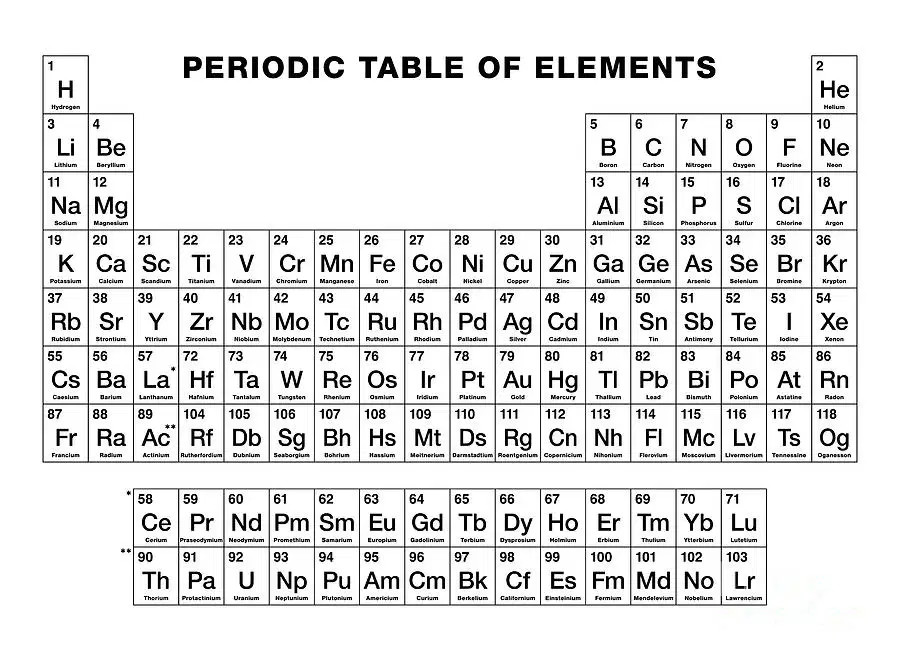
13. How many protons are in the nucleus of an atom of Boron (B)? Use a periodic table
a)
2
b)
9
c)
4
d)
5
14.
14. Fluorine’s atomic number is 9. This means that a Fluorine atom has?
a)
9 neutrons in its nucleus.
b)
a total of 9 protons and neutrons.
c)
9 protons in its nucleus.
d)
a total of 9 neutrons and electrons.
15.
15. How many electrons does an element have with a mass number of 68?
a)
34
b)
68
c)
18
d)
unknown
16.
16. What is the mass number of atom that has 7 protons and 7 neutrons?
a)
7
b)
4
c)
16
d)
14
17.
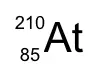
17. In the symbol in the figure what are the number of protons electrons and neutrons?
a)
85 protons, 85 electrons, 210 neutrons
b)
85 protons, 85 electrons, 125 neutrons
c)
85 protons, 210 electrons, 85 neutrons
d)
85 protons, 125 electrons, 85 neutrons
18.
18. What does the 22 in titanium-22 represent?
a)
Atomic number
b)
Twice the number of protons
c)
Mass number
d)
the sum of protons and electrons
19.
19. Which symbols represents atoms that are isotopes?
a)
Carbon-14 and Nitrogen-14
b)
Iodine-131 and Iodine-131
c)
Oxygen-16 and Oxygen-18
d)
Radon-222 and Radium-222
20.

20. Looking at the image which symbol represents atoms that are isotopes?
a)
a.
b)
b.
c)
c.
d)
d.
21.
21. How do the isotopes Carbon-12 and Carbon-13 differ?
a)
Carbon-12 has one more electron than hydrogen-1.
b)
Carbon-13 has one more neutron than carbon-12
c)
Carbon-12 has 12 neutrons; carbon-13 has 13 neutrons
d)
Carbon-13 has one more proton that carbon-12
22.
22. In an electrically neutral atom, the number of ______ is equal to the number of ______?
a)
neutrons, electrons
b)
protons, electrons
c)
electrons, ions
d)
protons, neutrons
23.
23. If an atom has an equal number of protons and electrons we say it is _____________
a)
neutral
b)
cation
c)
anion
d)
ion
24.
24. If an atom either gains or loses an electron, the atom is called a(an) ______.
a)
element
b)
molecule
c)
ion
d)
compound
25.
25. An ion with a charge of - 2 is called ___________ and has _________ electrons.
a)
cation, lost
b)
cation, gained
c)
anion, lost
d)
anion, gained
26.
26. An ion with a charge of +2 is called ___________ and has lost ________ electrons.
a)
cation, 1
b)
cation, 2
c)
anion, 1
d)
anion, 2
27.

Explain what is happening in the figure below in terms of the charged particles in the water and the balloon.
4 lines
28.
Is it possible to have 2 different elements with the same number of neutrons? Explain why or why not.
4 lines
29.

What subatomic particles are coloured green in this image?
(a)
Choose from the below words
electrons
protons
neutrons
30.
Which arrow points to the protons?
A
B
C
100 %

