
 Worksheets
etH Carrying Capacity 10.14.24
Total questions: 16
Worksheet time: 14mins

A lion and a cheetah attempt to occupy the same niche. The more aggressive lion survives; the cheetah does not.
Density-Dependent: Competition
Density-Independent: Competition
Density-Dependent: Predator-Prey
Density-Independent: Predator-Prey
Since lynx prey on hares, an increase in the hare population causes an increase in the lynx population.
Density-Dependent: Competition
Density-Independent: Competition
Density-Dependent: Predator-Prey
Density-Independent: Predator-Prey
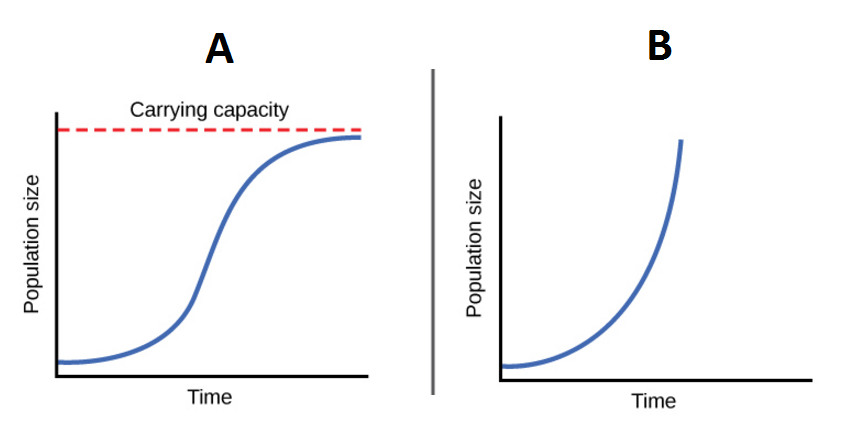
What type of growth model is shown in image A?
Exponential
Logistic
What type of growth model is shown in image B?
Exponential
Logistic
What is a limiting factor?
Factors that always increase a population
Factors that always decrease a population
Resources that are unlimited
Factors/resources that limit how many organisms can live in an area at the same time
If there was a wildfire in the forest that destroyed the plant life, what would happen to the herbivore population?
Herbivores would decrease due to a lack of food
Herbivores would increase due to an increase of food
Herbivores would not be affected
Herbivores would decrease due to an increase in predators
Choose the 4 limiting factors.
Food
Water
Time
Space
Shelter
Which of the following would lead to a decrease in tertiary consumers?
An increase in herbivores and omnivores
An increase in rain
A decrease in competition
A new carnivore population moving to the area
Many fish die due to a change in the winds and the appearance of the El Nino ocean current off the coast of Peru and Chile.
Density-Dependent
Density-Independent
Fish on a coral reef stake out their territory and chase away any younger fish that try to live there.
Density-Dependent
Density-Independent
A lion and a cheetah attempt to occupy the same niche. The more aggressive lion survives; the cheetah does not.
Density-Dependent: Competition
Density-Independent: Competition
Density-Dependent: Predator-Prey
Density-Independent: Predator-Prey
What questions do you have about our biodiversity lesson?

