
NEW
Font size
 Worksheets
Water Properties and Ocean
Total questions: 20
Worksheet time: 12mins
What is the term used to describe the ability of a liquid to flow in narrow spaces without the assistance of external forces?
Cohesion
Capillary action
Adhesion
Polarity
What property of water allows it to adhere to other substances?
Cohesion
Adhesion
Surface tension
Polarity
What is the term for the amount of heat required to raise the temperature of 1 gram of a substance by 1°C?
Latent heat
Specific heat capacity
Heat transfer
Energy transfer
Which of the following describes the movement of heat through fluids due to the movement of the fluid itself? Hint: ocean currents move because of this action
Conduction
Convection
Radiation
Evaporation
What is the process called when a liquid turns into a gas?
Condensation
Freezing
Evaporation
Melting
What term describes the force that causes molecules on the surface of a liquid to come together and form a layer?
Surface tension
Cohesion
Adhesion
Polarity
What is the name of the effect that causes moving air and water to spin and twist due to the Earth's rotation?
Thermohaline circulation
Coriolis effect
Ocean current
Wind patterns
Which of the following is a measure of the amount of salt in water?
Density
Salinity
Polarity
Specific heat
What is the term for the layer in the ocean where the temperature changes rapidly with depth?
Halocline
Thermocline
Pycnocline
Isocline
What process involves the change of state from solid to liquid?
Freezing
Melting
Condensation
Sublimation
It is 4.184 Joules per gram per degree Celsius (J/g°C), meaning it takes 4.184 Joules of energy to raise the temperature of 1 gram of water by 1 degree Celsius.
Specific heat of water
Latent heat of water
Heat capacity of water
Thermal energy of water
What is the term for the process by which a gas turns into a liquid?
Evaporation
Condensation
Sublimation
Freezing

The Earth's surface is covered by ___ % of saltwater.
49
65
71
82

True or False: Salinity increases as the depth of the ocean increases.
True
False
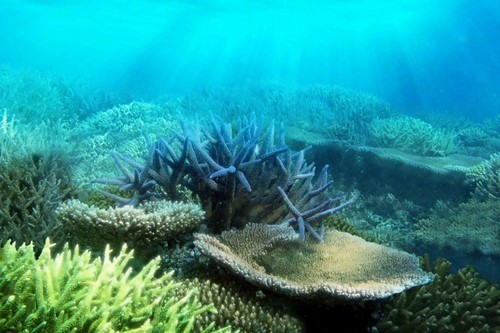
As the depth of ocean water increases, the temperature...
increases (warmer)
decreases (colder)
The tides are controlled by....
Salinity
Wind and storms
The gravitational pull of the moon
The temperature of the water

A wave that forms far below the ocean's surface is called _______________. This is usually caused by an earthquake beneath the ocean floor.
Tornado
Tsunami

Capillary action is key for
Water moves from the roots to the leaves in plants
Air moves from the mouth to the lungs
Ice floats on water
What depth does the ocean Surface Zone extend to and from?
0 - 350 meters
350 - 700 meters
700 meters to the bottom of the ocean
the top 5 feet
Cohesion of water means ........
water molecules stick to each other
water molecules stick to other surfaces
water molecules are less dense
water molecules are very far apart

