
 Worksheets
Unit 2 Learning Checkpoint 1 Review
Total questions: 44
Worksheet time: 1hrs 9mins
What is a characteristic of a gas?
Fixed shape and volume
Particles are close together
Particles are compressible
Particles vibrate in place
What is the primary difference between atoms and molecules?
Atoms are larger than molecules.
Atoms are single units, while molecules are combinations of atoms.
Molecules are single units, while atoms are combinations of molecules.
Atoms and molecules are the same.
What is the main difference between elements and compounds?
Elements are mixtures
Compounds are made of one type of atom
Elements cannot be broken down by ordinary means
Compounds are always solid
What are the two types of mixtures?
Solid and liquid
Chemical and physical
Heterogeneous and homogeneous
Simple and complex
Which of the following is NOT a characteristic of mixtures?
Can be separated by physical means
Identities of substances are retained
Always have a uniform composition
Are physical combinations
What type of bond is primarily responsible for holding the atoms together within a molecule?
Intermolecular attraction
Intramolecular attraction
Ionic bond
Hydrogen bond

Which of these samples shown best represents an element?
A
B
C
D
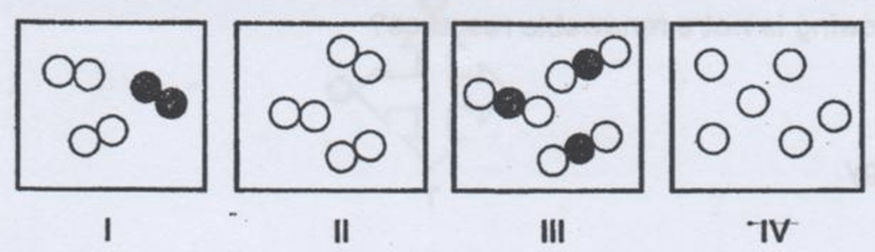
In the diagrams provided, the circles of different colors represent the atoms of different elements. Which diagram represents a mixture?
I
II
III
IV

Which of the following represents a compound?
Diagram (a)
Diagram (b)
Diagram (c)
All of the diagrams represent the parts of a compound.

Which diagram represents an element?
Diagram (a)
Diagram (b)
Diagram (c)
None of the diagrams represent the parts of an element.

What type of matter is shown in this particle diagram?
Element
Compound
Mixture of Elements
Mixture of Compounds
Mixture of Elements and Compounds

What type of matter is shown in this particle diagram?
Element
Compound
Mixture of Elements
Mixture of Compounds
Mixture of Elements and Compounds

What type of matter is shown in this particle diagram?
Element
Compound
Mixture of Elements
Mixture of Compounds
Mixture of Elements and Compounds

What type of matter is shown in this particle diagram?
Element
Compound
Mixture of Elements
Mixture of Compounds
Mixture of Elements and Compounds


What type of mixture does this diagram represent?
Homogeneous, because there are layers.
Heterogeneous, because there are layers.
Homogenous, because the contents are mixed evenly.
Heterogenous, because the contents are mixed evenly.
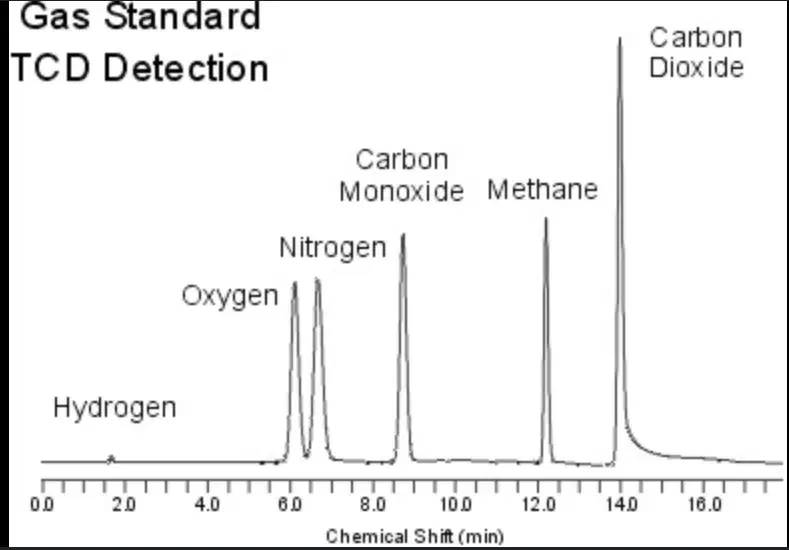
What does this image of a gas chromatography chart show?
The sample contains more carbon dioxide than methane.
The sample contains more nitrogen than methane.
The peaks represent different elements.
The Hydrogen sample interacted the most with the substance in the column.
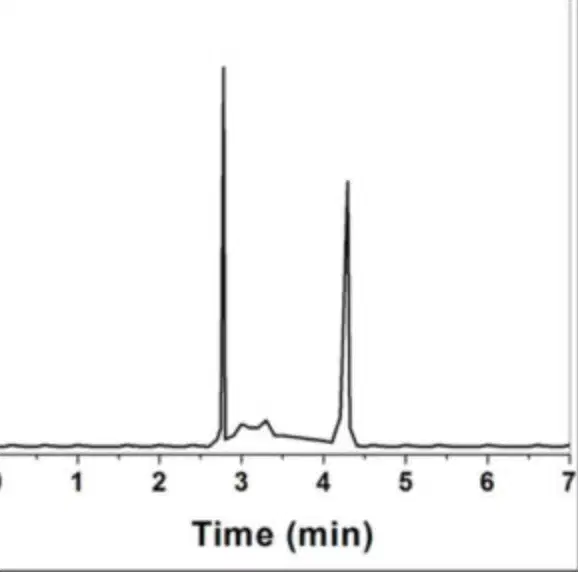
Which two statements about the chromatogram is true?
Chromatography separate compounds
The highest peak has the greatest concentration.
The samllest peak has the greatest concentration.
Chromotography separates mixtures
The weaker the intermolecular forces of a substance the _____________ the boiling point
higher
lower
Water and ammonia molecules are roughly the same size and the same mass but ammonia boils at -28°F and water boils at 212°F. What can we conclude about the intermolecular forces between water and ammonia?
Water has stronger intermolecular forces
Ammonia has stronger intermolecular forces
The intermolecular forces are the same strength
Not enough information is given
The melting points and boiling points of substances can lead to inferences about the intermolecular attraction of the atoms of these substances because higher melting and boiling points indicate that
the atomic mass of the substances is smaller.
the substances produce exothermic reactions.
atomic radii increases heat is added.
more energy is needed to separate molecules.
Intramolecular forces are the forces
within molecules
between molecules

What kind of force is the arrow pointing to?
Intramolecular Force
Intermolecular Force

What kind of force is the arrow pointing to?
Intramolecular force
Intermolecular force
Which factor influences the strength of London dispersion forces?
Molecular size
Molecular bonds
Molecular polarity
What is the relationship between molecule size and force?
Smaller molecule
weak forces
Bigger molecule
strong forces
Medium-sized molecule
moderate forces
Rank the following substances with their boiling points in order of strongest forces from strongest to weakest.
H2O - 100oC
C7H16- 98.4oC
C3H8 - 56oC
CH4 - 40.2oC
The weaker the intermolecular forces of a substance the _____________ the boiling point
higher
lower

Water has an unusually high boiling point for a molecular compound because it has
hydrogen bonding
ion-ion attractions
a high density
a large gram formula mass
Which substance has the weakest intermolecular forces?
Substance A, boiling point of 75 °C
Substance B, boiling point of 105 °C
Substance C, boiling point of 25 °C
Substance d, boiling point of 45 °C

Which is the stronger intermolecular force present in NH3?
London dispersion Force
Dipole dipole
Hydrogen bonding
Which sample has hydrogen bonding?
H2S
CH4
NH3
HI
________________________ have the strongest intermolecular forces of attraction.
Dipole- Dipole
Dispersion
Hydrogen Bonds
Which one has the highest boiling point?
BeCl2
CO2
SF4
NH4
Which of the following will have the highest melting point.
naphthalene, C8H10
SiO2
methane CH4
C2H5OH
Which of the following atoms would have the largest radius?
chlorine
silicon
sodium
argon

