
 Worksheets
Yr. 13 Tech. 1.24 Designing Prt. 2
Total questions: 21
Worksheet time: 19mins

What is particularly important to do during the early stages of exploring a design brief?
Finalize the design specification immediately.
Avoid gathering too much information.
Keep a log book to record ideas and the project’s progress.
Focus only on one idea to avoid confusion.
What is the primary purpose of thought shower (brainstorming) idea generation techniques?
To finalize the best idea immediately.
To limit the number of ideas to avoid confusion.
To ensure only one person contributes ideas.
To generate a wide range of ideas and solutions.

What is not a rule when engaging though shower idea generation?
no criticism of any idea is allowed – judgement is
withheld until later
all ideas are welcomed, no matter how bizarre
they may appear
ideas must meet all aspects of the product specification in order to be considered
building on someone else’s idea to create a group
chain reaction is encouraged
Fill in the Blank
"Too wide a difference in the (a) of the group
members should be avoided as this tends to
inhibit free expression".
Fill in the blank
"Advance (a) should be given of the problem so
that people can ‘tune in’ to it"

What is one method of primary research ?
Watching educational videos.
Direct contact with experts
Reading books in a library.
Listening to podcasts.
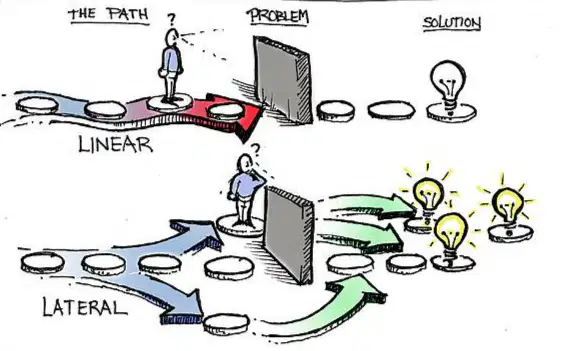
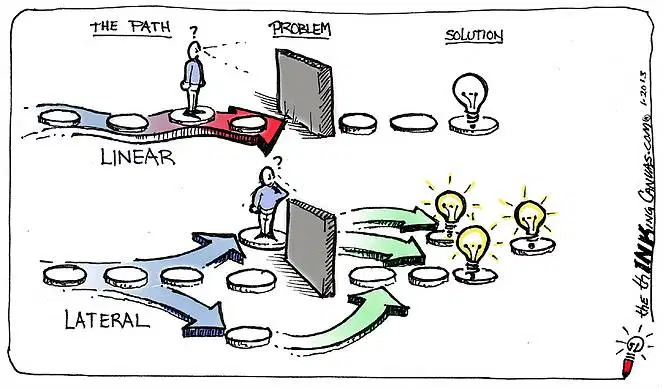
Who coined the term ‘lateral thinking’?
Fritz Zwicky
Philippe starck
Bethan Gray
Edward de Bono.
What is the focus of rearranging or reversing an idea?
Keeping the original order
Making the product less effective
Transposing positives and negatives
Adding more components
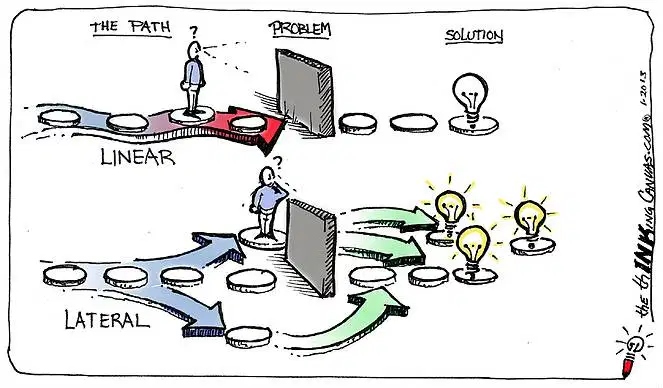
Which of the following is NOT a principle of lateral thinking?
A relaxation of the rigid logical control associated with vertical thinking
The search for different ways of looking at things
The recognition of dominant, polarising ideas
The strict adherence to vertical logic

Fill in the Blank
" (a) is based on the theory that everything
new is actually a modification of something
that already exists".

Organize these options into the right categories
Can I replace or change parts?
Can I use other materials?
What ideas or parts can be merged?
Can I merge it with other objects?
Is there something similar to it, but in a different
context?
Does the past offer any lessons with similar ideas?
What can be exaggerated?
Can I add extra features or somehow add extra
value?

Match description to the correct term
Find an alternative application for your current idea
Put to another use
enlarging your idea, or parts of it,
may increase its perceived value or give you
new insights about what components are most
important.
Magnify
Simplify, reduce or remove components. Through repeated trimming of ideas,
objects and processes you can gradually narrow
your challenge down to that part or function that is
most important.
Eliminate
What result might materialize if part of your product worked in reverse or were
in a different order.
Rearrange
Reorder the following elements as they occur in the design and development process
Divergence,
Transformation
Convergence

Once a design has been (a) , a period of concentrated (b) must follow. Commonly, two or more concepts will be developed alongside each other at this stage, sometimes, depending on the (c) of the project, with a different (d) responsible for each concept. The purpose of this is to explore the potential in a concept. It is not usually possible to know how feasible, how attractive, or how functional an initial design concept is until its (e) have been explored.
Label the image identifying each Design representation technique correctly
What does listing attributes in a Morphological matrix generate?
Fewer possibilities
Many more possibilities
No possibilities
Only existing designs
Which type of drawing is used to convey a 3D representation?
Isometric, planometric, oblique, and perspective
Financial, marketing, customer, and competitor
Analytical, strategic, operational, and tactical
Descriptive, narrative, expository, and persuasive
What is the benefit of using design sheets?
They form an effective record for the designer
They increase product sales
They enhance customer loyalty
They reduce production costs
What is the purpose of physical modelling?
To create a full-scale model
To make a digital representation
To reveal particular information about a product or system
To finalize the design
Why is rapid prototyping important for designers?
It increases the cost of production
It extends product development times
It helps reduce product lead times
It complicates the design process
What skills are applicable to designers?
Entrepreneurial and team working skills
Financial and accounting skills
Historical and archaeological skills
Scientific and experimental skills

