
 Worksheets
Electrical Circuits Foundation Quiz
Total questions: 46
Worksheet time: 29mins
What is the total resistance in a series circuit with three resistors of 2 Ω, 3 Ω, and 5 Ω?
10 Ω
5 Ω
3 Ω
2 Ω
According to Ohm's Law, what is the formula to calculate voltage?
V=I×R
V=RI
V=R−I
V=I+R
In a series circuit, if the current is 2 A and the total resistance is 5 Ω, what is the voltage across the circuit?
10 V
5 V
2 V
1 V
What happens to the total current in a parallel circuit when more branches are added?
It increases
It decreases
It remains the same
It becomes zero
Which of the following is NOT a component of an electrical circuit?
Battery
Switch
Water pump
Resistor
What is the unit of electrical resistance?
Ampere
Volt
Ohm
Watt
In a circuit diagram, what does a straight line with a break in the middle represent?
A closed switch
An open switch
A resistor
A battery
If a circuit has a voltage of 12 V and a resistance of 4 Ω, what is the current flowing through the circuit?
3 A
4 A
12 A
48 A
What is the main advantage of a parallel circuit over a series circuit?
Easier to build
Components can operate independently
Uses less wire
Lower total resistance
What is the power consumed by a device with a current of 2 A and a voltage of 10 V?
5 W
10 W
20 W
40 W
In a circuit diagram, what does a circle with a cross inside represent?
A light bulb
A battery
A resistor
A switch
What happens to the voltage across each component in a parallel circuit?
It is the same across all components
It is divided equally among components
It is zero
It varies randomly
What is the total voltage in a series circuit with two batteries of 6 V and 9 V?
6 V
9 V
15 V
3 V
In a parallel circuit, if one branch has a current of 3 A and another branch has a current of 2 A, what is the total current in the circuit?
1 A
2 A
3 A
5 A

Why is electrical wiring usually made from copper?
Because copper is shiny
Because copper conducts electricity
Because copper is not magnetic
Because copper insulate electricity
A material that does NOT let electricity pass through it is called ...
An electrical conductor
An electrical insulator
An electrical source
An electric appliance

What is a circuit that only has ONE path for electricity to flow?
series circuit
closed circuit
parallel circuit
light bulb

What is a circuit with several paths for electricity to flow?
conductor
series circuit
parallel circuit
open circuit

Which of the following devices measures current in an electric circuit?
an ammeter
an ohmmeter
a voltage meter
a resistor
In a closed circuit, how does battery voltage affect current?
As voltage increases, current increases.
As voltage increases, current decreases.
Voltage has no affect on current.
If voltage exceeds current, a short circuit circuit will develop.
An electrical circuit is powered by a 1.5-volt battery and contains a light bulb producing 5 Ohms of resistance. There is also another 5 Ohm resistor in the circuit. How many amps of current are in this circuit? HINT: V = IR
0.15 amps
15.0 amps
6.67 amps
1.50 amps
How should you put in an ammeter?


What is this the symbol for?
LED
LDR
Thermistor
Variable Resistor
Which is the correct symbol for a thermistor?


What is the unit of charge?
Amps
Volts
Coulombs
Watts

What device does this graph represent?
Diode
Fixed resistor
Filament lamp
Thermistor
What device does this IV graph represent?
Diode
Fixed resistor
Filament lamp
Thermistor

What device does this graph represent?
Diode
Fixed resistor
Filament lamp
Thermistor

What device does this graph represent?
Diode
Fixed resistor
Filament lamp
Thermistor
Which of the following has a resistance that decreases with temperature.
Filament bulb
thermistor
Light dependent resistor
Diode
Which of the following has a resistance that decreases with light intensity.
Filament bulb
thermistor
Light dependent resistor
Diode
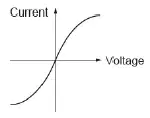
What does this graph represent?
Filament bulb
Diode
Resistor or wire
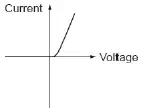
What does this IV graph represent?
The IV graph shows the resistor or a wire.
The IV graph shows the resistance in a filament bulb.
The IV graph represents the current-voltage relationship in a diode.
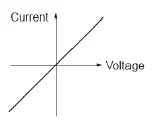
What does this IV graph represent?
The IV graph represents the current-voltage relationship in a filament.
The IV graph represents the current-voltage relationship in a diode.
The IV graph represents the current-voltage relationship in a resistor of wire.
A toaster takes 200 s to transfer 180,000 J of energy. What is the power of the toaster?
90 W
900 W
9,000 W
90,000 W
Energy (J) = Power (W) x Time (s)
Rearrange the equation to make "Power" the subject
Energy (J) = Power (W) x Time (s)
Rearrange the equation to make "Time" the subject
Energy (J) = Power (W) x Time (s)
If the energy is 300 J and the power is 50 W, rearrange the equation to find the time.
12 s
6 s
If the power is 100 W and the time is 20 s, what is the energy?
What is the formula to calculate current using Ohm's Law?
I=RV
I=V×R
I=R−V
I=V+R
In a parallel circuit, if the voltage is 12 V and the resistance is 4 Ω, what is the current through the circuit?
3 A
4 A
6 A
12 A
What is the unit of electrical resistance?
Ohm
Volt
Ampere
Watt
What is the effect on total resistance when resistors are added in series?
It increases
It decreases
It remains the same
It becomes zero

