
 Worksheets
Grade 8 Test 1 Review
Total questions: 128
Worksheet time: 4hrs 16mins
To make an object move you must first apply ---
an opposing force
an unbalanced force
a stationary force
a vertical force
A student pushes against a wall with 20 N of force and the wall does not move. In this situation, the wall exerts --
0 N of force
less than 20 N of force
20 N of force
more than 20 N of force
Which law explains the relationship among mass, force and acceleration?
Universal Law of Gavitation
Newton's First Law of Motion
Newton's Second Law of Motion
Newton's Third Law of Motion

In the diagram below, a girl sits on a sled and slides down a hill of snow. Which arrow represents the force of friction opposing the motion of the sled down the hill?
Arrow A
Arrow B
Arrow C
Arrow D
a force is best defined as ---
the application of weight
a push or pull that is exerted on matter
the flow of electric charges
a bond in which electrons are shared
Which of these examples best illustrates Newton's Second Low of Motion?
A 100 Ib boy has twice as much inertia as a 200 Ib boy.
A truck needs a more powerful engine than a small car.
A hockey puck slides easily across the ice.
A satellite stays in orbit for a long time.

According to Newton's Third Law of Motion, if Mike pushes down on the springboard to being his dive, what is the reaction force?
Mike splashing into the water
The springboard pushing Mike into the air
The height of the water when Mike enters the water
The sound the board makes as he pushes into the air
Ana pushed on a big rock in her back yard. She was unable to get it to move because she did not -
apply enough force
have a good grip on the rock
have enough mass
weigh enough
In a head-on collision, a person who is not wearing a seat belt continues to move forward at the original speed of the car because of -
weight
mass
gravity
inertia

A push or a pull are examples of
force
motion
weight
mass

The change in a objects position is________.
Force
Motion
Reaction
Movement


This motion graph represents:
constant speed
acceleration
object at rest
slowing down


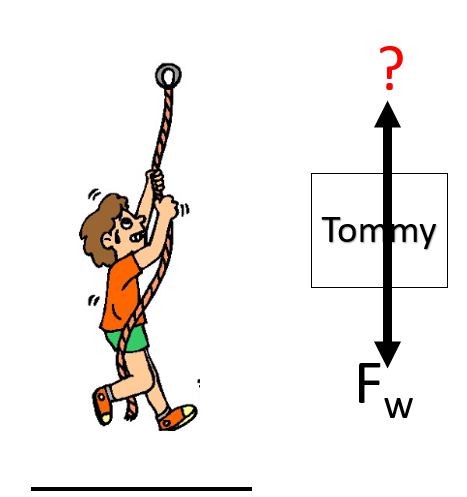


An Orange falls off a tree and lands on the ground. What force caused the orange to fall?
friction
heat
gravity
wind

The support force exerted upon an object that is in contact with another stable object.
Gravity
Electrical Force
Normal Force

The force that is transmitted through a string, rope, cable or wire when it is pulled tight.
Spring Force
Tension Force
Elastic Force
Which is the force that pulls a ball to the ground after being dropped?
friction
air resistance
gravity
What was the average speed of a car that traveled 180 miles in 3 hours? (speed = distance÷time)
55 mph
60 mph
180 mph
540 mph
A force that acts in an opposite direction to movement between two surfaces that are in contact with one another
Force
Friction
Gravity
Magnetism

If a car and bicycle are traveling down the street at the same velocity, which has more momentum?
The Car
The Bicycle
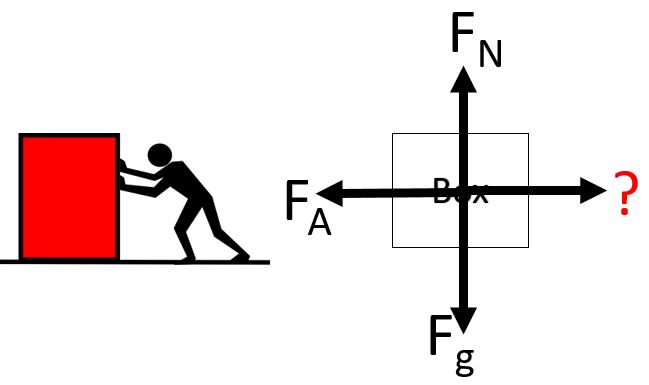
What is the name of the missing force?
frictional force
normal force
gravity
applied force
In a force diagram the size or length of the arrow tells you:
the strength of the force
the distance of the force
the direction of the force
A leftward force is applied to a crate to push it across the floor at a constant speed. Which is the correct force diagram?


A downward-moving skydiver who has just opened the parachute is slowing down. Which force diagram shows this sitation?


The force that keeps objects on top of surfaces instead of letting them sink into the surface is known as:
normal
abnormal
static
inertia
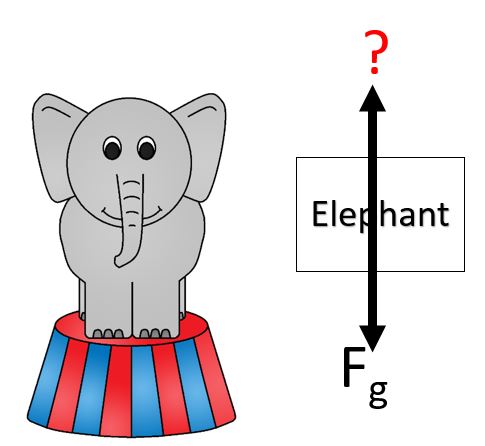


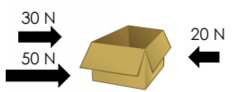
What is the net force?
19 N to the right
4 N to the left
7 N to the right
3 N to the right
Friction and drag are forces that act in the___________ direction of movement.
perpendicular
An explanation for a wide range of observations and results.
theory
law
Describes what will happen under certain conditions.
law
theory
These only tell you what will happen, they DO NOT tell how or why things happen.
law
theory
What is a scientific theory?
Describes what happens
Explains a process
What is a scientific law?
Describes what happens
Explains a process
Theory or Law?
Einstein's _______ of General Relativity: gravity curves space and time. Tries to explain why starlight bends.
Theory
Law
Theory or Law?
Newton's first ______ of Motion: Objects will stay in motion unless stopped. Can be used to calculate the force of a moving object.
Theory
Law
Which law states that for every action there is an equal and opposite reaction?
1st Law
2nd Law
3rd Law
Which law states that an object at rest stays at rest and an object in motion stays in motion unless an unbalanced force acts on it?
1st Law
2nd Law
3rd Law
Ted is playing with a yoyo outside. When he pushes the yoyo downward it returns back to him with the same force. Which law is this an example of?
1st Law
2nd Law
3rd Law
"Forces come in pairs" represents
Newton's 1st law
Newton's 2nd law
Newton's 3rd law
Law of conservation of momentum
F=ma represents
Newton's 1st law
Newton's 2nd law
Newton's 3rd law
Law of conservation of momentum
Determine the accelerations that result when a 12-N net force is applied to a 3-kg object.
3 ft/s
4 ft/s
26 m/s
4 m/s


Which car is accelerating?
A car that is not moving
A car that rounds a curve at a constant speed
A car traveling at a constant speed
A car that has a set speed of 60mph

What happens when two objects collide?
Energy is changed into force.
Energy is transferred from one object to another.
Energy is created and the objects move faster.

What effects the amount of energy transferred in a collision?
the speed
the weight
the speed AND weight

While playing with toy cars, Kirsten and Luca each push a car toward the center of the room. What happens when the toy cars collide?
Energy is transferred.
Energy is unchanged.
The momentum of an object depends upon the object's ___________&_____________.
size and shape
mass and speed
mass and veloctiy
mass and energy
An asteroid travels at 6,000 meters in 10 seconds. What is the speed?
60 meters/seconds
60 seconds/meter
600 meters/second
6 meters/second
You do not know an object's velocity until you know it's
Speed
Reference point
Speed and direction
Acceleration
Force = ma is the formula from
Newton's 1st Law
Newton's 2nd Law
Newton's 3rd Law
The Law of Conservation of Momentum states that the amount of momentum in a system is ___________________ before and after a collision.
greater
decreased
the same
unknown

When two objects of the same mass traveling at different speeds collide head on, both objects...
stop moving.
bounce backward and travel at their original speed.
change direction and move at their original speed.

When a ball is kicked harder at a slower moving ball the result is
the slower ball will return at a faster speed.
the slower ball will stop.
the slower ball with return at a slower speed.
Which of the following are an examples of an elastic collision? (select all that apply)
When a bowling ball hits a pin
When soft clay balls hit each other
When pool balls hit each other
When a snow ball smashes against a wall
Which of the following are examples of inelastic collisions? (select all that apply)
When a bowling ball hits a pin
When you flop on the couch and sink into the cushion
When a bat hits a ball
When a soft clay ball hits another soft clay ball
Which of the following are examples of Normal Force? (select all that apply)
your dinner sitting on the table
jumping on a trampoline
swimming in a pool
a Chromebook sitting on your table
A __________________ happens when two objects make contact.
transformation
distribution
force
collision
Which option is NOT likely to occur in a collision? (slide 2)
The objects change speed.
Everything stays the same.
You might hear a sound.
The objects change shape.
A collision where two objects bounce and move separately while kinetic energy is conserved is
perfectly inelastic
elastic
inelastic
nonexistent
In which collision is momentum conserved?
perfectly inelastic
elastic
inelastic
all collisions
Conservation of momentum means that the initial and final momentum in a collision are
different
the same/equal
impossible to determine
always the same as the kinetic energy

What is transferred at the instant the bat hits the ball?
matter
energy
sound
light

As an object moves faster, it has more of what to transfer?
weight
density
energy
matter
When a car goes around a corner at 20 mph, why do we say it accelerates?
The car is accelerating because of the velocity is constant
The car accelerates because it's going 20 mph
Cars always accelerate when they are in motion
The car is accelerating because it's changing direction

The turtle speeds up from 0m/s to 20m/s in 2 seconds. What is his acceleration?
40m/s2
20m/s2
10m/s2
2m/s2
A car is safely speeding up from 10 miles per hour to 50 miles per hour. what is the car doing?
accelerating
speeding
stopping

What is this?
"This airplane is traveling at 500 mph, West"
Speed
Velocity
Acceleration
A drag racer accelerated from 0 m/s to 200 m/s in 5 s. What was the acceleration?
0 m/s
-40 m/s2
40 m/s2
40 m/s

Vector is a quantity with:
magnitude and direction
magnitude
direction
none of the above
A vector includes ______ and ________.
direction, magnitude
magnitude, units
direction, units
scalars, scalars
Velocity is an example of a
Vector
Scalar
Momentum is represented with which letter?
b
m
v
p
Momentum is always conserved.
True
False
A bouncy ball hitting the ground.
Elastic Collison
Inelastic Collision
After an inelastic collision both objects will...
move at the same speed
have less mass
change momentum
have different speeds
If an object velocity is 0 m/s which of the is true.
The object has momentum
The object's momentum is changing
The object has NO momentum
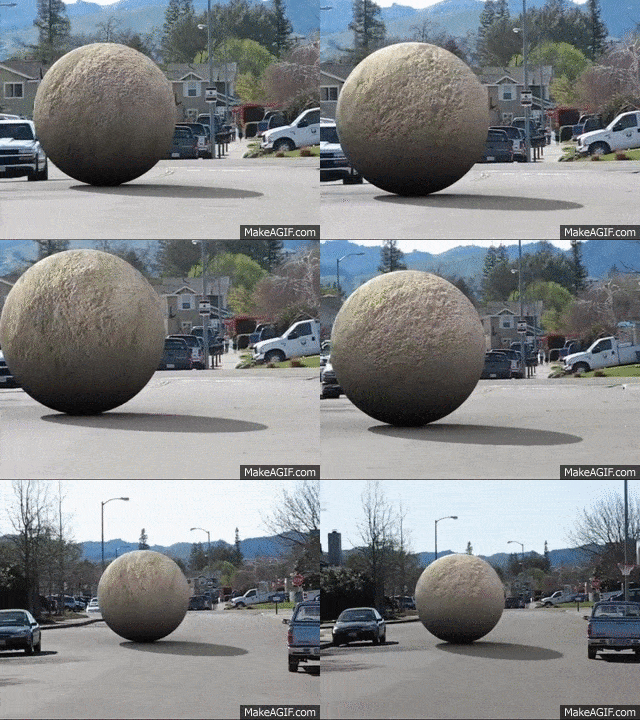
A 50 kg ball rolls east down the street at 5 m/s. Calculate the momentum of the ball.
55 kg*m/s east
10 kg*m/s east
250 kg*m/s east
500 kg*m/s east
A biker with a mass of 75 kg moves along the path with a constant velocity of 5 m/s due east. What is the biker's momentum?
25 m/s east
375 m/s west
25 kg m/s east
375 kg m/s east

Why does a semi truck have more momentum than a car if they are both traveling at 60kph?
Truck is more massive
Truck is less massive
Car is moving faster
Car is more massive
Which of the following has the MOST momentum? (they are all rolling at the same velocity)
rolling ping-pong ball
rolling bowling ball
rolling soccer ball
rolling basketball

